Graphical abstract template · Graphical abstracts · Graphical abstract
Electrochemical ammonia: nitrogen reduction versus nitrate reduction
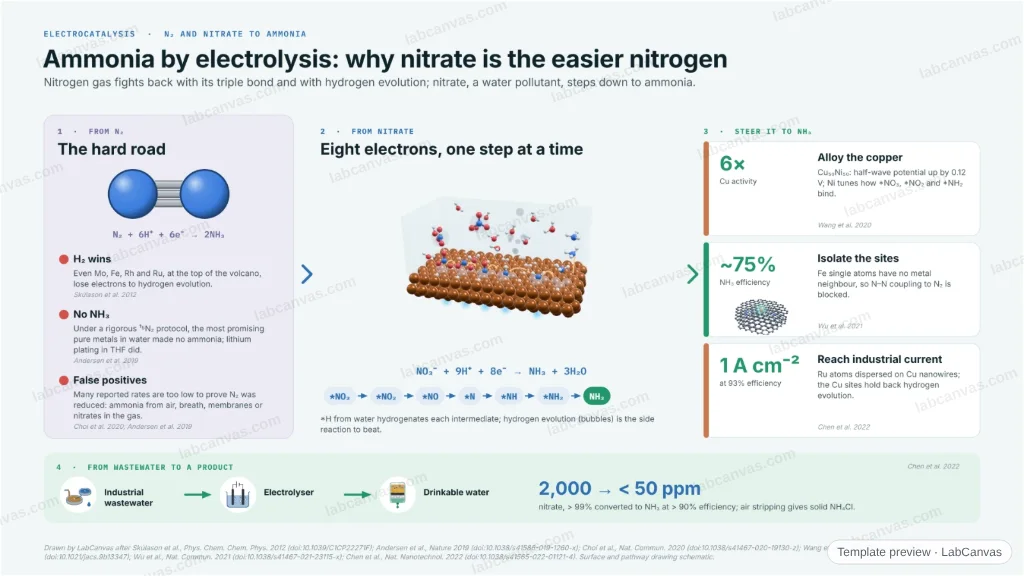
Why electrolysers make ammonia from nitrate far more easily than from nitrogen gas. N₂ reduction needs six electrons through a triple bond, hydrogen evolution wins even on the best metals, and a rigorous ¹⁵N₂ protocol found no ammonia on the most promising pure metals in water. Nitrate steps down a copper surface to ammonia in eight electrons; copper–nickel alloys, iron single atoms (no N–N coupling) and Ru-dispersed copper nanowires (1 A cm⁻² at 93% efficiency) steer it, and wastewater nitrate can be turned into solid ammonium chloride.
Updated 6 cited papers85 editable layers
At a glance
- Category
- Graphical abstracts
- Method
- Graphical abstract
- Starting materials
- N₂ gas, or nitrate dissolved in water (wastewater, polluted groundwater)
- Product
- Ammonia (as NH₃ solution or NH₄Cl)
- Key result
- No NH₃ from pure metals in water under the ¹⁵N₂ protocol (Andersen et al. 2019); 6× Cu activity, +0.12 V (Wang et al. 2020); ~75% FE, 0.46 mmol h⁻¹ cm⁻² (Wu et al. 2021); 1 A cm⁻² at 93% FE, > 99% conversion (Chen et al. 2022)
- Figure
- 1920 × 1080 px (16:9), 85 editable layers, 4 generated objects
Step by step
- From N₂Hydrogen evolution competes even on the metals at the top of the volcano (Skúlason et al. 2012); with ¹⁵N₂ controls, the most promising pure metals in water made no ammonia (Andersen et al. 2019); many reports are false positives (Choi et al. 2020)
- From nitrateNO₃⁻ + 9H⁺ + 8e⁻ → NH₃ + 3H₂O, step by step on the surface: *NO₃ → *NO₂ → *NO → *N → *NH → *NH₂ → NH₃
- Tune the metalCu₅₀Ni₅₀: half-wave potential up 0.12 V and 6× the activity of Cu (Wang et al. 2020)
- Isolate the sitesFe single atoms: ~75% Faradaic efficiency, no N–N coupling to N₂ (Wu et al. 2021)
- Go to industrial currentRu-dispersed Cu nanowires: 1 A cm⁻² at 93% Faradaic efficiency (Chen et al. 2022)
- Close the loop2,000 ppm wastewater nitrate to < 50 ppm, > 99% converted; air stripping gives solid NH₄Cl (Chen et al. 2022)
Uses
- Graphical abstracts on nitrate and nitrogen reduction to ammonia
- Talks on electrochemical ammonia and wastewater valorisation
- Teaching why N₂ reduction is hard
Papers this template follows
- Skúlason et al., “A theoretical evaluation of possible transition metal electro-catalysts for N₂ reduction”, Phys. Chem. Chem. Phys. 2012. doi:10.1039/C1CP22271Fprimary
- Andersen et al., “A rigorous electrochemical ammonia synthesis protocol with quantitative isotope measurements”, Nature 2019. doi:10.1038/s41586-019-1260-xprimary
- Choi et al., “Identification and elimination of false positives in electrochemical nitrogen reduction studies”, Nat. Commun. 2020. doi:10.1038/s41467-020-19130-zreview
- Wang et al., “Enhanced nitrate-to-ammonia activity on copper–nickel alloys via tuning of intermediate adsorption”, J. Am. Chem. Soc. 2020. doi:10.1021/jacs.9b13347primary
- Wu et al., “Electrochemical ammonia synthesis via nitrate reduction on Fe single atom catalyst”, Nat. Commun. 2021. doi:10.1038/s41467-021-23115-xprimary
- Chen et al., “Efficient conversion of low-concentration nitrate sources into ammonia on a Ru-dispersed Cu nanowire electrocatalyst”, Nat. Nanotechnol. 2022. doi:10.1038/s41565-022-01121-4primary
Drawn by LabCanvas after Skúlason et al., Phys. Chem. Chem. Phys. 2012 (doi:10.1039/C1CP22271F); Andersen et al., Nature 2019 (doi:10.1038/s41586-019-1260-x); Choi et al., Nat. Commun. 2020 (doi:10.1038/s41467-020-19130-z); Wang et al., J. Am. Chem. Soc. 2020 (doi:10.1021/jacs.9b13347); Wu et al., Nat. Commun. 2021 (doi:10.1038/s41467-021-23115-x); Chen et al., Nat. Nanotechnol. 2022 (doi:10.1038/s41565-022-01121-4). Surface and pathway drawing schematic.
How templates are written and checked: editorial guidelines.
Questions
What does the “Electrochemical ammonia: nitrogen reduction versus nitrate reduction” template show?
Why electrolysers make ammonia from nitrate far more easily than from nitrogen gas. N₂ reduction needs six electrons through a triple bond, hydrogen evolution wins even on the best metals, and a rigorous ¹⁵N₂ protocol found no ammonia on the most promising pure metals in water. Nitrate steps down a copper surface to ammonia in eight electrons; copper–nickel alloys, iron single atoms (no N–N coupling) and Ru-dispersed copper nanowires (1 A cm⁻² at 93% efficiency) steer it, and wastewater nitrate can be turned into solid ammonium chloride.
What are the steps shown in “Electrochemical ammonia: nitrogen reduction versus nitrate reduction”?
1. From N₂: Hydrogen evolution competes even on the metals at the top of the volcano (Skúlason et al. 2012); with ¹⁵N₂ controls, the most promising pure metals in water made no ammonia (Andersen et al. 2019); many reports are false positives (Choi et al. 2020). 2. From nitrate: NO₃⁻ + 9H⁺ + 8e⁻ → NH₃ + 3H₂O, step by step on the surface: *NO₃ → *NO₂ → *NO → *N → *NH → *NH₂ → NH₃. 3. Tune the metal: Cu₅₀Ni₅₀: half-wave potential up 0.12 V and 6× the activity of Cu (Wang et al. 2020). 4. Isolate the sites: Fe single atoms: ~75% Faradaic efficiency, no N–N coupling to N₂ (Wu et al. 2021). 5. Go to industrial current: Ru-dispersed Cu nanowires: 1 A cm⁻² at 93% Faradaic efficiency (Chen et al. 2022). 6. Close the loop: 2,000 ppm wastewater nitrate to < 50 ppm, > 99% converted; air stripping gives solid NH₄Cl (Chen et al. 2022).
What are the starting materials and the product?
Starting materials: N₂ gas, or nitrate dissolved in water (wastewater, polluted groundwater). Product: Ammonia (as NH₃ solution or NH₄Cl).
Which papers is “Electrochemical ammonia: nitrogen reduction versus nitrate reduction” based on?
Skúlason et al., “A theoretical evaluation of possible transition metal electro-catalysts for N₂ reduction”, Phys. Chem. Chem. Phys. 2012 (doi:10.1039/C1CP22271F); Andersen et al., “A rigorous electrochemical ammonia synthesis protocol with quantitative isotope measurements”, Nature 2019 (doi:10.1038/s41586-019-1260-x); Choi et al., “Identification and elimination of false positives in electrochemical nitrogen reduction studies”, Nat. Commun. 2020 (doi:10.1038/s41467-020-19130-z); Wang et al., “Enhanced nitrate-to-ammonia activity on copper–nickel alloys via tuning of intermediate adsorption”, J. Am. Chem. Soc. 2020 (doi:10.1021/jacs.9b13347); Wu et al., “Electrochemical ammonia synthesis via nitrate reduction on Fe single atom catalyst”, Nat. Commun. 2021 (doi:10.1038/s41467-021-23115-x); Chen et al., “Efficient conversion of low-concentration nitrate sources into ammonia on a Ru-dispersed Cu nanowire electrocatalyst”, Nat. Nanotechnol. 2022 (doi:10.1038/s41565-022-01121-4).
Can I edit the “Electrochemical ammonia: nitrogen reduction versus nitrate reduction” template?
Yes. Open it in the LabCanvas editor: all 85 layers are editable, including 4 generated objects (structures, plots, equipment) with their own settings. Change the text, colours and layout, then export PNG, TIFF or PDF at the width and DPI the journal asks for.
Do I need an account to use this template?
Not to view it here. To open and edit it, sign in to LabCanvas or create a free account (the free plan keeps up to 3 designs). Downloading the figure is part of LabCanvas Pro (US$19 a month or US$199 a year).