Graphical abstract template · Graphical abstracts · Graphical abstract
Fire and light: flame spray pyrolysis and laser ablation in liquids
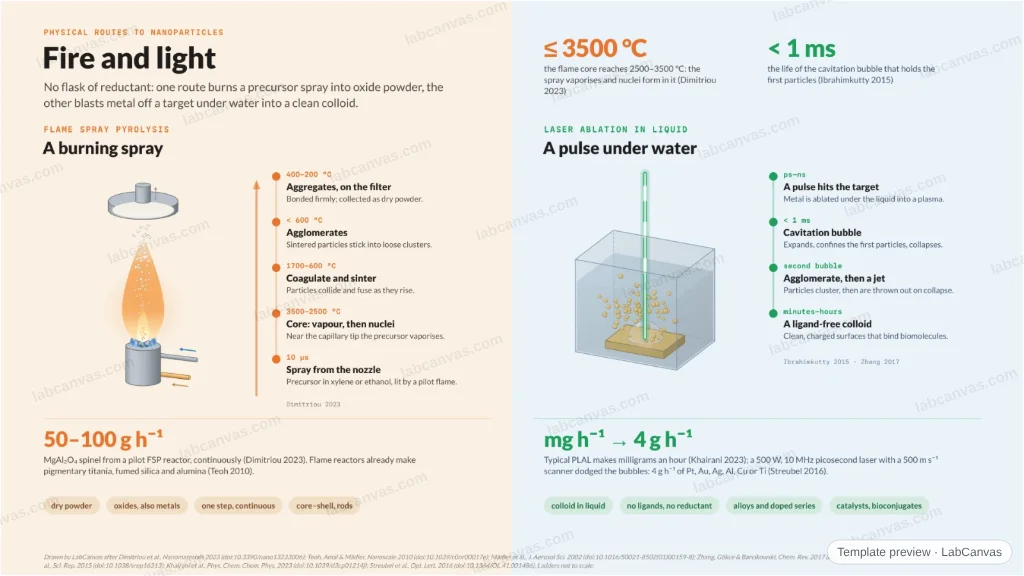
Two physical routes to nanoparticles side by side. Flame spray pyrolysis burns a precursor spray: the flame core at 2500–3500 °C vaporises it and nucleates particles that sinter, agglomerate and are collected as dry oxide powder, continuously, at up to 50–100 g h⁻¹ in a pilot reactor. Laser ablation in liquid fires short pulses at a metal target under water: a plasma, then a cavitation bubble that confines the particles for under a millisecond, gives a ligand-free colloid, now at up to 4 g h⁻¹ with a 500 W picosecond laser.
Updated 9 cited papers79 editable layers
At a glance
- Category
- Graphical abstracts
- Method
- Graphical abstract
- Starting materials
- FSP: metal 2-ethylhexanoates, nitrates, acetylacetonates or alkoxides in xylene, toluene or ethanol; LAL: a solid metal target under water or a solvent
- Product
- FSP: dry, loosely agglomerated oxide (or metal) nanopowders; LAL: ligand-free metal colloids
- Key result
- Flame core 2500–3500 °C; 50–100 g h⁻¹ pilot FSP (Dimitriou et al. 2023); bubble < 1 ms (Ibrahimkutty et al. 2015); up to 4 g h⁻¹ LAL (Streubel et al. 2016)
- Figure
- 1920 × 1080 px (16:9), 79 editable layers, 2 generated objects
Step by step
- Spray and burnThe precursor solution is atomised at a nozzle and lit by a pilot flame; the core near the tip reaches 3500–2500 °C, vaporising the precursor and nucleating particles (Dimitriou et al. 2023)
- Sinter, agglomerate, collectCoagulation and sintering at 1700–600 °C, agglomerates below 600 °C and aggregates at 400–200 °C; collected as dry powder; 50–100 g h⁻¹ MgAl₂O₄ in a pilot reactor (Dimitriou et al. 2023)
- Ablate under liquidA laser pulse on a metal target under liquid makes a plasma, then a cavitation bubble that confines the particles for under a millisecond (Ibrahimkutty et al. 2015)
- Ligand-free colloidThe particles leave with clean, charged surfaces that bind biomolecules and supports (Zhang, Gökce & Barcikowski 2017)
- ScalePLAL usually makes milligrams per hour (Khairani et al. 2023); a 500 W, 10 MHz picosecond laser with a 500 m s⁻¹ scanner reached 4 g h⁻¹ (Streubel et al. 2016)
Uses
- Graphical abstracts on gas-phase and physical nanoparticle synthesis
- Talks comparing flame aerosol and laser-ablation routes
- Teaching particle formation in flames and cavitation bubbles
Papers this template follows
- Dimitriou, Psathas, Solakidou & Deligiannakis, “Advanced flame spray pyrolysis (FSP) technologies for engineering multifunctional nanostructures and nanodevices”, Nanomaterials 2023. doi:10.3390/nano13233006review
- Teoh, Amal & Mädler, “Flame spray pyrolysis: an enabling technology for nanoparticles design and fabrication”, Nanoscale 2010. doi:10.1039/c0nr00017ereview
- Mädler, Kammler, Mueller & Pratsinis, “Controlled synthesis of nanostructured particles by flame spray pyrolysis”, J. Aerosol Sci. 2002. doi:10.1016/S0021-8502(01)00159-8method origin
- Pratsinis, “Flame aerosol synthesis of ceramic powders”, Prog. Energy Combust. Sci. 1998. doi:10.1016/S0360-1285(97)00028-2further reading
- Zhang, Gökce & Barcikowski, “Laser synthesis and processing of colloids: fundamentals and applications”, Chem. Rev. 2017. doi:10.1021/acs.chemrev.6b00468review
- Ibrahimkutty et al., “A hierarchical view on material formation during pulsed-laser synthesis of nanoparticles in liquid”, Sci. Rep. 2015. doi:10.1038/srep16313primary
- Khairani, Mínguez-Vega, Doñate-Buendía & Gökce, “Green nanoparticle synthesis at scale: a perspective on overcoming the limits of pulsed laser ablation in liquids for high-throughput production”, Phys. Chem. Chem. Phys. 2023. doi:10.1039/d3cp01214jreview
- Streubel, Barcikowski & Gökce, “Continuous multigram nanoparticle synthesis by high-power, high-repetition-rate ultrafast laser ablation in liquids”, Opt. Lett. 2016. doi:10.1364/OL.41.001486primary
- Neddersen, Chumanov & Cotton, “Laser ablation of metals: a new method for preparing SERS active colloids”, Appl. Spectrosc. 1993. doi:10.1366/0003702934066460method origin
Drawn by LabCanvas after Dimitriou et al., Nanomaterials 2023 (doi:10.3390/nano13233006); Teoh, Amal & Mädler, Nanoscale 2010 (doi:10.1039/c0nr00017e); Mädler et al., J. Aerosol Sci. 2002 (doi:10.1016/S0021-8502(01)00159-8); Zhang, Gökce & Barcikowski, Chem. Rev. 2017 (doi:10.1021/acs.chemrev.6b00468); Ibrahimkutty et al., Sci. Rep. 2015 (doi:10.1038/srep16313); Khairani et al., Phys. Chem. Chem. Phys. 2023 (doi:10.1039/d3cp01214j); Streubel et al., Opt. Lett. 2016 (doi:10.1364/OL.41.001486). Ladders not to scale.
How templates are written and checked: editorial guidelines.
Questions
What does the “Fire and light: flame spray pyrolysis and laser ablation in liquids” template show?
Two physical routes to nanoparticles side by side. Flame spray pyrolysis burns a precursor spray: the flame core at 2500–3500 °C vaporises it and nucleates particles that sinter, agglomerate and are collected as dry oxide powder, continuously, at up to 50–100 g h⁻¹ in a pilot reactor. Laser ablation in liquid fires short pulses at a metal target under water: a plasma, then a cavitation bubble that confines the particles for under a millisecond, gives a ligand-free colloid, now at up to 4 g h⁻¹ with a 500 W picosecond laser.
What are the steps shown in “Fire and light: flame spray pyrolysis and laser ablation in liquids”?
1. Spray and burn: The precursor solution is atomised at a nozzle and lit by a pilot flame; the core near the tip reaches 3500–2500 °C, vaporising the precursor and nucleating particles (Dimitriou et al. 2023). 2. Sinter, agglomerate, collect: Coagulation and sintering at 1700–600 °C, agglomerates below 600 °C and aggregates at 400–200 °C; collected as dry powder; 50–100 g h⁻¹ MgAl₂O₄ in a pilot reactor (Dimitriou et al. 2023). 3. Ablate under liquid: A laser pulse on a metal target under liquid makes a plasma, then a cavitation bubble that confines the particles for under a millisecond (Ibrahimkutty et al. 2015). 4. Ligand-free colloid: The particles leave with clean, charged surfaces that bind biomolecules and supports (Zhang, Gökce & Barcikowski 2017). 5. Scale: PLAL usually makes milligrams per hour (Khairani et al. 2023); a 500 W, 10 MHz picosecond laser with a 500 m s⁻¹ scanner reached 4 g h⁻¹ (Streubel et al. 2016).
What are the starting materials and the product?
Starting materials: FSP: metal 2-ethylhexanoates, nitrates, acetylacetonates or alkoxides in xylene, toluene or ethanol; LAL: a solid metal target under water or a solvent. Product: FSP: dry, loosely agglomerated oxide (or metal) nanopowders; LAL: ligand-free metal colloids.
Which papers is “Fire and light: flame spray pyrolysis and laser ablation in liquids” based on?
Dimitriou, Psathas, Solakidou & Deligiannakis, “Advanced flame spray pyrolysis (FSP) technologies for engineering multifunctional nanostructures and nanodevices”, Nanomaterials 2023 (doi:10.3390/nano13233006); Teoh, Amal & Mädler, “Flame spray pyrolysis: an enabling technology for nanoparticles design and fabrication”, Nanoscale 2010 (doi:10.1039/c0nr00017e); Mädler, Kammler, Mueller & Pratsinis, “Controlled synthesis of nanostructured particles by flame spray pyrolysis”, J. Aerosol Sci. 2002 (doi:10.1016/S0021-8502(01)00159-8); Pratsinis, “Flame aerosol synthesis of ceramic powders”, Prog. Energy Combust. Sci. 1998 (doi:10.1016/S0360-1285(97)00028-2); Zhang, Gökce & Barcikowski, “Laser synthesis and processing of colloids: fundamentals and applications”, Chem. Rev. 2017 (doi:10.1021/acs.chemrev.6b00468); Ibrahimkutty et al., “A hierarchical view on material formation during pulsed-laser synthesis of nanoparticles in liquid”, Sci. Rep. 2015 (doi:10.1038/srep16313); Khairani, Mínguez-Vega, Doñate-Buendía & Gökce, “Green nanoparticle synthesis at scale: a perspective on overcoming the limits of pulsed laser ablation in liquids for high-throughput production”, Phys. Chem. Chem. Phys. 2023 (doi:10.1039/d3cp01214j); Streubel, Barcikowski & Gökce, “Continuous multigram nanoparticle synthesis by high-power, high-repetition-rate ultrafast laser ablation in liquids”, Opt. Lett. 2016 (doi:10.1364/OL.41.001486); Neddersen, Chumanov & Cotton, “Laser ablation of metals: a new method for preparing SERS active colloids”, Appl. Spectrosc. 1993 (doi:10.1366/0003702934066460).
Can I edit the “Fire and light: flame spray pyrolysis and laser ablation in liquids” template?
Yes. Open it in the LabCanvas editor: all 79 layers are editable, including 2 generated objects (structures, plots, equipment) with their own settings. Change the text, colours and layout, then export PNG, TIFF or PDF at the width and DPI the journal asks for.
Do I need an account to use this template?
Not to view it here. To open and edit it, sign in to LabCanvas or create a free account (the free plan keeps up to 3 designs). Downloading the figure is part of LabCanvas Pro (US$19 a month or US$199 a year).





