Graphical abstract template · Graphical abstracts · Graphical abstract
Flow and microfluidic synthesis: reproducible nanoparticles, scaled out and self-optimising
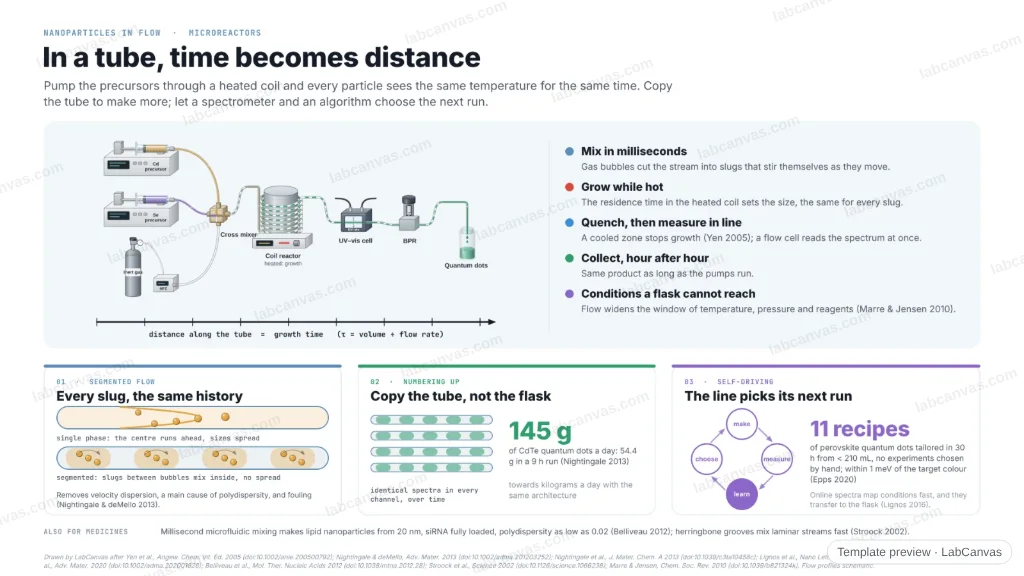
Continuous-flow nanoparticle synthesis as time turned into distance: precursors meet in a mixer, grow in a heated coil, are quenched in a cooled one and measured in line, so the growth time is how far along the tube a slug has travelled. Segmented flow gives every slug the same history; copying the reactor side by side gave 145 g of quantum dots a day with identical spectra in every channel; and a closed loop with machine learning found eleven quantum-dot recipes in 30 h. Lipid nanoparticles show the same control: 20 nm and up, polydispersity 0.02.
Updated 8 cited papers122 editable layers
At a glance
- Category
- Graphical abstracts
- Method
- Graphical abstract
- Starting materials
- Precursor solutions pumped continuously (cadmium and selenium precursors for CdSe; lipids in ethanol and siRNA in buffer for LNPs), with an inert gas or immiscible carrier to segment the flow
- Product
- Nanocrystals and lipid nanoparticles made continuously, with the same size and spectra over hours
- Key result
- 145 g/day CdTe, 54.4 g in 9 h (Nightingale et al. 2013); 11 compositions in 30 h, < 210 mL, within 1 meV of target (Epps et al. 2020); LNP PDI 0.02 (Belliveau et al. 2012)
- Figure
- 1920 × 1080 px (16:9), 122 editable layers, 1 generated objects
Step by step
- Time becomes distanceMix, grow in a heated zone, quench in a cooled zone: a gas–liquid segmented microreactor made monodisperse CdSe with narrow residence-time distributions (Yen et al. 2005)
- Same history for every slugSegmented flow removes velocity dispersion, a significant cause of polydispersity, and reduces fouling (Nightingale & deMello 2013)
- Scale outA multichannel droplet reactor gave identical spectra in every channel and over time: 54.4 g of CdTe in 9 h, 145 g per day (Nightingale et al. 2013)
- Close the loopOnline spectra map conditions quickly (Lignos et al. 2016); machine learning with autonomous flow made eleven tailored compositions in 30 h from < 210 mL (Epps et al. 2020)
- Beyond quantum dotsMillisecond microfluidic mixing makes lipid nanoparticles from 20 nm with PDI as low as 0.02 (Belliveau et al. 2012); herringbone floors mix laminar streams (Stroock et al. 2002)
Uses
- Graphical abstracts on flow and microfluidic nanomaterial synthesis
- Talks on reproducible scale-up and self-driving labs
- Teaching residence time and segmented flow
Papers this template follows
- Yen, Günther, Schmidt, Jensen & Bawendi, “A microfabricated gas–liquid segmented flow reactor for high-temperature synthesis: the case of CdSe quantum dots”, Angew. Chem. Int. Ed. 2005. doi:10.1002/anie.200500792primary
- Nightingale & deMello, “Segmented flow reactors for nanocrystal synthesis”, Adv. Mater. 2013. doi:10.1002/adma.201203252review
- Nightingale et al., “Large-scale synthesis of nanocrystals in a multichannel droplet reactor”, J. Mater. Chem. A 2013. doi:10.1039/c3ta10458cprimary
- Lignos et al., “Synthesis of cesium lead halide perovskite nanocrystals in a droplet-based microfluidic platform: fast parametric space mapping”, Nano Lett. 2016. doi:10.1021/acs.nanolett.5b04981primary
- Epps et al., “Artificial Chemist: an autonomous quantum dot synthesis bot”, Adv. Mater. 2020. doi:10.1002/adma.202001626primary
- Belliveau et al., “Microfluidic synthesis of highly potent limit-size lipid nanoparticles for in vivo delivery of siRNA”, Mol. Ther. Nucleic Acids 2012. doi:10.1038/mtna.2012.28primary
- Stroock et al., “Chaotic mixer for microchannels”, Science 2002. doi:10.1126/science.1066238primary
- Marre & Jensen, “Synthesis of micro and nanostructures in microfluidic systems”, Chem. Soc. Rev. 2010. doi:10.1039/b821324kreview
Drawn by LabCanvas after Yen et al., Angew. Chem. Int. Ed. 2005 (doi:10.1002/anie.200500792); Nightingale & deMello, Adv. Mater. 2013 (doi:10.1002/adma.201203252); Nightingale et al., J. Mater. Chem. A 2013 (doi:10.1039/c3ta10458c); Lignos et al., Nano Lett. 2016 (doi:10.1021/acs.nanolett.5b04981); Epps et al., Adv. Mater. 2020 (doi:10.1002/adma.202001626); Belliveau et al., Mol. Ther. Nucleic Acids 2012 (doi:10.1038/mtna.2012.28); Stroock et al., Science 2002 (doi:10.1126/science.1066238); Marre & Jensen, Chem. Soc. Rev. 2010 (doi:10.1039/b821324k). Flow profiles schematic.
How templates are written and checked: editorial guidelines.
Questions
What does the “Flow and microfluidic synthesis: reproducible nanoparticles, scaled out and self-optimising” template show?
Continuous-flow nanoparticle synthesis as time turned into distance: precursors meet in a mixer, grow in a heated coil, are quenched in a cooled one and measured in line, so the growth time is how far along the tube a slug has travelled. Segmented flow gives every slug the same history; copying the reactor side by side gave 145 g of quantum dots a day with identical spectra in every channel; and a closed loop with machine learning found eleven quantum-dot recipes in 30 h. Lipid nanoparticles show the same control: 20 nm and up, polydispersity 0.02.
What are the steps shown in “Flow and microfluidic synthesis: reproducible nanoparticles, scaled out and self-optimising”?
1. Time becomes distance: Mix, grow in a heated zone, quench in a cooled zone: a gas–liquid segmented microreactor made monodisperse CdSe with narrow residence-time distributions (Yen et al. 2005). 2. Same history for every slug: Segmented flow removes velocity dispersion, a significant cause of polydispersity, and reduces fouling (Nightingale & deMello 2013). 3. Scale out: A multichannel droplet reactor gave identical spectra in every channel and over time: 54.4 g of CdTe in 9 h, 145 g per day (Nightingale et al. 2013). 4. Close the loop: Online spectra map conditions quickly (Lignos et al. 2016); machine learning with autonomous flow made eleven tailored compositions in 30 h from < 210 mL (Epps et al. 2020). 5. Beyond quantum dots: Millisecond microfluidic mixing makes lipid nanoparticles from 20 nm with PDI as low as 0.02 (Belliveau et al. 2012); herringbone floors mix laminar streams (Stroock et al. 2002).
What are the starting materials and the product?
Starting materials: Precursor solutions pumped continuously (cadmium and selenium precursors for CdSe; lipids in ethanol and siRNA in buffer for LNPs), with an inert gas or immiscible carrier to segment the flow. Product: Nanocrystals and lipid nanoparticles made continuously, with the same size and spectra over hours.
Which papers is “Flow and microfluidic synthesis: reproducible nanoparticles, scaled out and self-optimising” based on?
Yen, Günther, Schmidt, Jensen & Bawendi, “A microfabricated gas–liquid segmented flow reactor for high-temperature synthesis: the case of CdSe quantum dots”, Angew. Chem. Int. Ed. 2005 (doi:10.1002/anie.200500792); Nightingale & deMello, “Segmented flow reactors for nanocrystal synthesis”, Adv. Mater. 2013 (doi:10.1002/adma.201203252); Nightingale et al., “Large-scale synthesis of nanocrystals in a multichannel droplet reactor”, J. Mater. Chem. A 2013 (doi:10.1039/c3ta10458c); Lignos et al., “Synthesis of cesium lead halide perovskite nanocrystals in a droplet-based microfluidic platform: fast parametric space mapping”, Nano Lett. 2016 (doi:10.1021/acs.nanolett.5b04981); Epps et al., “Artificial Chemist: an autonomous quantum dot synthesis bot”, Adv. Mater. 2020 (doi:10.1002/adma.202001626); Belliveau et al., “Microfluidic synthesis of highly potent limit-size lipid nanoparticles for in vivo delivery of siRNA”, Mol. Ther. Nucleic Acids 2012 (doi:10.1038/mtna.2012.28); Stroock et al., “Chaotic mixer for microchannels”, Science 2002 (doi:10.1126/science.1066238); Marre & Jensen, “Synthesis of micro and nanostructures in microfluidic systems”, Chem. Soc. Rev. 2010 (doi:10.1039/b821324k).
Can I edit the “Flow and microfluidic synthesis: reproducible nanoparticles, scaled out and self-optimising” template?
Yes. Open it in the LabCanvas editor: all 122 layers are editable, including 1 generated objects (structures, plots, equipment) with their own settings. Change the text, colours and layout, then export PNG, TIFF or PDF at the width and DPI the journal asks for.
Do I need an account to use this template?
Not to view it here. To open and edit it, sign in to LabCanvas or create a free account (the free plan keeps up to 3 designs). Downloading the figure is part of LabCanvas Pro (US$19 a month or US$199 a year).