Graphical abstract template · Graphical abstracts · Graphical abstract
Galvanic replacement: silver nanocubes titrated into gold nanocages
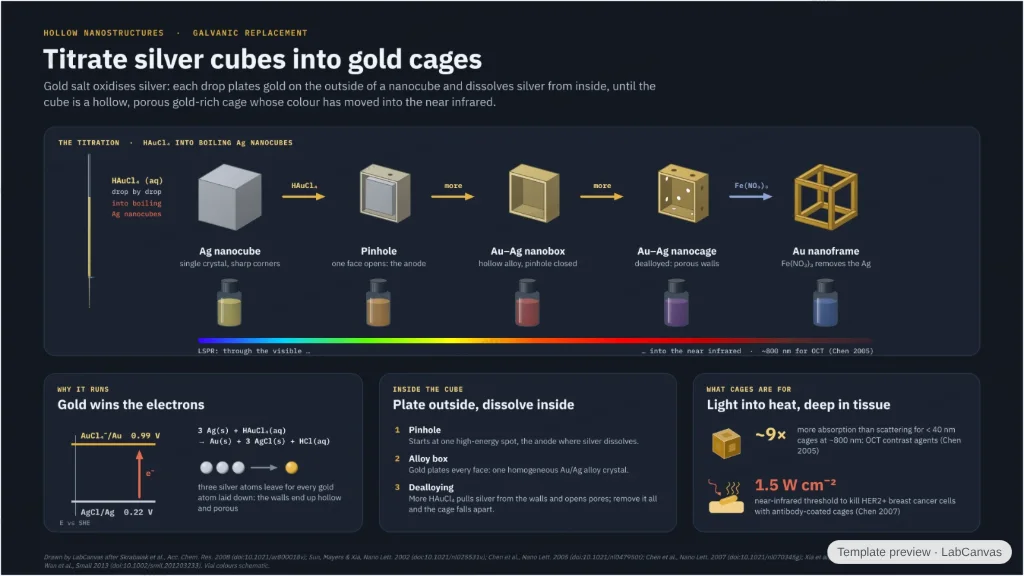
Galvanic replacement drawn as the titration it is: HAuCl₄ drips into boiling silver nanocubes, a pinhole opens, gold plates the faces while silver dissolves from inside (an alloy nanobox), dealloying opens pores (a nanocage), and an etchant can leave a bare gold frame. The colour moves through the visible into the near infrared as gold is added. Below, the 0.99 V against 0.22 V potentials and the three silver atoms out for each gold in, and the uses: optical-coherence-tomography contrast and photothermal killing of HER2 cancer cells.
Updated 6 cited papers82 editable layers
At a glance
- Category
- Graphical abstracts
- Method
- Graphical abstract
- Starting materials
- Silver nanocubes (polyol synthesis) in boiling water, titrated with aqueous HAuCl₄; Fe(NO₃)₃ as an optional etchant
- Product
- Hollow Au–Ag nanoboxes, porous Au nanocages and Au nanoframes with plasmons tuned into the near infrared
- Key result
- 0.99 V vs 0.22 V (Skrabalak et al. 2008); absorption 7.26 × 10⁻¹⁵ m², scattering 8.10 × 10⁻¹⁶ m² (Chen et al. 2005); 1.5 W cm⁻² threshold (Chen et al. 2007)
- Figure
- 1920 × 1080 px (16:9), 82 editable layers, 13 generated objects
Step by step
- Why it runsAuCl₄⁻/Au at 0.99 V vs SHE lies above AgCl/Ag at 0.22 V: 3 Ag + HAuCl₄ → Au + 3 AgCl + HCl (Skrabalak et al. 2008)
- Pinhole and nanoboxA pinhole opens on one face and acts as the anode; gold plates the faces as the inside dissolves: a single-crystalline Au/Ag alloy nanobox (Skrabalak et al. 2008)
- NanocageMore HAuCl₄ dealloys the walls, three Ag out for each Au in, opening pores; complete dealloying breaks the cage (Skrabalak et al. 2008)
- NanoframeFe(NO₃)₃ only dissolves silver: nanoboxes, nanocages or nanoframes depending on the amount (Skrabalak et al. 2008; Wan et al. 2013)
- UsesCages < 40 nm at ~800 nm with an absorption cross-section ~9× their scattering for OCT (Chen et al. 2005); anti-HER2 cages kill SK-BR-3 cells above 1.5 W cm⁻² (Chen et al. 2007)
Uses
- Graphical abstracts on hollow metal nanostructures
- Teaching galvanic replacement, alloying and dealloying
- Talks on near-infrared plasmonics for imaging and photothermal therapy
Papers this template follows
- Skrabalak et al., “Gold nanocages: synthesis, properties, and applications”, Acc. Chem. Res. 2008. doi:10.1021/ar800018vreview
- Sun, Mayers & Xia, “Template-engaged replacement reaction: a one-step approach to the large-scale synthesis of metal nanostructures with hollow interiors”, Nano Lett. 2002. doi:10.1021/nl025531vmethod origin
- Chen et al., “Gold nanocages: bioconjugation and their potential use as optical imaging contrast agents”, Nano Lett. 2005. doi:10.1021/nl047950tprimary
- Chen et al., “Immuno gold nanocages with tailored optical properties for targeted photothermal destruction of cancer cells”, Nano Lett. 2007. doi:10.1021/nl070345gprimary
- Xia, Wang, Ruditskiy & Xia, “Galvanic replacement: a simple and versatile route to hollow nanostructures with tunable and well-controlled properties”, Adv. Mater. 2013. doi:10.1002/adma.201302820review
- Wan, Xia, Wang & Xia, “Robust synthesis of gold cubic nanoframes through a combination of galvanic replacement, gold deposition, and silver dealloying”, Small 2013. doi:10.1002/smll.201203233primary
Drawn by LabCanvas after Skrabalak et al., Acc. Chem. Res. 2008 (doi:10.1021/ar800018v); Sun, Mayers & Xia, Nano Lett. 2002 (doi:10.1021/nl025531v); Chen et al., Nano Lett. 2005 (doi:10.1021/nl047950t); Chen et al., Nano Lett. 2007 (doi:10.1021/nl070345g); Xia et al., Adv. Mater. 2013 (doi:10.1002/adma.201302820); Wan et al., Small 2013 (doi:10.1002/smll.201203233). Vial colours schematic.
How templates are written and checked: editorial guidelines.
Questions
What does the “Galvanic replacement: silver nanocubes titrated into gold nanocages” template show?
Galvanic replacement drawn as the titration it is: HAuCl₄ drips into boiling silver nanocubes, a pinhole opens, gold plates the faces while silver dissolves from inside (an alloy nanobox), dealloying opens pores (a nanocage), and an etchant can leave a bare gold frame. The colour moves through the visible into the near infrared as gold is added. Below, the 0.99 V against 0.22 V potentials and the three silver atoms out for each gold in, and the uses: optical-coherence-tomography contrast and photothermal killing of HER2 cancer cells.
What are the steps shown in “Galvanic replacement: silver nanocubes titrated into gold nanocages”?
1. Why it runs: AuCl₄⁻/Au at 0.99 V vs SHE lies above AgCl/Ag at 0.22 V: 3 Ag + HAuCl₄ → Au + 3 AgCl + HCl (Skrabalak et al. 2008). 2. Pinhole and nanobox: A pinhole opens on one face and acts as the anode; gold plates the faces as the inside dissolves: a single-crystalline Au/Ag alloy nanobox (Skrabalak et al. 2008). 3. Nanocage: More HAuCl₄ dealloys the walls, three Ag out for each Au in, opening pores; complete dealloying breaks the cage (Skrabalak et al. 2008). 4. Nanoframe: Fe(NO₃)₃ only dissolves silver: nanoboxes, nanocages or nanoframes depending on the amount (Skrabalak et al. 2008; Wan et al. 2013). 5. Uses: Cages < 40 nm at ~800 nm with an absorption cross-section ~9× their scattering for OCT (Chen et al. 2005); anti-HER2 cages kill SK-BR-3 cells above 1.5 W cm⁻² (Chen et al. 2007).
What are the starting materials and the product?
Starting materials: Silver nanocubes (polyol synthesis) in boiling water, titrated with aqueous HAuCl₄; Fe(NO₃)₃ as an optional etchant. Product: Hollow Au–Ag nanoboxes, porous Au nanocages and Au nanoframes with plasmons tuned into the near infrared.
Which papers is “Galvanic replacement: silver nanocubes titrated into gold nanocages” based on?
Skrabalak et al., “Gold nanocages: synthesis, properties, and applications”, Acc. Chem. Res. 2008 (doi:10.1021/ar800018v); Sun, Mayers & Xia, “Template-engaged replacement reaction: a one-step approach to the large-scale synthesis of metal nanostructures with hollow interiors”, Nano Lett. 2002 (doi:10.1021/nl025531v); Chen et al., “Gold nanocages: bioconjugation and their potential use as optical imaging contrast agents”, Nano Lett. 2005 (doi:10.1021/nl047950t); Chen et al., “Immuno gold nanocages with tailored optical properties for targeted photothermal destruction of cancer cells”, Nano Lett. 2007 (doi:10.1021/nl070345g); Xia, Wang, Ruditskiy & Xia, “Galvanic replacement: a simple and versatile route to hollow nanostructures with tunable and well-controlled properties”, Adv. Mater. 2013 (doi:10.1002/adma.201302820); Wan, Xia, Wang & Xia, “Robust synthesis of gold cubic nanoframes through a combination of galvanic replacement, gold deposition, and silver dealloying”, Small 2013 (doi:10.1002/smll.201203233).
Can I edit the “Galvanic replacement: silver nanocubes titrated into gold nanocages” template?
Yes. Open it in the LabCanvas editor: all 82 layers are editable, including 13 generated objects (structures, plots, equipment) with their own settings. Change the text, colours and layout, then export PNG, TIFF or PDF at the width and DPI the journal asks for.
Do I need an account to use this template?
Not to view it here. To open and edit it, sign in to LabCanvas or create a free account (the free plan keeps up to 3 designs). Downloading the figure is part of LabCanvas Pro (US$19 a month or US$199 a year).





