Graphical abstract template · Graphical abstracts · Graphical abstract
Graphitic carbon nitride photocatalysis: band ladder and Z-schemes
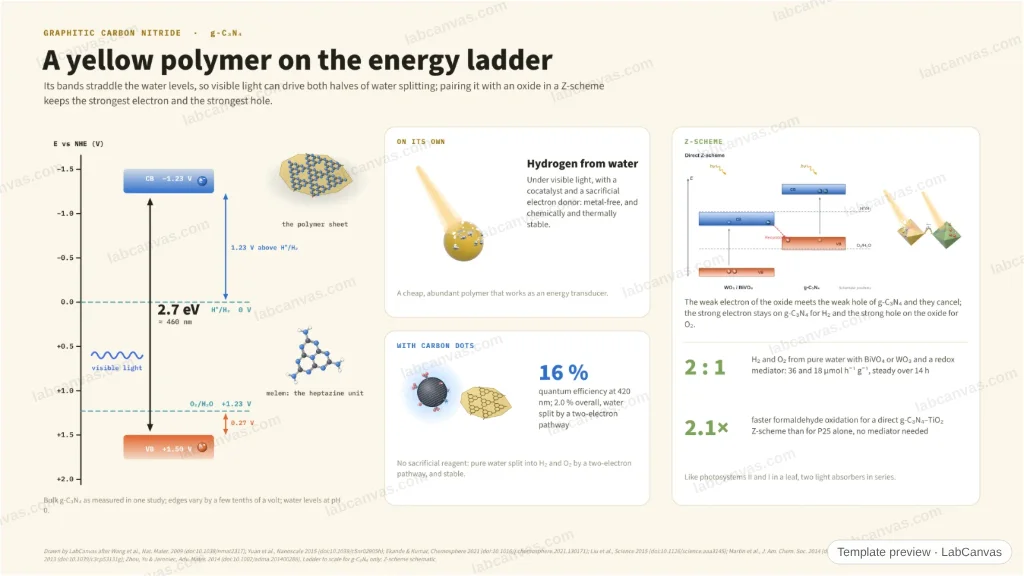
An energy-ladder graphical abstract of g-C₃N₄: the bands of bulk carbon nitride drawn to scale against the water levels (a 2.7 eV gap, conduction band at −1.23 V vs NHE), the heptazine polymer in 3D, hydrogen from water with a sacrificial donor, carbon dots that let it split water with 16 % quantum efficiency at 420 nm, and Z-schemes with WO₃, BiVO₄ or TiO₂ that keep the strongest electron and the strongest hole.
Updated 9 cited papers73 editable layers
At a glance
- Category
- Graphical abstracts
- Method
- Graphical abstract
- Starting materials
- Polymeric graphitic carbon nitride (heptazine units), made by heating nitrogen-rich precursors
- Product
- Visible-light photocatalysts for hydrogen, overall water splitting and pollutant oxidation
- Key result
- Eg 2.7 eV (Yuan et al. 2015); CB −1.23 V vs NHE (Ekande & Kumar 2021); QE 16 % at 420 nm, 2.0 % overall (Liu et al. 2015); H₂/O₂ 36/18 µmol h⁻¹ g⁻¹ (Martin et al. 2014)
- Figure
- 1920 × 1080 px (16:9), 73 editable layers, 5 generated objects
Step by step
- The ladderA 2.7 eV gap (Yuan et al. 2015); for bulk g-C₃N₄ the conduction band sits at −1.23 V vs NHE with a 2.73 eV gap, putting the valence band near +1.50 V (Ekande & Kumar 2021): above H⁺/H₂ and below O₂/H₂O
- AlonePolymeric carbon nitride makes H₂ from water under visible light with a sacrificial donor, and is chemically and thermally stable (Wang et al. 2009)
- With carbon dotsCarbon-dot/C₃N₄ splits water by a two-electron pathway: 16 % quantum efficiency at 420 nm, 2.0 % overall (Liu et al. 2015)
- Z-schemeWith BiVO₄ or WO₃ and a redox mediator, H₂ and O₂ evolve in a 2 : 1 ratio at 36 and 18 µmol h⁻¹ g⁻¹ over 14 h (Martin et al. 2014); a direct g-C₃N₄–TiO₂ Z-scheme oxidises formaldehyde 2.1× faster than P25 (Yu et al. 2013)
Uses
- Graphical abstracts on carbon nitride and polymer photocatalysts
- Talks on Z-scheme and heterojunction design for solar fuels
- Teaching band edges against water redox levels
Papers this template follows
- Wang et al., “A metal-free polymeric photocatalyst for hydrogen production from water under visible light”, Nat. Mater. 2009. doi:10.1038/nmat2317method origin
- Yuan et al., “High-yield synthesis and optical properties of g-C3N4”, Nanoscale 2015. doi:10.1039/c5nr02905hprimary
- Ekande & Kumar, “Facile synthesis of graphitic carbon nitride from acetic acid pretreatment to activate persulfate in presence of blue light for photocatalytic removal of metronidazole”, Chemosphere 2021. doi:10.1016/j.chemosphere.2021.130171primary
- Liu et al., “Metal-free efficient photocatalyst for stable visible water splitting via a two-electron pathway”, Science 2015. doi:10.1126/science.aaa3145primary
- Martin et al., “Visible light-driven pure water splitting by a nature-inspired organic semiconductor-based system”, J. Am. Chem. Soc. 2014. doi:10.1021/ja506386eprimary
- Yu et al., “Enhanced photocatalytic performance of direct Z-scheme g-C3N4–TiO2 photocatalysts for the decomposition of formaldehyde in air”, Phys. Chem. Chem. Phys. 2013. doi:10.1039/c3cp53131gprimary
- Zhou, Yu & Jaroniec, “All-solid-state Z-scheme photocatalytic systems”, Adv. Mater. 2014. doi:10.1002/adma.201400288review
- Low et al., “Heterojunction photocatalysts”, Adv. Mater. 2017. doi:10.1002/adma.201601694review
- Ong et al., “Graphitic carbon nitride (g-C3N4)-based photocatalysts for artificial photosynthesis and environmental remediation: are we a step closer to achieving sustainability?”, Chem. Rev. 2016. doi:10.1021/acs.chemrev.6b00075review
Drawn by LabCanvas after Wang et al., Nat. Mater. 2009 (doi:10.1038/nmat2317); Yuan et al., Nanoscale 2015 (doi:10.1039/c5nr02905h); Ekande & Kumar, Chemosphere 2021 (doi:10.1016/j.chemosphere.2021.130171); Liu et al., Science 2015 (doi:10.1126/science.aaa3145); Martin et al., J. Am. Chem. Soc. 2014 (doi:10.1021/ja506386e); Yu et al., Phys. Chem. Chem. Phys. 2013 (doi:10.1039/c3cp53131g); Zhou, Yu & Jaroniec, Adv. Mater. 2014 (doi:10.1002/adma.201400288). Ladder to scale for g-C₃N₄ only; Z-scheme schematic.
How templates are written and checked: editorial guidelines.
Questions
What does the “Graphitic carbon nitride photocatalysis: band ladder and Z-schemes” template show?
An energy-ladder graphical abstract of g-C₃N₄: the bands of bulk carbon nitride drawn to scale against the water levels (a 2.7 eV gap, conduction band at −1.23 V vs NHE), the heptazine polymer in 3D, hydrogen from water with a sacrificial donor, carbon dots that let it split water with 16 % quantum efficiency at 420 nm, and Z-schemes with WO₃, BiVO₄ or TiO₂ that keep the strongest electron and the strongest hole.
What are the steps shown in “Graphitic carbon nitride photocatalysis: band ladder and Z-schemes”?
1. The ladder: A 2.7 eV gap (Yuan et al. 2015); for bulk g-C₃N₄ the conduction band sits at −1.23 V vs NHE with a 2.73 eV gap, putting the valence band near +1.50 V (Ekande & Kumar 2021): above H⁺/H₂ and below O₂/H₂O. 2. Alone: Polymeric carbon nitride makes H₂ from water under visible light with a sacrificial donor, and is chemically and thermally stable (Wang et al. 2009). 3. With carbon dots: Carbon-dot/C₃N₄ splits water by a two-electron pathway: 16 % quantum efficiency at 420 nm, 2.0 % overall (Liu et al. 2015). 4. Z-scheme: With BiVO₄ or WO₃ and a redox mediator, H₂ and O₂ evolve in a 2 : 1 ratio at 36 and 18 µmol h⁻¹ g⁻¹ over 14 h (Martin et al. 2014); a direct g-C₃N₄–TiO₂ Z-scheme oxidises formaldehyde 2.1× faster than P25 (Yu et al. 2013).
What are the starting materials and the product?
Starting materials: Polymeric graphitic carbon nitride (heptazine units), made by heating nitrogen-rich precursors. Product: Visible-light photocatalysts for hydrogen, overall water splitting and pollutant oxidation.
Which papers is “Graphitic carbon nitride photocatalysis: band ladder and Z-schemes” based on?
Wang et al., “A metal-free polymeric photocatalyst for hydrogen production from water under visible light”, Nat. Mater. 2009 (doi:10.1038/nmat2317); Yuan et al., “High-yield synthesis and optical properties of g-C3N4”, Nanoscale 2015 (doi:10.1039/c5nr02905h); Ekande & Kumar, “Facile synthesis of graphitic carbon nitride from acetic acid pretreatment to activate persulfate in presence of blue light for photocatalytic removal of metronidazole”, Chemosphere 2021 (doi:10.1016/j.chemosphere.2021.130171); Liu et al., “Metal-free efficient photocatalyst for stable visible water splitting via a two-electron pathway”, Science 2015 (doi:10.1126/science.aaa3145); Martin et al., “Visible light-driven pure water splitting by a nature-inspired organic semiconductor-based system”, J. Am. Chem. Soc. 2014 (doi:10.1021/ja506386e); Yu et al., “Enhanced photocatalytic performance of direct Z-scheme g-C3N4–TiO2 photocatalysts for the decomposition of formaldehyde in air”, Phys. Chem. Chem. Phys. 2013 (doi:10.1039/c3cp53131g); Zhou, Yu & Jaroniec, “All-solid-state Z-scheme photocatalytic systems”, Adv. Mater. 2014 (doi:10.1002/adma.201400288); Low et al., “Heterojunction photocatalysts”, Adv. Mater. 2017 (doi:10.1002/adma.201601694); Ong et al., “Graphitic carbon nitride (g-C3N4)-based photocatalysts for artificial photosynthesis and environmental remediation: are we a step closer to achieving sustainability?”, Chem. Rev. 2016 (doi:10.1021/acs.chemrev.6b00075).
Can I edit the “Graphitic carbon nitride photocatalysis: band ladder and Z-schemes” template?
Yes. Open it in the LabCanvas editor: all 73 layers are editable, including 5 generated objects (structures, plots, equipment) with their own settings. Change the text, colours and layout, then export PNG, TIFF or PDF at the width and DPI the journal asks for.
Do I need an account to use this template?
Not to view it here. To open and edit it, sign in to LabCanvas or create a free account (the free plan keeps up to 3 designs). Downloading the figure is part of LabCanvas Pro (US$19 a month or US$199 a year).