Graphical abstract template · Graphical abstracts · Graphical abstract
Green chemistry metrics: atom economy, E-factor and process mass intensity of a route
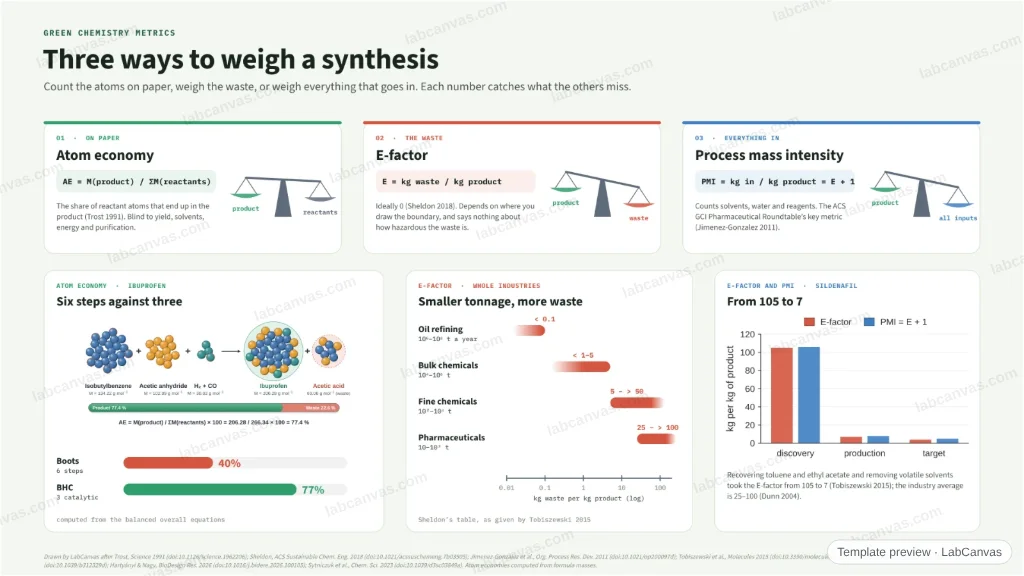
Three ways to weigh a synthesis: atom economy (the atoms on paper), the E-factor (the waste) and process mass intensity (everything that goes in, PMI = E + 1). Applied to real cases: the Boots and BHC ibuprofen routes on paper (40% against 77% atom economy, computed from the balanced equations), the E-factors of whole industries from oil refining (< 0.1) to pharmaceuticals (25 to > 100), and the sildenafil process brought from an E-factor of 105 to 7 by recovering its solvents.
Updated 10 cited papers108 editable layers
At a glance
- Category
- Graphical abstracts
- Method
- Graphical abstract
- Starting materials
- A synthetic route: its balanced equations, and the masses of everything charged to the plant
- Product
- Three numbers that compare routes: atom economy, E-factor and PMI
- Key result
- AE 40% (Boots) vs 77% (BHC), computed; E-factor < 0.1 to > 100 by sector; sildenafil 105 → 7 → 4 (Tobiszewski et al. 2015); industry average 25–100 kg/kg (Dunn et al. 2004)
- Figure
- 1920 × 1080 px (16:9), 108 editable layers, 1 generated objects
Step by step
- Atom economyM(product) / ΣM(reactants): how many reactant atoms end up in the product (Trost 1991); on paper only, it ignores yield, solvents and purification (Hartyányi & Nagy 2026)
- E-factorkg waste per kg product, ideally 0 (Sheldon 2018): < 0.1 for oil refining, 25 to > 100 for pharmaceuticals (Tobiszewski et al. 2015)
- Process mass intensitykg of all inputs per kg product, PMI = E + 1 (Tobiszewski et al. 2015); the ACS GCI Pharmaceutical Roundtable’s key metric (Jimenez-Gonzalez et al. 2011)
- Ibuprofen on paperThe six-step Boots route has an atom economy of 40%, the three-step catalytic BHC route 77% (computed from the balanced equations; routes after Hartyányi & Nagy 2026)
- Sildenafil in the plantE-factor 105 at discovery, 7 in production after solvent recovery, target 4 (Tobiszewski et al. 2015, after Dunn et al. 2004)
Uses
- Graphical abstracts on green chemistry and process sustainability
- Teaching atom economy, E-factor and PMI with real numbers
- Talks on greener pharmaceutical manufacturing
Papers this template follows
- Trost, “The atom economy—a search for synthetic efficiency”, Science 1991. doi:10.1126/science.1962206method origin
- Sheldon, “Metrics of green chemistry and sustainability: past, present, and future”, ACS Sustainable Chem. Eng. 2018. doi:10.1021/acssuschemeng.7b03505review
- Sheldon, “The E Factor: fifteen years on”, Green Chem. 2007. doi:10.1039/b713736mreview
- Jimenez-Gonzalez, Ponder, Broxterman & Manley, “Using the right green yardstick: why process mass intensity is used in the pharmaceutical industry to drive more sustainable processes”, Org. Process Res. Dev. 2011. doi:10.1021/op200097dprimary
- Tobiszewski, Marć, Gałuszka & Namieśnik, “Green chemistry metrics with special reference to green analytical chemistry”, Molecules 2015. doi:10.3390/molecules200610928review
- Dunn, Galvin & Hettenbach, “The development of an environmentally benign synthesis of sildenafil citrate (Viagra™) and its assessment by Green Chemistry metrics”, Green Chem. 2004. doi:10.1039/b312329dprimary
- Constable, Curzons & Cunningham, “Metrics to ‘green’ chemistry—which are the best?”, Green Chem. 2002. doi:10.1039/B206169Bprimary
- Hartyányi & Nagy, “Sustainable chemical technology: core concepts, key subfields, and assessment approaches”, BioDesign Res. 2026. doi:10.1016/j.bidere.2026.100105review
- Sytniczuk, Struzik, Grela & Kajetanowicz, “A tunable family of CAAC-ruthenium olefin metathesis catalysts modularly derived from a large-scale produced ibuprofen intermediate”, Chem. Sci. 2023. doi:10.1039/d3sc03849afurther reading
- Murphy, “Early industrial roots of green chemistry and the history of the BHC ibuprofen process invention and its quality connection”, Found. Chem. 2017. doi:10.1007/s10698-017-9300-9further reading
Drawn by LabCanvas after Trost, Science 1991 (doi:10.1126/science.1962206); Sheldon, ACS Sustainable Chem. Eng. 2018 (doi:10.1021/acssuschemeng.7b03505); Jimenez-Gonzalez et al., Org. Process Res. Dev. 2011 (doi:10.1021/op200097d); Tobiszewski et al., Molecules 2015 (doi:10.3390/molecules200610928); Dunn et al., Green Chem. 2004 (doi:10.1039/b312329d); Hartyányi & Nagy, BioDesign Res. 2026 (doi:10.1016/j.bidere.2026.100105); Sytniczuk et al., Chem. Sci. 2023 (doi:10.1039/d3sc03849a). Atom economies computed from formula masses.
How templates are written and checked: editorial guidelines.
Questions
What does the “Green chemistry metrics: atom economy, E-factor and process mass intensity of a route” template show?
Three ways to weigh a synthesis: atom economy (the atoms on paper), the E-factor (the waste) and process mass intensity (everything that goes in, PMI = E + 1). Applied to real cases: the Boots and BHC ibuprofen routes on paper (40% against 77% atom economy, computed from the balanced equations), the E-factors of whole industries from oil refining (< 0.1) to pharmaceuticals (25 to > 100), and the sildenafil process brought from an E-factor of 105 to 7 by recovering its solvents.
What are the steps shown in “Green chemistry metrics: atom economy, E-factor and process mass intensity of a route”?
1. Atom economy: M(product) / ΣM(reactants): how many reactant atoms end up in the product (Trost 1991); on paper only, it ignores yield, solvents and purification (Hartyányi & Nagy 2026). 2. E-factor: kg waste per kg product, ideally 0 (Sheldon 2018): < 0.1 for oil refining, 25 to > 100 for pharmaceuticals (Tobiszewski et al. 2015). 3. Process mass intensity: kg of all inputs per kg product, PMI = E + 1 (Tobiszewski et al. 2015); the ACS GCI Pharmaceutical Roundtable’s key metric (Jimenez-Gonzalez et al. 2011). 4. Ibuprofen on paper: The six-step Boots route has an atom economy of 40%, the three-step catalytic BHC route 77% (computed from the balanced equations; routes after Hartyányi & Nagy 2026). 5. Sildenafil in the plant: E-factor 105 at discovery, 7 in production after solvent recovery, target 4 (Tobiszewski et al. 2015, after Dunn et al. 2004).
What are the starting materials and the product?
Starting materials: A synthetic route: its balanced equations, and the masses of everything charged to the plant. Product: Three numbers that compare routes: atom economy, E-factor and PMI.
Which papers is “Green chemistry metrics: atom economy, E-factor and process mass intensity of a route” based on?
Trost, “The atom economy—a search for synthetic efficiency”, Science 1991 (doi:10.1126/science.1962206); Sheldon, “Metrics of green chemistry and sustainability: past, present, and future”, ACS Sustainable Chem. Eng. 2018 (doi:10.1021/acssuschemeng.7b03505); Sheldon, “The E Factor: fifteen years on”, Green Chem. 2007 (doi:10.1039/b713736m); Jimenez-Gonzalez, Ponder, Broxterman & Manley, “Using the right green yardstick: why process mass intensity is used in the pharmaceutical industry to drive more sustainable processes”, Org. Process Res. Dev. 2011 (doi:10.1021/op200097d); Tobiszewski, Marć, Gałuszka & Namieśnik, “Green chemistry metrics with special reference to green analytical chemistry”, Molecules 2015 (doi:10.3390/molecules200610928); Dunn, Galvin & Hettenbach, “The development of an environmentally benign synthesis of sildenafil citrate (Viagra™) and its assessment by Green Chemistry metrics”, Green Chem. 2004 (doi:10.1039/b312329d); Constable, Curzons & Cunningham, “Metrics to ‘green’ chemistry—which are the best?”, Green Chem. 2002 (doi:10.1039/B206169B); Hartyányi & Nagy, “Sustainable chemical technology: core concepts, key subfields, and assessment approaches”, BioDesign Res. 2026 (doi:10.1016/j.bidere.2026.100105); Sytniczuk, Struzik, Grela & Kajetanowicz, “A tunable family of CAAC-ruthenium olefin metathesis catalysts modularly derived from a large-scale produced ibuprofen intermediate”, Chem. Sci. 2023 (doi:10.1039/d3sc03849a); Murphy, “Early industrial roots of green chemistry and the history of the BHC ibuprofen process invention and its quality connection”, Found. Chem. 2017 (doi:10.1007/s10698-017-9300-9).
Can I edit the “Green chemistry metrics: atom economy, E-factor and process mass intensity of a route” template?
Yes. Open it in the LabCanvas editor: all 108 layers are editable, including 1 generated objects (structures, plots, equipment) with their own settings. Change the text, colours and layout, then export PNG, TIFF or PDF at the width and DPI the journal asks for.
Do I need an account to use this template?
Not to view it here. To open and edit it, sign in to LabCanvas or create a free account (the free plan keeps up to 3 designs). Downloading the figure is part of LabCanvas Pro (US$19 a month or US$199 a year).





