Graphical abstract template · Graphical abstracts · Graphical abstract
Hot-injection quantum dots: from one burst of nuclei to bright core/shell dots
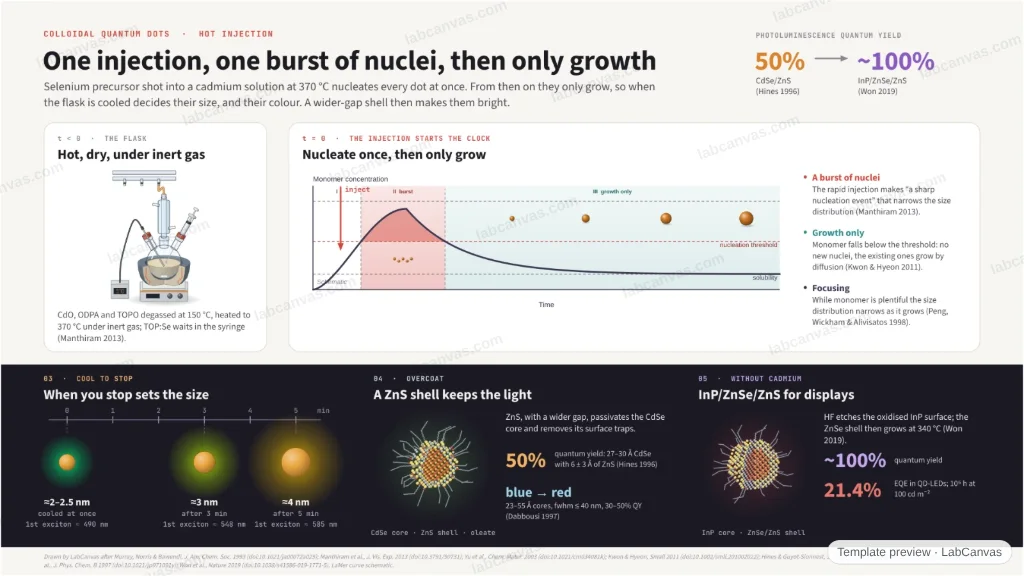
A graphical abstract of the hot-injection synthesis read as a clock: TOP:Se shot into CdO in TOPO at 370 °C starts one burst of nucleation (the LaMer picture), the nuclei then only grow, and the moment the flask is cooled sets the size and colour (≈2–2.5 nm at once, 3 nm after 3 min, 4 nm after 5 min). A ZnS shell lifts the quantum yield to 50%, and cadmium-free InP/ZnSe/ZnS dots reach ~100% and 21.4%-efficient LEDs.
Updated 9 cited papers86 editable layers
At a glance
- Category
- Graphical abstracts
- Method
- Graphical abstract
- Starting materials
- CdO with ODPA in TOPO (cadmium phosphonate), TOP:Se injected at 370 °C; shells from zinc and sulfur or selenium precursors
- Product
- Nearly monodisperse CdSe dots whose size is set by the growth time, and CdSe/ZnS and InP/ZnSe/ZnS core/shell dots
- Key result
- ≈2–2.5, 3 and 4 nm CdSe after 0, 3 and 5 min at 370 °C (Manthiram et al. 2013); 50% QY CdSe/ZnS (Hines & Guyot-Sionnest 1996); 30–50% QY, fwhm ≤ 40 nm (Dabbousi et al. 1997); ~100% QY InP/ZnSe/ZnS, 21.4% EQE (Won et al. 2019)
- Figure
- 1920 × 1080 px (16:9), 86 editable layers, 7 generated objects
Step by step
- InjectTOP:Se shot through a 14 G needle into the degassed cadmium solution at 370 °C: a sharp nucleation event that narrows the size distribution (Manthiram et al. 2013)
- Burst, then growBurst nucleation and diffusion-controlled growth set the size distribution (Kwon & Hyeon 2011), the LaMer picture (LaMer & Dinegar 1950)
- Stop the clockCooled at once ≈2–2.5 nm, after 3 min ≈3 nm, after 5 min ≈4 nm, sized from the first exciton (Manthiram et al. 2013; Yu et al. 2003)
- Add a shellA ZnS cap 6 ± 3 Å thick on 27–30 Å CdSe removes surface traps: 50% quantum yield (Hines & Guyot-Sionnest 1996); 23–55 Å cores emit blue to red, fwhm ≤ 40 nm (Dabbousi et al. 1997)
- Cadmium-freeInP/ZnSe/ZnS with an HF etch and ZnSe grown at 340 °C: ~100% quantum yield, LEDs with 21.4% EQE (Won et al. 2019)
Uses
- Graphical abstracts on colloidal quantum-dot synthesis
- Teaching nucleation, growth and size focusing
- Talks on core/shell and cadmium-free quantum dots for displays
Papers this template follows
- Murray, Norris & Bawendi, “Synthesis and characterization of nearly monodisperse CdE (E = sulfur, selenium, tellurium) semiconductor nanocrystallites”, J. Am. Chem. Soc. 1993. doi:10.1021/ja00072a025method origin
- LaMer & Dinegar, “Theory, production and mechanism of formation of monodispersed hydrosols”, J. Am. Chem. Soc. 1950. doi:10.1021/ja01167a001method origin
- Peng, Wickham & Alivisatos, “Kinetics of II-VI and III-V colloidal semiconductor nanocrystal growth: “focusing” of size distributions”, J. Am. Chem. Soc. 1998. doi:10.1021/ja9805425primary
- Manthiram, Beberwyck, Talapin & Alivisatos, “Seeded synthesis of CdSe/CdS rod and tetrapod nanocrystals”, J. Vis. Exp. 2013. doi:10.3791/50731primary
- Yu, Qu, Guo & Peng, “Experimental determination of the extinction coefficient of CdTe, CdSe, and CdS nanocrystals”, Chem. Mater. 2003. doi:10.1021/cm034081kprimary
- Kwon & Hyeon, “Formation mechanisms of uniform nanocrystals via hot-injection and heat-up methods”, Small 2011. doi:10.1002/smll.201002022review
- Hines & Guyot-Sionnest, “Synthesis and characterization of strongly luminescing ZnS-capped CdSe nanocrystals”, J. Phys. Chem. 1996. doi:10.1021/jp9530562primary
- Dabbousi et al., “(CdSe)ZnS core−shell quantum dots: synthesis and characterization of a size series of highly luminescent nanocrystallites”, J. Phys. Chem. B 1997. doi:10.1021/jp971091yprimary
- Won et al., “Highly efficient and stable InP/ZnSe/ZnS quantum dot light-emitting diodes”, Nature 2019. doi:10.1038/s41586-019-1771-5primary
Drawn by LabCanvas after Murray, Norris & Bawendi, J. Am. Chem. Soc. 1993 (doi:10.1021/ja00072a025); Manthiram et al., J. Vis. Exp. 2013 (doi:10.3791/50731); Yu et al., Chem. Mater. 2003 (doi:10.1021/cm034081k); Kwon & Hyeon, Small 2011 (doi:10.1002/smll.201002022); Hines & Guyot-Sionnest, J. Phys. Chem. 1996 (doi:10.1021/jp9530562); Dabbousi et al., J. Phys. Chem. B 1997 (doi:10.1021/jp971091y); Won et al., Nature 2019 (doi:10.1038/s41586-019-1771-5). LaMer curve schematic.
How templates are written and checked: editorial guidelines.
Questions
What does the “Hot-injection quantum dots: from one burst of nuclei to bright core/shell dots” template show?
A graphical abstract of the hot-injection synthesis read as a clock: TOP:Se shot into CdO in TOPO at 370 °C starts one burst of nucleation (the LaMer picture), the nuclei then only grow, and the moment the flask is cooled sets the size and colour (≈2–2.5 nm at once, 3 nm after 3 min, 4 nm after 5 min). A ZnS shell lifts the quantum yield to 50%, and cadmium-free InP/ZnSe/ZnS dots reach ~100% and 21.4%-efficient LEDs.
What are the steps shown in “Hot-injection quantum dots: from one burst of nuclei to bright core/shell dots”?
1. Inject: TOP:Se shot through a 14 G needle into the degassed cadmium solution at 370 °C: a sharp nucleation event that narrows the size distribution (Manthiram et al. 2013). 2. Burst, then grow: Burst nucleation and diffusion-controlled growth set the size distribution (Kwon & Hyeon 2011), the LaMer picture (LaMer & Dinegar 1950). 3. Stop the clock: Cooled at once ≈2–2.5 nm, after 3 min ≈3 nm, after 5 min ≈4 nm, sized from the first exciton (Manthiram et al. 2013; Yu et al. 2003). 4. Add a shell: A ZnS cap 6 ± 3 Å thick on 27–30 Å CdSe removes surface traps: 50% quantum yield (Hines & Guyot-Sionnest 1996); 23–55 Å cores emit blue to red, fwhm ≤ 40 nm (Dabbousi et al. 1997). 5. Cadmium-free: InP/ZnSe/ZnS with an HF etch and ZnSe grown at 340 °C: ~100% quantum yield, LEDs with 21.4% EQE (Won et al. 2019).
What are the starting materials and the product?
Starting materials: CdO with ODPA in TOPO (cadmium phosphonate), TOP:Se injected at 370 °C; shells from zinc and sulfur or selenium precursors. Product: Nearly monodisperse CdSe dots whose size is set by the growth time, and CdSe/ZnS and InP/ZnSe/ZnS core/shell dots.
Which papers is “Hot-injection quantum dots: from one burst of nuclei to bright core/shell dots” based on?
Murray, Norris & Bawendi, “Synthesis and characterization of nearly monodisperse CdE (E = sulfur, selenium, tellurium) semiconductor nanocrystallites”, J. Am. Chem. Soc. 1993 (doi:10.1021/ja00072a025); LaMer & Dinegar, “Theory, production and mechanism of formation of monodispersed hydrosols”, J. Am. Chem. Soc. 1950 (doi:10.1021/ja01167a001); Peng, Wickham & Alivisatos, “Kinetics of II-VI and III-V colloidal semiconductor nanocrystal growth: “focusing” of size distributions”, J. Am. Chem. Soc. 1998 (doi:10.1021/ja9805425); Manthiram, Beberwyck, Talapin & Alivisatos, “Seeded synthesis of CdSe/CdS rod and tetrapod nanocrystals”, J. Vis. Exp. 2013 (doi:10.3791/50731); Yu, Qu, Guo & Peng, “Experimental determination of the extinction coefficient of CdTe, CdSe, and CdS nanocrystals”, Chem. Mater. 2003 (doi:10.1021/cm034081k); Kwon & Hyeon, “Formation mechanisms of uniform nanocrystals via hot-injection and heat-up methods”, Small 2011 (doi:10.1002/smll.201002022); Hines & Guyot-Sionnest, “Synthesis and characterization of strongly luminescing ZnS-capped CdSe nanocrystals”, J. Phys. Chem. 1996 (doi:10.1021/jp9530562); Dabbousi et al., “(CdSe)ZnS core−shell quantum dots: synthesis and characterization of a size series of highly luminescent nanocrystallites”, J. Phys. Chem. B 1997 (doi:10.1021/jp971091y); Won et al., “Highly efficient and stable InP/ZnSe/ZnS quantum dot light-emitting diodes”, Nature 2019 (doi:10.1038/s41586-019-1771-5).
Can I edit the “Hot-injection quantum dots: from one burst of nuclei to bright core/shell dots” template?
Yes. Open it in the LabCanvas editor: all 86 layers are editable, including 7 generated objects (structures, plots, equipment) with their own settings. Change the text, colours and layout, then export PNG, TIFF or PDF at the width and DPI the journal asks for.
Do I need an account to use this template?
Not to view it here. To open and edit it, sign in to LabCanvas or create a free account (the free plan keeps up to 3 designs). Downloading the figure is part of LabCanvas Pro (US$19 a month or US$199 a year).