Graphical abstract template · Graphical abstracts · Graphical abstract
Lateral-flow tests: how a rapid test reads out
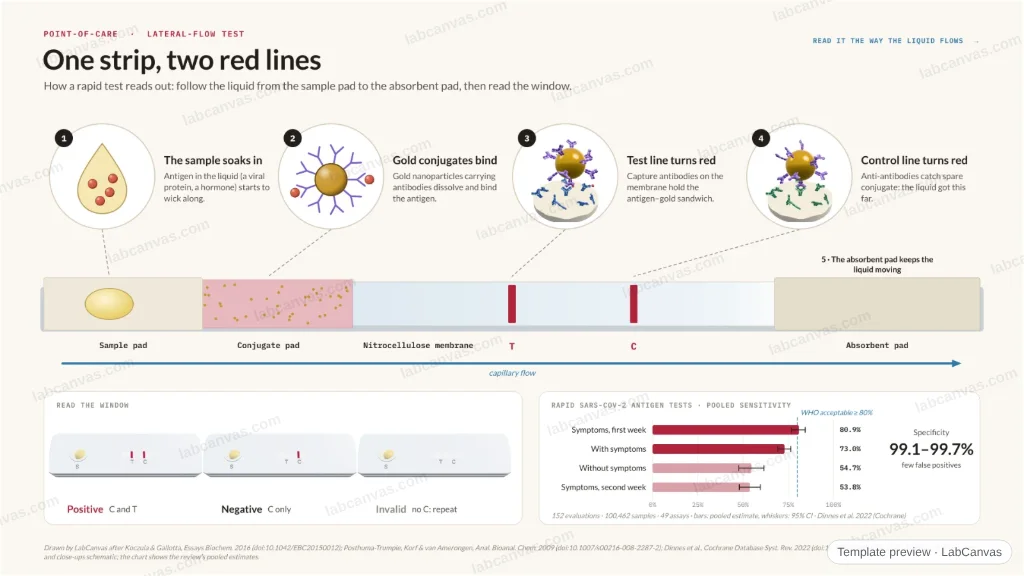
A lateral-flow strip read in the direction the liquid flows: the sample wets the sample pad, gold–antibody conjugates in the conjugate pad pick up the antigen, the test line catches the sandwich and turns red, and the control line catches spare conjugate to show the test ran. Below: how to read positive, negative and invalid cassettes, and how well rapid SARS-CoV-2 antigen tests performed in a Cochrane review (sensitivity 73.0% with symptoms, 54.7% without; specificity above 99%).
Updated 3 cited papers166 editable layers
At a glance
- Category
- Graphical abstracts
- Method
- Graphical abstract
- Starting materials
- A drop of sample (swab extract, urine, blood) on the sample pad
- Product
- Two red lines (positive), the control line alone (negative), or no control line (invalid)
- Key result
- Pooled sensitivity 73.0% (95% CI 69.3–76.4) symptomatic, 54.7% (47.7–61.6) asymptomatic, 80.9% (76.9–84.4) week 1, 53.8% (48.0–59.6) week 2; specificity 99.1% and 99.7% (Dinnes et al. 2022)
- Figure
- 1920 × 1080 px (16:9), 166 editable layers
Step by step
- 1 · Sample padThe sample soaks in and starts to wick along the strip by capillary flow
- 2 · Conjugate padGold nanoparticles carrying detection antibodies dissolve and bind the antigen (Koczula & Gallotta 2016)
- 3 · Test lineCapture antibodies on the nitrocellulose hold the antigen–gold sandwich: the line turns red
- 4 · Control lineAnti-antibodies catch spare gold conjugate, showing the liquid reached the end
- 5 · Absorbent padKeeps the liquid moving through the membrane
- How well it worksRapid SARS-CoV-2 antigen tests: sensitivity 73.0% with symptoms, 54.7% without, 80.9% in the first week; specificity 99.1–99.7% (Dinnes et al. 2022)
Uses
- Graphical abstracts on lateral-flow and point-of-care diagnostics
- Teaching how a rapid antigen or pregnancy test works
- Talks on test sensitivity and specificity
Papers this template follows
- Koczula & Gallotta, “Lateral flow assays”, Essays Biochem. 2016. doi:10.1042/EBC20150012review
- Posthuma-Trumpie, Korf & van Amerongen, “Lateral flow (immuno)assay: its strengths, weaknesses, opportunities and threats. A literature survey”, Anal. Bioanal. Chem. 2009. doi:10.1007/s00216-008-2287-2review
- Dinnes et al. (Cochrane COVID-19 Diagnostic Test Accuracy Group), “Rapid, point-of-care antigen tests for diagnosis of SARS-CoV-2 infection”, Cochrane Database Syst. Rev. 2022. doi:10.1002/14651858.CD013705.pub3primary
Drawn by LabCanvas after Koczula & Gallotta, Essays Biochem. 2016 (doi:10.1042/EBC20150012); Posthuma-Trumpie, Korf & van Amerongen, Anal. Bioanal. Chem. 2009 (doi:10.1007/s00216-008-2287-2); Dinnes et al., Cochrane Database Syst. Rev. 2022 (doi:10.1002/14651858.CD013705.pub3). Strip zones and close-ups schematic; the chart shows the review’s pooled estimates.
How templates are written and checked: editorial guidelines.
Questions
What does the “Lateral-flow tests: how a rapid test reads out” template show?
A lateral-flow strip read in the direction the liquid flows: the sample wets the sample pad, gold–antibody conjugates in the conjugate pad pick up the antigen, the test line catches the sandwich and turns red, and the control line catches spare conjugate to show the test ran. Below: how to read positive, negative and invalid cassettes, and how well rapid SARS-CoV-2 antigen tests performed in a Cochrane review (sensitivity 73.0% with symptoms, 54.7% without; specificity above 99%).
What are the steps shown in “Lateral-flow tests: how a rapid test reads out”?
1. 1 · Sample pad: The sample soaks in and starts to wick along the strip by capillary flow. 2. 2 · Conjugate pad: Gold nanoparticles carrying detection antibodies dissolve and bind the antigen (Koczula & Gallotta 2016). 3. 3 · Test line: Capture antibodies on the nitrocellulose hold the antigen–gold sandwich: the line turns red. 4. 4 · Control line: Anti-antibodies catch spare gold conjugate, showing the liquid reached the end. 5. 5 · Absorbent pad: Keeps the liquid moving through the membrane. 6. How well it works: Rapid SARS-CoV-2 antigen tests: sensitivity 73.0% with symptoms, 54.7% without, 80.9% in the first week; specificity 99.1–99.7% (Dinnes et al. 2022).
What are the starting materials and the product?
Starting materials: A drop of sample (swab extract, urine, blood) on the sample pad. Product: Two red lines (positive), the control line alone (negative), or no control line (invalid).
Which papers is “Lateral-flow tests: how a rapid test reads out” based on?
Koczula & Gallotta, “Lateral flow assays”, Essays Biochem. 2016 (doi:10.1042/EBC20150012); Posthuma-Trumpie, Korf & van Amerongen, “Lateral flow (immuno)assay: its strengths, weaknesses, opportunities and threats. A literature survey”, Anal. Bioanal. Chem. 2009 (doi:10.1007/s00216-008-2287-2); Dinnes et al. (Cochrane COVID-19 Diagnostic Test Accuracy Group), “Rapid, point-of-care antigen tests for diagnosis of SARS-CoV-2 infection”, Cochrane Database Syst. Rev. 2022 (doi:10.1002/14651858.CD013705.pub3).
Can I edit the “Lateral-flow tests: how a rapid test reads out” template?
Yes. Open it in the LabCanvas editor: all 166 layers are editable. Change the text, colours and layout, then export PNG, TIFF or PDF at the width and DPI the journal asks for.
Do I need an account to use this template?
Not to view it here. To open and edit it, sign in to LabCanvas or create a free account (the free plan keeps up to 3 designs). Downloading the figure is part of LabCanvas Pro (US$19 a month or US$199 a year).





