Graphical abstract template · Graphical abstracts · Graphical abstract
Lithium-metal anodes: dendrites, the SEI and four ways to stop them
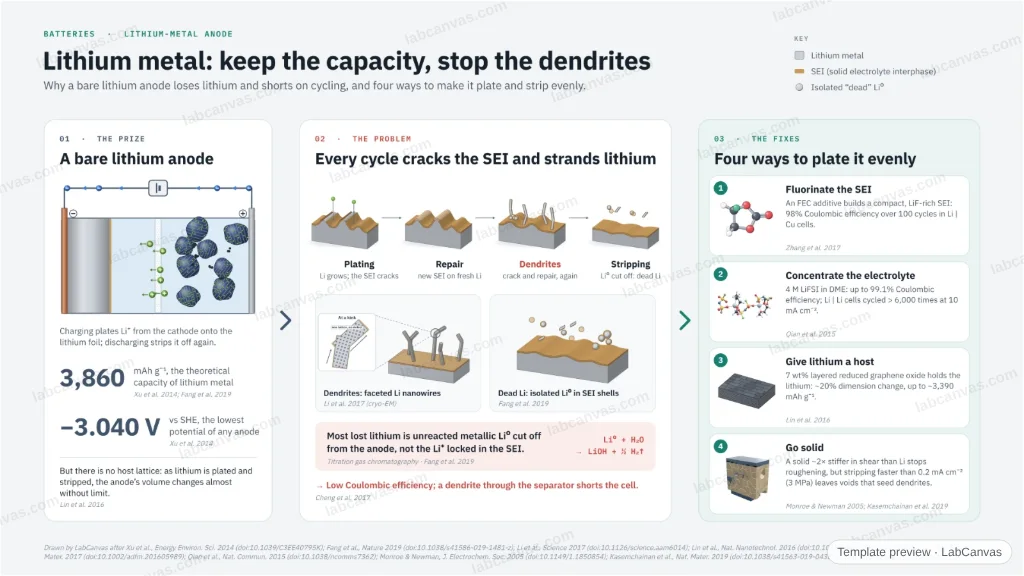
Why the lithium-metal anode, with 3,860 mAh g⁻¹ at −3.040 V vs SHE, is hard to cycle: each plating–stripping cycle cracks and re-forms the SEI, grows dendrites and strands isolated metallic lithium, which titration gas chromatography shows is the main inactive lithium. Four fixes follow with their numbers: an FEC-made LiF-rich SEI, a concentrated 4 M LiFSI–DME electrolyte, a layered reduced-graphene-oxide host and a stiff solid electrolyte, with its critical stripping current.
Updated 9 cited papers85 editable layers
At a glance
- Category
- Graphical abstracts
- Method
- Graphical abstract
- Starting materials
- A lithium-metal anode facing a cathode across a liquid or solid electrolyte
- Product
- An anode that plates and strips lithium evenly, with high Coulombic efficiency and no short circuit
- Key result
- 3,860 mAh g⁻¹ and −3.040 V vs SHE (Xu et al. 2014); unreacted Li⁰ dominates inactive Li (Fang et al. 2019); CE 98% with FEC (Zhang et al. 2017); CE up to 99.1%, > 6,000 cycles at 10 mA cm⁻² in 4 M LiFSI–DME (Qian et al. 2015); ~20% dimension change in a 7 wt% rGO host (Lin et al. 2016); shear modulus ≈ 2× Li (Monroe & Newman 2005); critical stripping current 0.2 mA cm⁻² at 3 MPa (Kasemchainan et al. 2019)
- Figure
- 1920 × 1080 px (16:9), 85 editable layers, 6 generated objects
Step by step
- a · The prizeLithium metal stores 3,860 mAh g⁻¹ at the lowest potential of any anode, −3.040 V vs SHE, but has no host lattice, so its volume changes almost without limit (Xu et al. 2014; Lin et al. 2016)
- b · The problemPlating cracks the SEI, fresh SEI forms on the exposed lithium, dendrites grow, and stripping leaves isolated Li⁰ in SEI shells; that unreacted Li⁰, not SEI Li⁺, is most of the inactive lithium (Fang et al. 2019)
- c · Fluorinate the SEIAn FEC additive forms a compact, LiF-rich SEI: 98% Coulombic efficiency within 100 cycles in Li | Cu cells (Zhang et al. 2017)
- c · Concentrate the electrolyte4 M LiFSI in DME: Coulombic efficiency up to 99.1% and Li | Li cells cycled more than 6,000 times at 10 mA cm⁻² (Qian et al. 2015)
- c · Give lithium a host7 wt% layered reduced graphene oxide holds the lithium: about 20% dimension change and up to ~3,390 mAh g⁻¹ (Lin et al. 2016)
- c · Go solidA separator about twice as stiff in shear as lithium suppresses roughening (Monroe & Newman 2005), but stripping above 0.2 mA cm⁻² at 3 MPa leaves voids that seed dendrites in Li₆PS₅Cl cells (Kasemchainan et al. 2019)
Uses
- Graphical abstracts on lithium-metal and anode-free batteries
- Talks on dendrites, the SEI and dead lithium
- Teaching why lithium metal is hard to cycle
Papers this template follows
- Xu, Wang, Ding, Chen, Nasybulin, Zhang & Zhang, “Lithium metal anodes for rechargeable batteries”, Energy Environ. Sci. 2014. doi:10.1039/C3EE40795Kreview
- Fang et al., “Quantifying inactive lithium in lithium metal batteries”, Nature 2019. doi:10.1038/s41586-019-1481-zprimary
- Li et al., “Atomic structure of sensitive battery materials and interfaces revealed by cryo-electron microscopy”, Science 2017. doi:10.1126/science.aam6014primary
- Lin, Liu, Liang, Lee, Sun, Wang, Yan, Xie & Cui, “Layered reduced graphene oxide with nanoscale interlayer gaps as a stable host for lithium metal anodes”, Nat. Nanotechnol. 2016. doi:10.1038/nnano.2016.32primary
- Zhang, Cheng, Chen, Yan & Zhang, “Fluoroethylene carbonate additives to render uniform Li deposits in lithium metal batteries”, Adv. Funct. Mater. 2017. doi:10.1002/adfm.201605989primary
- Qian, Henderson, Xu, Bhattacharya, Engelhard, Borodin & Zhang, “High rate and stable cycling of lithium metal anode”, Nat. Commun. 2015. doi:10.1038/ncomms7362primary
- Monroe & Newman, “The impact of elastic deformation on deposition kinetics at lithium/polymer interfaces”, J. Electrochem. Soc. 2005. doi:10.1149/1.1850854primary
- Kasemchainan, Zekoll, Spencer Jolly, Ning, Hartley, Marrow & Bruce, “Critical stripping current leads to dendrite formation on plating in lithium anode solid electrolyte cells”, Nat. Mater. 2019. doi:10.1038/s41563-019-0438-9primary
- Cheng, Zhang, Zhao & Zhang, “Toward safe lithium metal anode in rechargeable batteries: a review”, Chem. Rev. 2017. doi:10.1021/acs.chemrev.7b00115review
Drawn by LabCanvas after Xu et al., Energy Environ. Sci. 2014 (doi:10.1039/C3EE40795K); Fang et al., Nature 2019 (doi:10.1038/s41586-019-1481-z); Li et al., Science 2017 (doi:10.1126/science.aam6014); Lin et al., Nat. Nanotechnol. 2016 (doi:10.1038/nnano.2016.32); Zhang et al., Adv. Funct. Mater. 2017 (doi:10.1002/adfm.201605989); Qian et al., Nat. Commun. 2015 (doi:10.1038/ncomms7362); Monroe & Newman, J. Electrochem. Soc. 2005 (doi:10.1149/1.1850854); Kasemchainan et al., Nat. Mater. 2019 (doi:10.1038/s41563-019-0438-9). Cell, steps and grains schematic.
How templates are written and checked: editorial guidelines.
Questions
What does the “Lithium-metal anodes: dendrites, the SEI and four ways to stop them” template show?
Why the lithium-metal anode, with 3,860 mAh g⁻¹ at −3.040 V vs SHE, is hard to cycle: each plating–stripping cycle cracks and re-forms the SEI, grows dendrites and strands isolated metallic lithium, which titration gas chromatography shows is the main inactive lithium. Four fixes follow with their numbers: an FEC-made LiF-rich SEI, a concentrated 4 M LiFSI–DME electrolyte, a layered reduced-graphene-oxide host and a stiff solid electrolyte, with its critical stripping current.
What are the steps shown in “Lithium-metal anodes: dendrites, the SEI and four ways to stop them”?
1. a · The prize: Lithium metal stores 3,860 mAh g⁻¹ at the lowest potential of any anode, −3.040 V vs SHE, but has no host lattice, so its volume changes almost without limit (Xu et al. 2014; Lin et al. 2016). 2. b · The problem: Plating cracks the SEI, fresh SEI forms on the exposed lithium, dendrites grow, and stripping leaves isolated Li⁰ in SEI shells; that unreacted Li⁰, not SEI Li⁺, is most of the inactive lithium (Fang et al. 2019). 3. c · Fluorinate the SEI: An FEC additive forms a compact, LiF-rich SEI: 98% Coulombic efficiency within 100 cycles in Li | Cu cells (Zhang et al. 2017). 4. c · Concentrate the electrolyte: 4 M LiFSI in DME: Coulombic efficiency up to 99.1% and Li | Li cells cycled more than 6,000 times at 10 mA cm⁻² (Qian et al. 2015). 5. c · Give lithium a host: 7 wt% layered reduced graphene oxide holds the lithium: about 20% dimension change and up to ~3,390 mAh g⁻¹ (Lin et al. 2016). 6. c · Go solid: A separator about twice as stiff in shear as lithium suppresses roughening (Monroe & Newman 2005), but stripping above 0.2 mA cm⁻² at 3 MPa leaves voids that seed dendrites in Li₆PS₅Cl cells (Kasemchainan et al. 2019).
What are the starting materials and the product?
Starting materials: A lithium-metal anode facing a cathode across a liquid or solid electrolyte. Product: An anode that plates and strips lithium evenly, with high Coulombic efficiency and no short circuit.
Which papers is “Lithium-metal anodes: dendrites, the SEI and four ways to stop them” based on?
Xu, Wang, Ding, Chen, Nasybulin, Zhang & Zhang, “Lithium metal anodes for rechargeable batteries”, Energy Environ. Sci. 2014 (doi:10.1039/C3EE40795K); Fang et al., “Quantifying inactive lithium in lithium metal batteries”, Nature 2019 (doi:10.1038/s41586-019-1481-z); Li et al., “Atomic structure of sensitive battery materials and interfaces revealed by cryo-electron microscopy”, Science 2017 (doi:10.1126/science.aam6014); Lin, Liu, Liang, Lee, Sun, Wang, Yan, Xie & Cui, “Layered reduced graphene oxide with nanoscale interlayer gaps as a stable host for lithium metal anodes”, Nat. Nanotechnol. 2016 (doi:10.1038/nnano.2016.32); Zhang, Cheng, Chen, Yan & Zhang, “Fluoroethylene carbonate additives to render uniform Li deposits in lithium metal batteries”, Adv. Funct. Mater. 2017 (doi:10.1002/adfm.201605989); Qian, Henderson, Xu, Bhattacharya, Engelhard, Borodin & Zhang, “High rate and stable cycling of lithium metal anode”, Nat. Commun. 2015 (doi:10.1038/ncomms7362); Monroe & Newman, “The impact of elastic deformation on deposition kinetics at lithium/polymer interfaces”, J. Electrochem. Soc. 2005 (doi:10.1149/1.1850854); Kasemchainan, Zekoll, Spencer Jolly, Ning, Hartley, Marrow & Bruce, “Critical stripping current leads to dendrite formation on plating in lithium anode solid electrolyte cells”, Nat. Mater. 2019 (doi:10.1038/s41563-019-0438-9); Cheng, Zhang, Zhao & Zhang, “Toward safe lithium metal anode in rechargeable batteries: a review”, Chem. Rev. 2017 (doi:10.1021/acs.chemrev.7b00115).
Can I edit the “Lithium-metal anodes: dendrites, the SEI and four ways to stop them” template?
Yes. Open it in the LabCanvas editor: all 85 layers are editable, including 6 generated objects (structures, plots, equipment) with their own settings. Change the text, colours and layout, then export PNG, TIFF or PDF at the width and DPI the journal asks for.
Do I need an account to use this template?
Not to view it here. To open and edit it, sign in to LabCanvas or create a free account (the free plan keeps up to 3 designs). Downloading the figure is part of LabCanvas Pro (US$19 a month or US$199 a year).