Graphical abstract template · Graphical abstracts · Graphical abstract
Mechanochemistry: one solvent-free ball mill, three materials (MOFs, COFs, cocrystals)
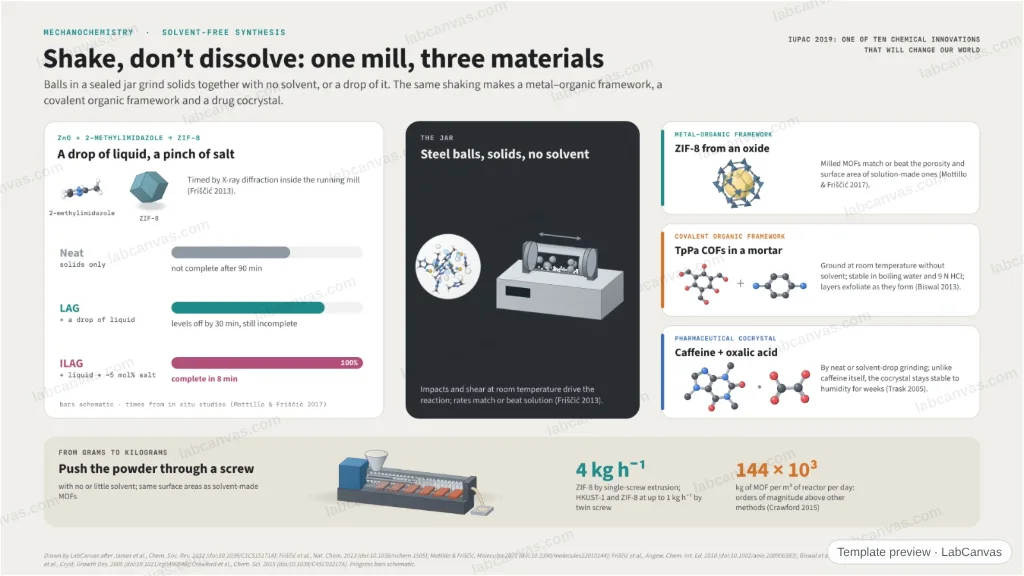
A ball-mill jar and no solvent bottle: ZnO and 2-methylimidazole become the framework ZIF-8, two COF monomers become an acid- and water-stable covalent organic framework, and caffeine with oxalic acid becomes a cocrystal that no longer takes up water. A drop of liquid and a pinch of salt turn an incomplete 90-minute milling into complete conversion in eight minutes, and extruders make the same MOFs at kilograms per hour.
Updated 9 cited papers67 editable layers
At a glance
- Category
- Graphical abstracts
- Method
- Graphical abstract
- Starting materials
- Solid reactants with no or a catalytic amount of liquid (and salt): ZnO + 2-methylimidazole; 1,3,5-triformylphloroglucinol + p-phenylenediamine; caffeine + oxalic acid
- Product
- ZIF-8, β-ketoenamine COFs (TpPa-1, TpPa-2, TpBD) and caffeine cocrystals, made without bulk solvent
- Key result
- ILAG ZIF-8 in 8 min vs > 90 min neat (Mottillo & Friščić 2017); COFs stable in 9 N HCl (Biswal et al. 2013); 4 kg h⁻¹ ZIF-8, STY 144 × 10³ kg m⁻³ d⁻¹ (Crawford et al. 2015)
- Figure
- 1920 × 1080 px (16:9), 67 editable layers, 9 generated objects
Step by step
- Grind, do not dissolveSolid reactants ground together with no or minimal solvent (James et al. 2012); in situ X-ray diffraction shows rates comparable to or faster than in solution (Friščić et al. 2013)
- A drop of liquid, a pinch of saltZnO + 2-methylimidazole: neat milling incomplete after 90 min, LAG incomplete at 30 min, ILAG complete in 8 min (Mottillo & Friščić 2017; Friščić et al. 2010)
- COFs at room temperatureTpPa-1, TpPa-2 and TpBD by solvent-free grinding, stable in boiling water and 9 N HCl (Biswal et al. 2013)
- CocrystalsCaffeine with dicarboxylic acids by neat or solvent-drop grinding; the oxalic acid cocrystal is stable to humidity for weeks (Trask et al. 2005)
- Scale by extrusionHKUST-1 and ZIF-8 by twin-screw extrusion at up to 1 kg h⁻¹, ZIF-8 at 4 kg h⁻¹ by single screw; space-time yields up to 144 × 10³ kg m⁻³ d⁻¹ (Crawford et al. 2015)
Uses
- Graphical abstracts on mechanochemistry and solvent-free synthesis
- Talks on green routes to MOFs, COFs and pharmaceutical cocrystals
- Teaching LAG, ILAG and reactive extrusion
Papers this template follows
- James et al., “Mechanochemistry: opportunities for new and cleaner synthesis”, Chem. Soc. Rev. 2012. doi:10.1039/C1CS15171Areview
- Friščić et al., “Real-time and in situ monitoring of mechanochemical milling reactions”, Nat. Chem. 2013. doi:10.1038/nchem.1505primary
- Mottillo & Friščić, “Advances in solid-state transformations of coordination bonds: from the ball mill to the aging chamber”, Molecules 2017. doi:10.3390/molecules22010144review
- Friščić et al., “Ion- and liquid-assisted grinding: improved mechanochemical synthesis of metal–organic frameworks reveals salt inclusion and anion templating”, Angew. Chem. Int. Ed. 2010. doi:10.1002/anie.200906583primary
- Biswal et al., “Mechanochemical synthesis of chemically stable isoreticular covalent organic frameworks”, J. Am. Chem. Soc. 2013. doi:10.1021/ja4017842primary
- Trask, Motherwell & Jones, “Pharmaceutical cocrystallization: engineering a remedy for caffeine hydration”, Cryst. Growth Des. 2005. doi:10.1021/cg0496540primary
- Trask, Motherwell & Jones, “Solvent-drop grinding: green polymorph control of cocrystallisation”, Chem. Commun. 2004. doi:10.1039/b400978aprimary
- Crawford et al., “Synthesis by extrusion: continuous, large-scale preparation of MOFs using little or no solvent”, Chem. Sci. 2015. doi:10.1039/C4SC03217Aprimary
- Gomollón-Bel, “Ten chemical innovations that will change our world”, Chem. Int. 2019. doi:10.1515/ci-2019-0203further reading
Drawn by LabCanvas after James et al., Chem. Soc. Rev. 2012 (doi:10.1039/C1CS15171A); Friščić et al., Nat. Chem. 2013 (doi:10.1038/nchem.1505); Mottillo & Friščić, Molecules 2017 (doi:10.3390/molecules22010144); Friščić et al., Angew. Chem. Int. Ed. 2010 (doi:10.1002/anie.200906583); Biswal et al., J. Am. Chem. Soc. 2013 (doi:10.1021/ja4017842); Trask et al., Cryst. Growth Des. 2005 (doi:10.1021/cg0496540); Crawford et al., Chem. Sci. 2015 (doi:10.1039/C4SC03217A). Progress bars schematic.
How templates are written and checked: editorial guidelines.
Questions
What does the “Mechanochemistry: one solvent-free ball mill, three materials (MOFs, COFs, cocrystals)” template show?
A ball-mill jar and no solvent bottle: ZnO and 2-methylimidazole become the framework ZIF-8, two COF monomers become an acid- and water-stable covalent organic framework, and caffeine with oxalic acid becomes a cocrystal that no longer takes up water. A drop of liquid and a pinch of salt turn an incomplete 90-minute milling into complete conversion in eight minutes, and extruders make the same MOFs at kilograms per hour.
What are the steps shown in “Mechanochemistry: one solvent-free ball mill, three materials (MOFs, COFs, cocrystals)”?
1. Grind, do not dissolve: Solid reactants ground together with no or minimal solvent (James et al. 2012); in situ X-ray diffraction shows rates comparable to or faster than in solution (Friščić et al. 2013). 2. A drop of liquid, a pinch of salt: ZnO + 2-methylimidazole: neat milling incomplete after 90 min, LAG incomplete at 30 min, ILAG complete in 8 min (Mottillo & Friščić 2017; Friščić et al. 2010). 3. COFs at room temperature: TpPa-1, TpPa-2 and TpBD by solvent-free grinding, stable in boiling water and 9 N HCl (Biswal et al. 2013). 4. Cocrystals: Caffeine with dicarboxylic acids by neat or solvent-drop grinding; the oxalic acid cocrystal is stable to humidity for weeks (Trask et al. 2005). 5. Scale by extrusion: HKUST-1 and ZIF-8 by twin-screw extrusion at up to 1 kg h⁻¹, ZIF-8 at 4 kg h⁻¹ by single screw; space-time yields up to 144 × 10³ kg m⁻³ d⁻¹ (Crawford et al. 2015).
What are the starting materials and the product?
Starting materials: Solid reactants with no or a catalytic amount of liquid (and salt): ZnO + 2-methylimidazole; 1,3,5-triformylphloroglucinol + p-phenylenediamine; caffeine + oxalic acid. Product: ZIF-8, β-ketoenamine COFs (TpPa-1, TpPa-2, TpBD) and caffeine cocrystals, made without bulk solvent.
Which papers is “Mechanochemistry: one solvent-free ball mill, three materials (MOFs, COFs, cocrystals)” based on?
James et al., “Mechanochemistry: opportunities for new and cleaner synthesis”, Chem. Soc. Rev. 2012 (doi:10.1039/C1CS15171A); Friščić et al., “Real-time and in situ monitoring of mechanochemical milling reactions”, Nat. Chem. 2013 (doi:10.1038/nchem.1505); Mottillo & Friščić, “Advances in solid-state transformations of coordination bonds: from the ball mill to the aging chamber”, Molecules 2017 (doi:10.3390/molecules22010144); Friščić et al., “Ion- and liquid-assisted grinding: improved mechanochemical synthesis of metal–organic frameworks reveals salt inclusion and anion templating”, Angew. Chem. Int. Ed. 2010 (doi:10.1002/anie.200906583); Biswal et al., “Mechanochemical synthesis of chemically stable isoreticular covalent organic frameworks”, J. Am. Chem. Soc. 2013 (doi:10.1021/ja4017842); Trask, Motherwell & Jones, “Pharmaceutical cocrystallization: engineering a remedy for caffeine hydration”, Cryst. Growth Des. 2005 (doi:10.1021/cg0496540); Trask, Motherwell & Jones, “Solvent-drop grinding: green polymorph control of cocrystallisation”, Chem. Commun. 2004 (doi:10.1039/b400978a); Crawford et al., “Synthesis by extrusion: continuous, large-scale preparation of MOFs using little or no solvent”, Chem. Sci. 2015 (doi:10.1039/C4SC03217A); Gomollón-Bel, “Ten chemical innovations that will change our world”, Chem. Int. 2019 (doi:10.1515/ci-2019-0203).
Can I edit the “Mechanochemistry: one solvent-free ball mill, three materials (MOFs, COFs, cocrystals)” template?
Yes. Open it in the LabCanvas editor: all 67 layers are editable, including 9 generated objects (structures, plots, equipment) with their own settings. Change the text, colours and layout, then export PNG, TIFF or PDF at the width and DPI the journal asks for.
Do I need an account to use this template?
Not to view it here. To open and edit it, sign in to LabCanvas or create a free account (the free plan keeps up to 3 designs). Downloading the figure is part of LabCanvas Pro (US$19 a month or US$199 a year).