Graphical abstract template · Graphical abstracts · Graphical abstract
Mesoporous silica with gatekeepers: capped pores for controlled release
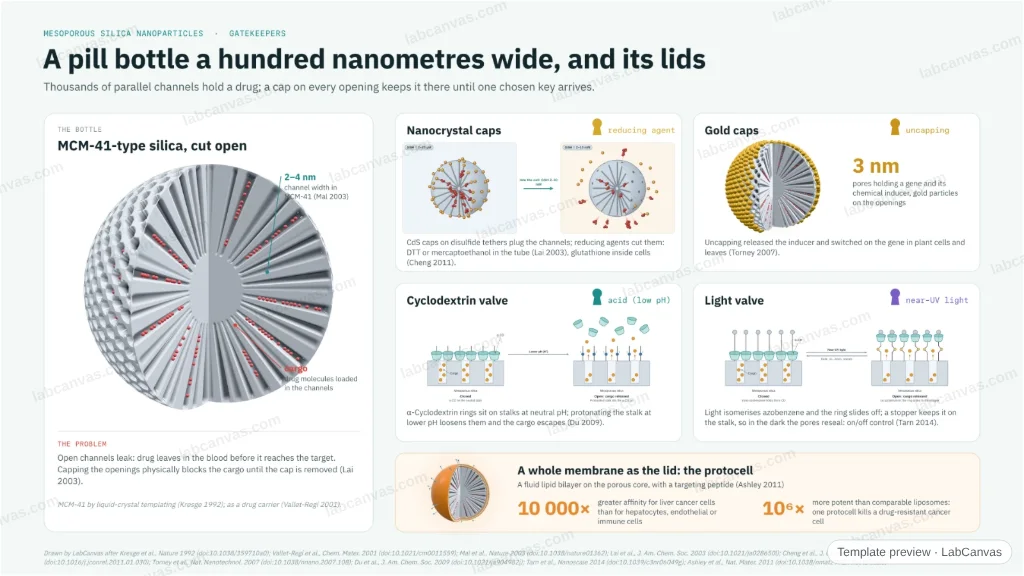
A mesoporous silica nanoparticle is a pill bottle with thousands of 2–4 nm channels; the trick is the lid. Cadmium sulfide caps on disulfide tethers come off with a reducing agent, gold caps let plant cells receive a gene and its inducer, cyclodextrin valves open in acid, an azobenzene valve opens under near-UV light and reseals in the dark, and a lipid bilayer turns the particle into a protocell that targets cancer cells 10 000 times more tightly.
Updated 9 cited papers62 editable layers
At a glance
- Category
- Graphical abstracts
- Method
- Graphical abstract
- Starting materials
- MCM-41-type silica nanoparticles with ordered 2–4 nm channels, and caps: CdS or gold nanocrystals, cyclodextrin rings on stalks, lipid bilayers
- Product
- Silica carriers that hold their cargo until a chosen key opens the pores
- Key result
- Pores 2–4 nm (Mal et al. 2003), 3 nm (Torney et al. 2007); protocell affinity 10 000× and potency 10⁶× (Ashley et al. 2011)
- Figure
- 1920 × 1080 px (16:9), 62 editable layers, 3 generated objects
Step by step
- The bottleOrdered mesoporous silica by liquid-crystal templating (Kresge et al. 1992), proposed as a drug carrier (Vallet-Regí et al. 2001); channels 2–4 nm across (Mal et al. 2003)
- Nanocrystal capsCdS caps on disulfide tethers block vancomycin and ATP in the channels until DTT or mercaptoethanol cuts them (Lai et al. 2003)
- Gold caps3 nm pores holding a gene and its chemical inducer, capped with gold particles; uncapping triggered gene expression in plant cells (Torney et al. 2007)
- Molecular valvesα-Cyclodextrin on an anilino stalk opens when protonated at low pH (Du et al. 2009); an azobenzene valve opens under near-UV light and reseals as it relaxes (Tarn et al. 2014)
- A membrane lidProtocells: a lipid bilayer on the porous core; with a targeting peptide 10 000-fold higher affinity for liver cancer cells, 10⁶-fold more potent than liposomes (Ashley et al. 2011)
Uses
- Graphical abstracts on mesoporous silica carriers and gatekeepers
- Reviews of mechanized nanoparticles and nanovalves
- Teaching zero-premature-release design
Papers this template follows
- Kresge et al., “Ordered mesoporous molecular sieves synthesized by a liquid-crystal template mechanism”, Nature 1992. doi:10.1038/359710a0method origin
- Vallet-Regí et al., “A new property of MCM-41: drug delivery system”, Chem. Mater. 2001. doi:10.1021/cm0011559primary
- Mal, Fujiwara & Tanaka, “Photocontrolled reversible release of guest molecules from coumarin-modified mesoporous silica”, Nature 2003. doi:10.1038/nature01362primary
- Lai et al., “A mesoporous silica nanosphere-based carrier system with chemically removable CdS nanoparticle caps for stimuli-responsive controlled release of neurotransmitters and drug molecules”, J. Am. Chem. Soc. 2003. doi:10.1021/ja028650lprimary
- Cheng et al., “Glutathione-responsive nano-vehicles as a promising platform for targeted intracellular drug and gene delivery”, J. Control. Release 2011. doi:10.1016/j.jconrel.2011.01.030review
- Torney et al., “Mesoporous silica nanoparticles deliver DNA and chemicals into plants”, Nat. Nanotechnol. 2007. doi:10.1038/nnano.2007.108primary
- Du et al., “Controlled-access hollow mechanized silica nanocontainers”, J. Am. Chem. Soc. 2009. doi:10.1021/ja904982jprimary
- Tarn et al., “A reversible light-operated nanovalve on mesoporous silica nanoparticles”, Nanoscale 2014. doi:10.1039/c3nr06049gprimary
- Ashley et al., “The targeted delivery of multicomponent cargos to cancer cells by nanoporous particle-supported lipid bilayers”, Nat. Mater. 2011. doi:10.1038/nmat2992primary
Drawn by LabCanvas after Kresge et al., Nature 1992 (doi:10.1038/359710a0); Vallet-Regí et al., Chem. Mater. 2001 (doi:10.1021/cm0011559); Mal et al., Nature 2003 (doi:10.1038/nature01362); Lai et al., J. Am. Chem. Soc. 2003 (doi:10.1021/ja028650l); Cheng et al., J. Control. Release 2011 (doi:10.1016/j.jconrel.2011.01.030); Torney et al., Nat. Nanotechnol. 2007 (doi:10.1038/nnano.2007.108); Du et al., J. Am. Chem. Soc. 2009 (doi:10.1021/ja904982j); Tarn et al., Nanoscale 2014 (doi:10.1039/c3nr06049g); Ashley et al., Nat. Mater. 2011 (doi:10.1038/nmat2992). Not to scale.
How templates are written and checked: editorial guidelines.
Questions
What does the “Mesoporous silica with gatekeepers: capped pores for controlled release” template show?
A mesoporous silica nanoparticle is a pill bottle with thousands of 2–4 nm channels; the trick is the lid. Cadmium sulfide caps on disulfide tethers come off with a reducing agent, gold caps let plant cells receive a gene and its inducer, cyclodextrin valves open in acid, an azobenzene valve opens under near-UV light and reseals in the dark, and a lipid bilayer turns the particle into a protocell that targets cancer cells 10 000 times more tightly.
What are the steps shown in “Mesoporous silica with gatekeepers: capped pores for controlled release”?
1. The bottle: Ordered mesoporous silica by liquid-crystal templating (Kresge et al. 1992), proposed as a drug carrier (Vallet-Regí et al. 2001); channels 2–4 nm across (Mal et al. 2003). 2. Nanocrystal caps: CdS caps on disulfide tethers block vancomycin and ATP in the channels until DTT or mercaptoethanol cuts them (Lai et al. 2003). 3. Gold caps: 3 nm pores holding a gene and its chemical inducer, capped with gold particles; uncapping triggered gene expression in plant cells (Torney et al. 2007). 4. Molecular valves: α-Cyclodextrin on an anilino stalk opens when protonated at low pH (Du et al. 2009); an azobenzene valve opens under near-UV light and reseals as it relaxes (Tarn et al. 2014). 5. A membrane lid: Protocells: a lipid bilayer on the porous core; with a targeting peptide 10 000-fold higher affinity for liver cancer cells, 10⁶-fold more potent than liposomes (Ashley et al. 2011).
What are the starting materials and the product?
Starting materials: MCM-41-type silica nanoparticles with ordered 2–4 nm channels, and caps: CdS or gold nanocrystals, cyclodextrin rings on stalks, lipid bilayers. Product: Silica carriers that hold their cargo until a chosen key opens the pores.
Which papers is “Mesoporous silica with gatekeepers: capped pores for controlled release” based on?
Kresge et al., “Ordered mesoporous molecular sieves synthesized by a liquid-crystal template mechanism”, Nature 1992 (doi:10.1038/359710a0); Vallet-Regí et al., “A new property of MCM-41: drug delivery system”, Chem. Mater. 2001 (doi:10.1021/cm0011559); Mal, Fujiwara & Tanaka, “Photocontrolled reversible release of guest molecules from coumarin-modified mesoporous silica”, Nature 2003 (doi:10.1038/nature01362); Lai et al., “A mesoporous silica nanosphere-based carrier system with chemically removable CdS nanoparticle caps for stimuli-responsive controlled release of neurotransmitters and drug molecules”, J. Am. Chem. Soc. 2003 (doi:10.1021/ja028650l); Cheng et al., “Glutathione-responsive nano-vehicles as a promising platform for targeted intracellular drug and gene delivery”, J. Control. Release 2011 (doi:10.1016/j.jconrel.2011.01.030); Torney et al., “Mesoporous silica nanoparticles deliver DNA and chemicals into plants”, Nat. Nanotechnol. 2007 (doi:10.1038/nnano.2007.108); Du et al., “Controlled-access hollow mechanized silica nanocontainers”, J. Am. Chem. Soc. 2009 (doi:10.1021/ja904982j); Tarn et al., “A reversible light-operated nanovalve on mesoporous silica nanoparticles”, Nanoscale 2014 (doi:10.1039/c3nr06049g); Ashley et al., “The targeted delivery of multicomponent cargos to cancer cells by nanoporous particle-supported lipid bilayers”, Nat. Mater. 2011 (doi:10.1038/nmat2992).
Can I edit the “Mesoporous silica with gatekeepers: capped pores for controlled release” template?
Yes. Open it in the LabCanvas editor: all 62 layers are editable, including 3 generated objects (structures, plots, equipment) with their own settings. Change the text, colours and layout, then export PNG, TIFF or PDF at the width and DPI the journal asks for.
Do I need an account to use this template?
Not to view it here. To open and edit it, sign in to LabCanvas or create a free account (the free plan keeps up to 3 designs). Downloading the figure is part of LabCanvas Pro (US$19 a month or US$199 a year).





