Graphical abstract template · Graphical abstracts · Graphical abstract
Microemulsion synthesis: water droplets in oil as nanoreactors
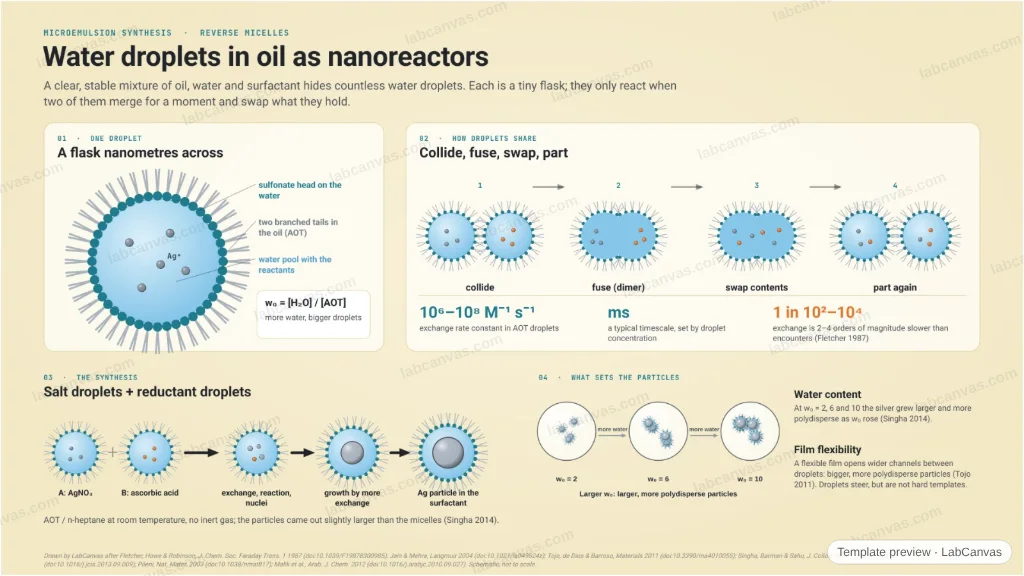
Reverse-micelle synthesis as a page of oil full of water droplets: one droplet opened as a reactor, with the water-to-surfactant ratio w₀ that sets its size; the collide–fuse–exchange–separate cycle that lets droplets share reactants on a millisecond timescale (k = 10⁶–10⁸ M⁻¹ s⁻¹, far below the encounter rate); and how mixing a salt microemulsion with a reductant microemulsion nucleates and grows particles inside the droplets, larger and more polydisperse at higher w₀ or with a more flexible film.
Updated 7 cited papers138 editable layers
At a glance
- Category
- Graphical abstracts
- Method
- Graphical abstract
- Starting materials
- Two AOT/n-heptane water-in-oil microemulsions, one holding AgNO₃, one holding ascorbic acid (Singha et al. 2014)
- Product
- Surfactant-capped nanoparticles grown inside the water droplets
- Key result
- k_ex = 10⁶–10⁸ dm³ mol⁻¹ s⁻¹, milliseconds (Fletcher et al. 1987); w₀ = 2, 6, 10 in AOT/n-heptane at room temperature (Singha et al. 2014)
- Figure
- 1920 × 1080 px (16:9), 138 editable layers, 1 generated objects
Step by step
- Droplets as reactorsWater droplets wrapped in surfactant float in oil; w₀ = [water]/[surfactant] sets their size (Singha et al. 2014); reverse micelles act as nanoreactors (Pileni 2003)
- Collide, fuse, swap, partDroplets exchange contents through transient dimers, k = 10⁶–10⁸ dm³ mol⁻¹ s⁻¹, two to four orders below the encounter rate, on a millisecond timescale (Fletcher et al. 1987)
- Mix two microemulsionsOne with the metal salt, one with the reductant: reaction, nucleation and growth proceed through intermicellar exchange (Jain & Mehra 2004)
- Tune the particlesHigher w₀ gives larger, more polydisperse silver (Singha et al. 2014); a more flexible film gives bigger, more polydisperse particles; droplets are not hard templates (Tojo et al. 2011)
Uses
- Graphical abstracts on microemulsion and reverse-micelle synthesis
- Teaching soft templates and droplet exchange kinetics
- Talks on nanoreactors for metals, oxides and core–shell particles
Papers this template follows
- Boutonnet, Kizling, Stenius & Maire, “The preparation of monodisperse colloidal metal particles from microemulsions”, Colloids Surf. 1982. doi:10.1016/0166-6622(82)80079-6method origin
- Fletcher, Howe & Robinson, “The kinetics of solubilisate exchange between water droplets of a water-in-oil microemulsion”, J. Chem. Soc., Faraday Trans. 1 1987. doi:10.1039/F19878300985primary
- Jain & Mehra, “Monte Carlo models for nanoparticle formation in two microemulsion systems”, Langmuir 2004. doi:10.1021/la049624zprimary
- Tojo, de Dios & Barroso, “Surfactant effects on microemulsion-based nanoparticle synthesis”, Materials 2011. doi:10.3390/ma4010055primary
- Singha, Barman & Sahu, “A facile synthesis of high optical quality silver nanoparticles by ascorbic acid reduction in reverse micelles at room temperature”, J. Colloid Interface Sci. 2014. doi:10.1016/j.jcis.2013.09.009primary
- Pileni, “The role of soft colloidal templates in controlling the size and shape of inorganic nanocrystals”, Nat. Mater. 2003. doi:10.1038/nmat817review
- Malik, Wani & Hashim, “Microemulsion method: a novel route to synthesize organic and inorganic nanomaterials”, Arab. J. Chem. 2012. doi:10.1016/j.arabjc.2010.09.027review
Drawn by LabCanvas after Fletcher, Howe & Robinson, J. Chem. Soc. Faraday Trans. 1 1987 (doi:10.1039/F19878300985); Jain & Mehra, Langmuir 2004 (doi:10.1021/la049624z); Tojo, de Dios & Barroso, Materials 2011 (doi:10.3390/ma4010055); Singha, Barman & Sahu, J. Colloid Interface Sci. 2014 (doi:10.1016/j.jcis.2013.09.009); Pileni, Nat. Mater. 2003 (doi:10.1038/nmat817); Malik et al., Arab. J. Chem. 2012 (doi:10.1016/j.arabjc.2010.09.027). Schematic, not to scale.
How templates are written and checked: editorial guidelines.
Questions
What does the “Microemulsion synthesis: water droplets in oil as nanoreactors” template show?
Reverse-micelle synthesis as a page of oil full of water droplets: one droplet opened as a reactor, with the water-to-surfactant ratio w₀ that sets its size; the collide–fuse–exchange–separate cycle that lets droplets share reactants on a millisecond timescale (k = 10⁶–10⁸ M⁻¹ s⁻¹, far below the encounter rate); and how mixing a salt microemulsion with a reductant microemulsion nucleates and grows particles inside the droplets, larger and more polydisperse at higher w₀ or with a more flexible film.
What are the steps shown in “Microemulsion synthesis: water droplets in oil as nanoreactors”?
1. Droplets as reactors: Water droplets wrapped in surfactant float in oil; w₀ = [water]/[surfactant] sets their size (Singha et al. 2014); reverse micelles act as nanoreactors (Pileni 2003). 2. Collide, fuse, swap, part: Droplets exchange contents through transient dimers, k = 10⁶–10⁸ dm³ mol⁻¹ s⁻¹, two to four orders below the encounter rate, on a millisecond timescale (Fletcher et al. 1987). 3. Mix two microemulsions: One with the metal salt, one with the reductant: reaction, nucleation and growth proceed through intermicellar exchange (Jain & Mehra 2004). 4. Tune the particles: Higher w₀ gives larger, more polydisperse silver (Singha et al. 2014); a more flexible film gives bigger, more polydisperse particles; droplets are not hard templates (Tojo et al. 2011).
What are the starting materials and the product?
Starting materials: Two AOT/n-heptane water-in-oil microemulsions, one holding AgNO₃, one holding ascorbic acid (Singha et al. 2014). Product: Surfactant-capped nanoparticles grown inside the water droplets.
Which papers is “Microemulsion synthesis: water droplets in oil as nanoreactors” based on?
Boutonnet, Kizling, Stenius & Maire, “The preparation of monodisperse colloidal metal particles from microemulsions”, Colloids Surf. 1982 (doi:10.1016/0166-6622(82)80079-6); Fletcher, Howe & Robinson, “The kinetics of solubilisate exchange between water droplets of a water-in-oil microemulsion”, J. Chem. Soc., Faraday Trans. 1 1987 (doi:10.1039/F19878300985); Jain & Mehra, “Monte Carlo models for nanoparticle formation in two microemulsion systems”, Langmuir 2004 (doi:10.1021/la049624z); Tojo, de Dios & Barroso, “Surfactant effects on microemulsion-based nanoparticle synthesis”, Materials 2011 (doi:10.3390/ma4010055); Singha, Barman & Sahu, “A facile synthesis of high optical quality silver nanoparticles by ascorbic acid reduction in reverse micelles at room temperature”, J. Colloid Interface Sci. 2014 (doi:10.1016/j.jcis.2013.09.009); Pileni, “The role of soft colloidal templates in controlling the size and shape of inorganic nanocrystals”, Nat. Mater. 2003 (doi:10.1038/nmat817); Malik, Wani & Hashim, “Microemulsion method: a novel route to synthesize organic and inorganic nanomaterials”, Arab. J. Chem. 2012 (doi:10.1016/j.arabjc.2010.09.027).
Can I edit the “Microemulsion synthesis: water droplets in oil as nanoreactors” template?
Yes. Open it in the LabCanvas editor: all 138 layers are editable, including 1 generated objects (structures, plots, equipment) with their own settings. Change the text, colours and layout, then export PNG, TIFF or PDF at the width and DPI the journal asks for.
Do I need an account to use this template?
Not to view it here. To open and edit it, sign in to LabCanvas or create a free account (the free plan keeps up to 3 designs). Downloading the figure is part of LabCanvas Pro (US$19 a month or US$199 a year).





