Graphical abstract template · Graphical abstracts · Graphical abstract
MOF water harvesters: from the adsorbent to the device in the desert
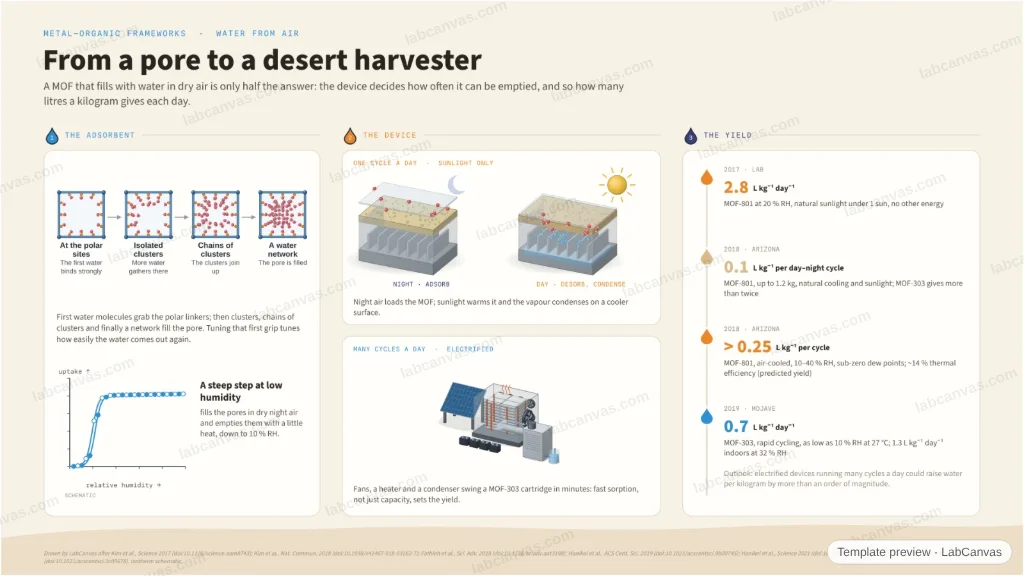
Three tiers follow a metal–organic framework from adsorbent to harvester: how water fills a MOF-303 pore and why an S-shaped isotherm works in dry air; passive solar boxes that run one cycle a day and electrified harvesters that cycle in minutes; and the yields measured in the lab and the Arizona and Mojave deserts, from 0.1 to 1.3 L of water per kilogram of MOF per day, each with its humidity and temperature.
Updated 6 cited papers59 editable layers
At a glance
- Category
- Graphical abstracts
- Method
- Graphical abstract
- Starting materials
- Water-stable, microporous MOFs (MOF-801, aluminium MOF-303) as packed sorbent layers
- Product
- Liquid water from desert air in passive solar and rapid-cycling harvesters
- Key result
- 0.7 L kg⁻¹ day⁻¹ at 10 % RH in the Mojave and 1.3 L kg⁻¹ day⁻¹ indoors (Hanikel et al. 2019); 100 g kg⁻¹ per cycle in Arizona (Fathieh et al. 2018); ~14 % thermal efficiency (Kim et al. 2018)
- Figure
- 1920 × 1080 px (16:9), 59 editable layers, 4 generated objects
Step by step
- The adsorbentIn MOF-303 the first water molecules bind polar linkers, then clusters, chains and a network form; multivariate pores tune binding and regeneration (Hanikel et al. 2021). MOFs trap water at RH as low as 10 % (Xu & Yaghi 2020)
- One cycle a dayNight air loads the MOF; sunlight releases the water to a condenser: 2.8 L kg⁻¹ day⁻¹ at 20 % RH with < 1 sun (Kim et al. 2017); in Arizona, 100 g kg⁻¹ per day–night cycle with MOF-801 and more than twice with MOF-303 (Fathieh et al. 2018); air-cooled, ~14 % thermal efficiency, > 0.25 L kg⁻¹ per cycle (Kim et al. 2018)
- Cycles in minutesMOF-303 adsorbs and desorbs within minutes under a mild temperature swing: 1.3 L kg⁻¹ day⁻¹ indoors (32 % RH, 27 °C) and 0.7 L kg⁻¹ day⁻¹ in the Mojave (down to 10 % RH) (Hanikel et al. 2019)
Uses
- Graphical abstracts on atmospheric water harvesting
- Talks on sorbent and device design for arid climates
- Teaching adsorption–desorption cycling and why kinetics matter
Papers this template follows
- Kim et al., “Water harvesting from air with metal-organic frameworks powered by natural sunlight”, Science 2017. doi:10.1126/science.aam8743method origin
- Kim et al., “Adsorption-based atmospheric water harvesting device for arid climates”, Nat. Commun. 2018. doi:10.1038/s41467-018-03162-7primary
- Fathieh et al., “Practical water production from desert air”, Sci. Adv. 2018. doi:10.1126/sciadv.aat3198primary
- Hanikel et al., “Rapid cycling and exceptional yield in a metal-organic framework water harvester”, ACS Cent. Sci. 2019. doi:10.1021/acscentsci.9b00745primary
- Hanikel et al., “Evolution of water structures in metal-organic frameworks for improved atmospheric water harvesting”, Science 2021. doi:10.1126/science.abj0890primary
- Xu & Yaghi, “Metal–organic frameworks for water harvesting from air, anywhere, anytime”, ACS Cent. Sci. 2020. doi:10.1021/acscentsci.0c00678review
Drawn by LabCanvas after Kim et al., Science 2017 (doi:10.1126/science.aam8743); Kim et al., Nat. Commun. 2018 (doi:10.1038/s41467-018-03162-7); Fathieh et al., Sci. Adv. 2018 (doi:10.1126/sciadv.aat3198); Hanikel et al., ACS Cent. Sci. 2019 (doi:10.1021/acscentsci.9b00745); Hanikel et al., Science 2021 (doi:10.1126/science.abj0890); Xu & Yaghi, ACS Cent. Sci. 2020 (doi:10.1021/acscentsci.0c00678). Isotherm schematic.
How templates are written and checked: editorial guidelines.
Questions
What does the “MOF water harvesters: from the adsorbent to the device in the desert” template show?
Three tiers follow a metal–organic framework from adsorbent to harvester: how water fills a MOF-303 pore and why an S-shaped isotherm works in dry air; passive solar boxes that run one cycle a day and electrified harvesters that cycle in minutes; and the yields measured in the lab and the Arizona and Mojave deserts, from 0.1 to 1.3 L of water per kilogram of MOF per day, each with its humidity and temperature.
What are the steps shown in “MOF water harvesters: from the adsorbent to the device in the desert”?
1. The adsorbent: In MOF-303 the first water molecules bind polar linkers, then clusters, chains and a network form; multivariate pores tune binding and regeneration (Hanikel et al. 2021). MOFs trap water at RH as low as 10 % (Xu & Yaghi 2020). 2. One cycle a day: Night air loads the MOF; sunlight releases the water to a condenser: 2.8 L kg⁻¹ day⁻¹ at 20 % RH with < 1 sun (Kim et al. 2017); in Arizona, 100 g kg⁻¹ per day–night cycle with MOF-801 and more than twice with MOF-303 (Fathieh et al. 2018); air-cooled, ~14 % thermal efficiency, > 0.25 L kg⁻¹ per cycle (Kim et al. 2018). 3. Cycles in minutes: MOF-303 adsorbs and desorbs within minutes under a mild temperature swing: 1.3 L kg⁻¹ day⁻¹ indoors (32 % RH, 27 °C) and 0.7 L kg⁻¹ day⁻¹ in the Mojave (down to 10 % RH) (Hanikel et al. 2019).
What are the starting materials and the product?
Starting materials: Water-stable, microporous MOFs (MOF-801, aluminium MOF-303) as packed sorbent layers. Product: Liquid water from desert air in passive solar and rapid-cycling harvesters.
Which papers is “MOF water harvesters: from the adsorbent to the device in the desert” based on?
Kim et al., “Water harvesting from air with metal-organic frameworks powered by natural sunlight”, Science 2017 (doi:10.1126/science.aam8743); Kim et al., “Adsorption-based atmospheric water harvesting device for arid climates”, Nat. Commun. 2018 (doi:10.1038/s41467-018-03162-7); Fathieh et al., “Practical water production from desert air”, Sci. Adv. 2018 (doi:10.1126/sciadv.aat3198); Hanikel et al., “Rapid cycling and exceptional yield in a metal-organic framework water harvester”, ACS Cent. Sci. 2019 (doi:10.1021/acscentsci.9b00745); Hanikel et al., “Evolution of water structures in metal-organic frameworks for improved atmospheric water harvesting”, Science 2021 (doi:10.1126/science.abj0890); Xu & Yaghi, “Metal–organic frameworks for water harvesting from air, anywhere, anytime”, ACS Cent. Sci. 2020 (doi:10.1021/acscentsci.0c00678).
Can I edit the “MOF water harvesters: from the adsorbent to the device in the desert” template?
Yes. Open it in the LabCanvas editor: all 59 layers are editable, including 4 generated objects (structures, plots, equipment) with their own settings. Change the text, colours and layout, then export PNG, TIFF or PDF at the width and DPI the journal asks for.
Do I need an account to use this template?
Not to view it here. To open and edit it, sign in to LabCanvas or create a free account (the free plan keeps up to 3 designs). Downloading the figure is part of LabCanvas Pro (US$19 a month or US$199 a year).





