Graphical abstract template · Graphical abstracts · Graphical abstract
MXene films: one stack of flakes that stores charge and blocks radiation
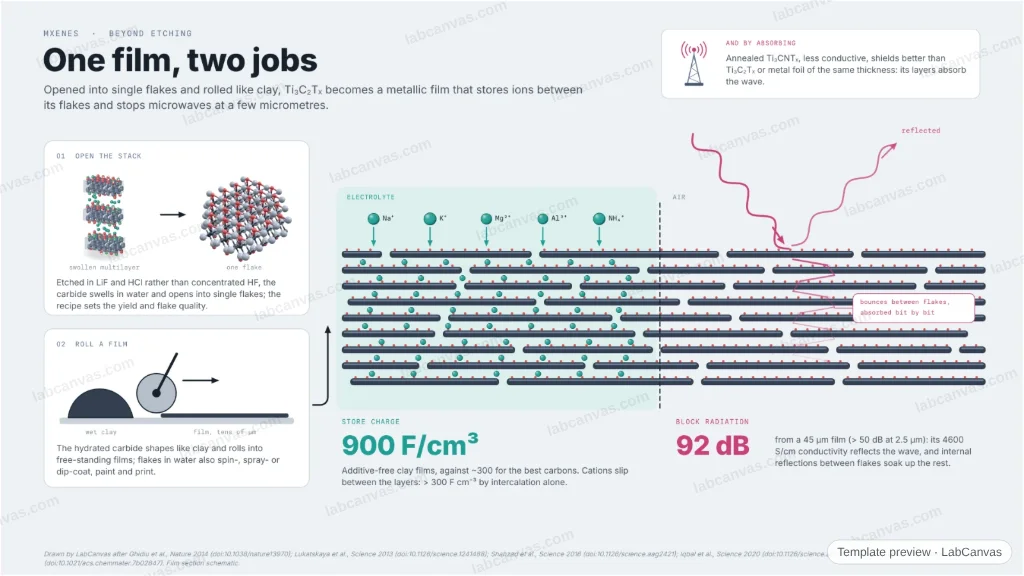
Beyond etching: Ti₃C₂Tₓ swells and opens into single flakes, and the wet clay rolls into films. A cross-section of one film shows its two jobs: in an electrolyte, cations slip between the flakes for up to 900 F cm⁻³; in air, a 45 µm film reflects and absorbs microwaves for 92 dB of shielding, with multiple internal reflections between flakes.
Updated 5 cited papers686 editable layers
At a glance
- Category
- Graphical abstracts
- Method
- Graphical abstract
- Starting materials
- Etched multilayer Ti₃C₂Tₓ (from Ti₃AlC₂ in LiF and HCl)
- Product
- Free-standing films of stacked Ti₃C₂Tₓ flakes for EMI shielding and charge storage
- Key result
- 900 F cm⁻³ clay films (Ghidiu et al. 2014); > 300 F cm⁻³ by cation intercalation (Lukatskaya et al. 2013); 92 dB at 45 µm, > 50 dB at 2.5 µm, 4600 S cm⁻¹ (Shahzad et al. 2016)
- Figure
- 1920 × 1080 px (16:9), 686 editable layers, 2 generated objects
Step by step
- Open the stackEtched in LiF and HCl instead of concentrated HF, the hydrophilic carbide swells in water (Ghidiu et al. 2014); the protocol sets the delamination yield and flake quality (Alhabeb et al. 2017)
- Roll a filmThe hydrated carbide shapes like clay and rolls into films tens of micrometres thick (Ghidiu et al. 2014); flakes also spin-, spray- or dip-coat, paint and print (Alhabeb et al. 2017)
- Store chargeCations (Na⁺, K⁺, NH₄⁺, Mg²⁺, Al³⁺) intercalate between the layers: > 300 F cm⁻³ (Lukatskaya et al. 2013); additive-free clay films reach 900 F cm⁻³ (Ghidiu et al. 2014)
- Block radiationA 45 µm film shields 92 dB (> 50 dB at 2.5 µm), from 4600 S cm⁻¹ conductivity and multiple internal reflections (Shahzad et al. 2016)
- Absorb insteadAnnealed Ti₃CNTₓ shields better than Ti₃C₂Tₓ or metal foil of the same thickness, by anomalous absorption (Iqbal et al. 2020)
Uses
- Graphical abstracts on MXene films, inks and devices
- Talks on EMI shielding and volumetric energy storage with 2D materials
- Teaching intercalation pseudocapacitance and shielding by reflection and absorption
Papers this template follows
- Ghidiu et al., “Conductive two-dimensional titanium carbide ‘clay’ with high volumetric capacitance”, Nature 2014. doi:10.1038/nature13970primary
- Lukatskaya et al., “Cation intercalation and high volumetric capacitance of two-dimensional titanium carbide”, Science 2013. doi:10.1126/science.1241488primary
- Shahzad et al., “Electromagnetic interference shielding with 2D transition metal carbides (MXenes)”, Science 2016. doi:10.1126/science.aag2421primary
- Iqbal et al., “Anomalous absorption of electromagnetic waves by 2D transition metal carbonitride Ti3CNTx (MXene)”, Science 2020. doi:10.1126/science.aba7977primary
- Alhabeb et al., “Guidelines for synthesis and processing of two-dimensional titanium carbide (Ti3C2Tx MXene)”, Chem. Mater. 2017. doi:10.1021/acs.chemmater.7b02847method origin
Drawn by LabCanvas after Ghidiu et al., Nature 2014 (doi:10.1038/nature13970); Lukatskaya et al., Science 2013 (doi:10.1126/science.1241488); Shahzad et al., Science 2016 (doi:10.1126/science.aag2421); Iqbal et al., Science 2020 (doi:10.1126/science.aba7977); Alhabeb et al., Chem. Mater. 2017 (doi:10.1021/acs.chemmater.7b02847). Film section schematic.
How templates are written and checked: editorial guidelines.
Questions
What does the “MXene films: one stack of flakes that stores charge and blocks radiation” template show?
Beyond etching: Ti₃C₂Tₓ swells and opens into single flakes, and the wet clay rolls into films. A cross-section of one film shows its two jobs: in an electrolyte, cations slip between the flakes for up to 900 F cm⁻³; in air, a 45 µm film reflects and absorbs microwaves for 92 dB of shielding, with multiple internal reflections between flakes.
What are the steps shown in “MXene films: one stack of flakes that stores charge and blocks radiation”?
1. Open the stack: Etched in LiF and HCl instead of concentrated HF, the hydrophilic carbide swells in water (Ghidiu et al. 2014); the protocol sets the delamination yield and flake quality (Alhabeb et al. 2017). 2. Roll a film: The hydrated carbide shapes like clay and rolls into films tens of micrometres thick (Ghidiu et al. 2014); flakes also spin-, spray- or dip-coat, paint and print (Alhabeb et al. 2017). 3. Store charge: Cations (Na⁺, K⁺, NH₄⁺, Mg²⁺, Al³⁺) intercalate between the layers: > 300 F cm⁻³ (Lukatskaya et al. 2013); additive-free clay films reach 900 F cm⁻³ (Ghidiu et al. 2014). 4. Block radiation: A 45 µm film shields 92 dB (> 50 dB at 2.5 µm), from 4600 S cm⁻¹ conductivity and multiple internal reflections (Shahzad et al. 2016). 5. Absorb instead: Annealed Ti₃CNTₓ shields better than Ti₃C₂Tₓ or metal foil of the same thickness, by anomalous absorption (Iqbal et al. 2020).
What are the starting materials and the product?
Starting materials: Etched multilayer Ti₃C₂Tₓ (from Ti₃AlC₂ in LiF and HCl). Product: Free-standing films of stacked Ti₃C₂Tₓ flakes for EMI shielding and charge storage.
Which papers is “MXene films: one stack of flakes that stores charge and blocks radiation” based on?
Ghidiu et al., “Conductive two-dimensional titanium carbide ‘clay’ with high volumetric capacitance”, Nature 2014 (doi:10.1038/nature13970); Lukatskaya et al., “Cation intercalation and high volumetric capacitance of two-dimensional titanium carbide”, Science 2013 (doi:10.1126/science.1241488); Shahzad et al., “Electromagnetic interference shielding with 2D transition metal carbides (MXenes)”, Science 2016 (doi:10.1126/science.aag2421); Iqbal et al., “Anomalous absorption of electromagnetic waves by 2D transition metal carbonitride Ti3CNTx (MXene)”, Science 2020 (doi:10.1126/science.aba7977); Alhabeb et al., “Guidelines for synthesis and processing of two-dimensional titanium carbide (Ti3C2Tx MXene)”, Chem. Mater. 2017 (doi:10.1021/acs.chemmater.7b02847).
Can I edit the “MXene films: one stack of flakes that stores charge and blocks radiation” template?
Yes. Open it in the LabCanvas editor: all 686 layers are editable, including 2 generated objects (structures, plots, equipment) with their own settings. Change the text, colours and layout, then export PNG, TIFF or PDF at the width and DPI the journal asks for.
Do I need an account to use this template?
Not to view it here. To open and edit it, sign in to LabCanvas or create a free account (the free plan keeps up to 3 designs). Downloading the figure is part of LabCanvas Pro (US$19 a month or US$199 a year).