Graphical abstract template · Graphical abstracts · Graphical abstract
Nanocrystal superlattices: a crystal made of crystals
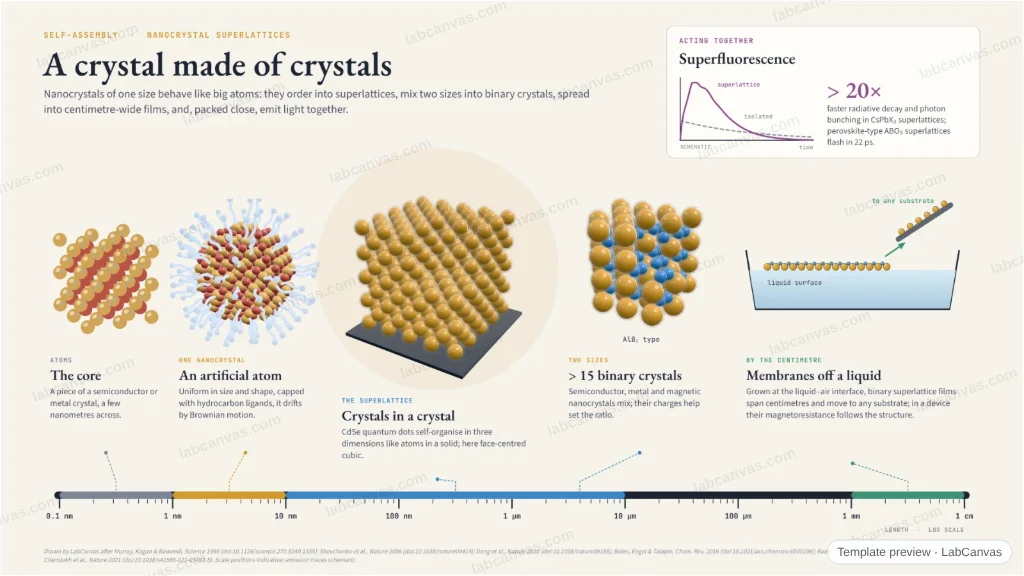
A graphical abstract laid out on a length ruler from 0.1 nm to 1 cm: atoms in a nanocrystal core, one ligand-capped nanocrystal, the face-centred cubic superlattice such crystals build, a binary AlB₂-type superlattice of two sizes, and a centimetre-wide superlattice membrane grown on a liquid surface. A card shows the payoff of order: perovskite nanocrystals in superlattices emit together (superfluorescence).
Updated 6 cited papers178 editable layers
At a glance
- Category
- Graphical abstracts
- Method
- Graphical abstract
- Starting materials
- Colloidal nanocrystals of uniform size and shape, capped with hydrocarbon ligands
- Product
- Ordered superlattices: single-component, binary and perovskite-type, and transferable membranes
- Key result
- > 15 binary superlattice structures (Shevchenko et al. 2006); centimetre-scale membranes (Dong et al. 2010); > 20-fold faster radiative decay (Rainò et al. 2018); 22 ps superfluorescence (Cherniukh et al. 2021)
- Figure
- 1920 × 1080 px (16:9), 178 editable layers, 1 generated objects
Step by step
- Artificial atomsColloidal nanocrystals of uniform size and shape are Brownian objects that readily order into superlattices (Boles et al. 2016)
- SuperlatticeCdSe nanocrystallites self-organise into three-dimensional quantum-dot superlattices (Murray et al. 1995)
- Two sizesMore than 15 binary superlattice structures from semiconducting, metallic and magnetic nanoparticles; charges on the particles set the stoichiometry (Shevchenko et al. 2006)
- MembranesAssembly at the liquid–air interface gives centimetre-scale binary superlattice membranes that transfer to any substrate; their magnetoresistance depends on the structure (Dong et al. 2010)
- Acting togetherCsPbX₃ superlattices show superfluorescence, with more than 20-fold faster radiative decay and photon bunching (Rainò et al. 2018); perovskite-type ABO₃ superlattices emit 22 ps bursts (Cherniukh et al. 2021)
Uses
- Graphical abstracts on nanocrystal self-assembly and superlattices
- Talks on quantum-dot solids and nanocrystal metamaterials
- Teaching packing, binary crystal structures and collective optical effects
Papers this template follows
- Murray, Kagan & Bawendi, “Self-organization of CdSe nanocrystallites into three-dimensional quantum dot superlattices”, Science 1995. doi:10.1126/science.270.5240.1335method origin
- Shevchenko et al., “Structural diversity in binary nanoparticle superlattices”, Nature 2006. doi:10.1038/nature04414primary
- Dong et al., “Binary nanocrystal superlattice membranes self-assembled at the liquid–air interface”, Nature 2010. doi:10.1038/nature09188primary
- Boles, Engel & Talapin, “Self-assembly of colloidal nanocrystals: from intricate structures to functional materials”, Chem. Rev. 2016. doi:10.1021/acs.chemrev.6b00196review
- Rainò et al., “Superfluorescence from lead halide perovskite quantum dot superlattices”, Nature 2018. doi:10.1038/s41586-018-0683-0primary
- Cherniukh et al., “Perovskite-type superlattices from lead halide perovskite nanocubes”, Nature 2021. doi:10.1038/s41586-021-03492-5primary
Drawn by LabCanvas after Murray, Kagan & Bawendi, Science 1995 (doi:10.1126/science.270.5240.1335); Shevchenko et al., Nature 2006 (doi:10.1038/nature04414); Dong et al., Nature 2010 (doi:10.1038/nature09188); Boles, Engel & Talapin, Chem. Rev. 2016 (doi:10.1021/acs.chemrev.6b00196); Rainò et al., Nature 2018 (doi:10.1038/s41586-018-0683-0); Cherniukh et al., Nature 2021 (doi:10.1038/s41586-021-03492-5). Scale positions indicative; emission traces schematic.
How templates are written and checked: editorial guidelines.
Questions
What does the “Nanocrystal superlattices: a crystal made of crystals” template show?
A graphical abstract laid out on a length ruler from 0.1 nm to 1 cm: atoms in a nanocrystal core, one ligand-capped nanocrystal, the face-centred cubic superlattice such crystals build, a binary AlB₂-type superlattice of two sizes, and a centimetre-wide superlattice membrane grown on a liquid surface. A card shows the payoff of order: perovskite nanocrystals in superlattices emit together (superfluorescence).
What are the steps shown in “Nanocrystal superlattices: a crystal made of crystals”?
1. Artificial atoms: Colloidal nanocrystals of uniform size and shape are Brownian objects that readily order into superlattices (Boles et al. 2016). 2. Superlattice: CdSe nanocrystallites self-organise into three-dimensional quantum-dot superlattices (Murray et al. 1995). 3. Two sizes: More than 15 binary superlattice structures from semiconducting, metallic and magnetic nanoparticles; charges on the particles set the stoichiometry (Shevchenko et al. 2006). 4. Membranes: Assembly at the liquid–air interface gives centimetre-scale binary superlattice membranes that transfer to any substrate; their magnetoresistance depends on the structure (Dong et al. 2010). 5. Acting together: CsPbX₃ superlattices show superfluorescence, with more than 20-fold faster radiative decay and photon bunching (Rainò et al. 2018); perovskite-type ABO₃ superlattices emit 22 ps bursts (Cherniukh et al. 2021).
What are the starting materials and the product?
Starting materials: Colloidal nanocrystals of uniform size and shape, capped with hydrocarbon ligands. Product: Ordered superlattices: single-component, binary and perovskite-type, and transferable membranes.
Which papers is “Nanocrystal superlattices: a crystal made of crystals” based on?
Murray, Kagan & Bawendi, “Self-organization of CdSe nanocrystallites into three-dimensional quantum dot superlattices”, Science 1995 (doi:10.1126/science.270.5240.1335); Shevchenko et al., “Structural diversity in binary nanoparticle superlattices”, Nature 2006 (doi:10.1038/nature04414); Dong et al., “Binary nanocrystal superlattice membranes self-assembled at the liquid–air interface”, Nature 2010 (doi:10.1038/nature09188); Boles, Engel & Talapin, “Self-assembly of colloidal nanocrystals: from intricate structures to functional materials”, Chem. Rev. 2016 (doi:10.1021/acs.chemrev.6b00196); Rainò et al., “Superfluorescence from lead halide perovskite quantum dot superlattices”, Nature 2018 (doi:10.1038/s41586-018-0683-0); Cherniukh et al., “Perovskite-type superlattices from lead halide perovskite nanocubes”, Nature 2021 (doi:10.1038/s41586-021-03492-5).
Can I edit the “Nanocrystal superlattices: a crystal made of crystals” template?
Yes. Open it in the LabCanvas editor: all 178 layers are editable, including 1 generated objects (structures, plots, equipment) with their own settings. Change the text, colours and layout, then export PNG, TIFF or PDF at the width and DPI the journal asks for.
Do I need an account to use this template?
Not to view it here. To open and edit it, sign in to LabCanvas or create a free account (the free plan keeps up to 3 designs). Downloading the figure is part of LabCanvas Pro (US$19 a month or US$199 a year).