Graphical abstract template · Graphical abstracts · Graphical abstract
Nanoplastics in the environment: sources, fate and toxicity
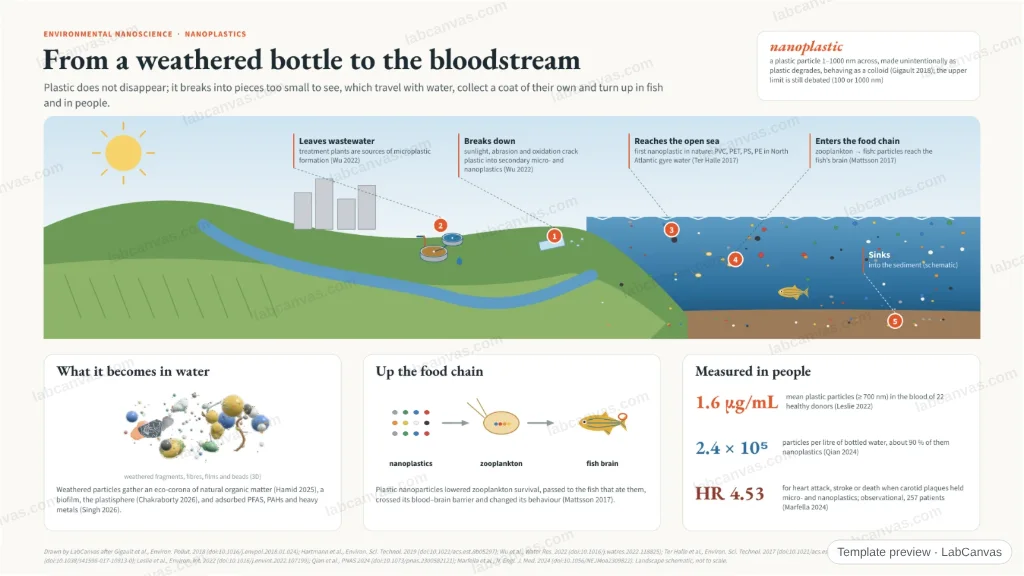
From a weathered bottle to the bloodstream: plastic breaks down into colloidal particles below a micrometre, leaves wastewater plants, reaches the open ocean (first found in the North Atlantic gyre), wears an eco-corona and a biofilm and climbs a food chain into a fish’s brain. In people: 1.6 µg/mL of plastic particles in blood, about 2.4 × 10⁵ particles per litre of bottled water (90 % nano), and a higher risk of heart attack, stroke or death when plaques contain them.
Updated 11 cited papers218 editable layers
At a glance
- Category
- Graphical abstracts
- Method
- Graphical abstract
- Starting materials
- Plastic objects (PE, PP, PET, PS, PVC) weathered by sunlight, abrasion and oxidation
- Product
- Colloidal plastic particles (1–1000 nm) in water, sediment, organisms and people
- Key result
- 1.6 µg/mL in blood (Leslie et al. 2022); 2.4 ± 1.3 × 10⁵ particles/L bottled water, ~90 % nano (Qian et al. 2024); HR 4.53 (Marfella et al. 2024)
- Figure
- 1920 × 1080 px (16:9), 218 editable layers, 3 generated objects
Step by step
- Made by breakdownNanoplastics: unintentionally produced, colloidal, 1–1000 nm (Gigault et al. 2018; framework of Hartmann et al. 2019); wastewater plants are sources, and weathering breaks particles into secondary micro- and nanoplastics (Wu et al. 2022)
- Carried to the seaThe first nanoplastic in nature: PVC, PET, PS and PE in the colloidal fraction of North Atlantic gyre seawater (Ter Halle et al. 2017)
- Transformed in waterAn eco-corona of natural organic matter (Hamid et al. 2025), a biofilm (Chakraborty 2026) and adsorbed PFAS, PAHs and metals (Singh et al. 2026)
- Up the food chainPlastic nanoparticles reduced zooplankton survival, passed to fish, crossed the blood–brain barrier and changed behaviour (Mattsson et al. 2017)
- In peopleMean 1.6 µg/mL of plastic particles ≥ 700 nm in blood of 22 donors (Leslie et al. 2022); ~2.4 × 10⁵ particles per litre of bottled water, ~90 % nano (Qian et al. 2024); plaques containing them: hazard ratio 4.53 for MI, stroke or death, observational (Marfella et al. 2024)
Uses
- Graphical abstracts on micro- and nanoplastic pollution
- Environmental chemistry and ecotoxicology talks
- Teaching the life cycle of plastic debris
Papers this template follows
- Gigault et al., “Current opinion: what is a nanoplastic?”, Environ. Pollut. 2018. doi:10.1016/j.envpol.2018.01.024review
- Hartmann et al., “Are we speaking the same language? Recommendations for a definition and categorization framework for plastic debris”, Environ. Sci. Technol. 2019. doi:10.1021/acs.est.8b05297review
- Wu et al., “Wastewater treatment plants act as essential sources of microplastic formation in aquatic environments: a critical review”, Water Res. 2022. doi:10.1016/j.watres.2022.118825review
- Ter Halle et al., “Nanoplastic in the North Atlantic subtropical gyre”, Environ. Sci. Technol. 2017. doi:10.1021/acs.est.7b03667primary
- Hamid et al., “Interactions between micro(nano)plastics and natural organic matter: implications for toxicity mitigation in aquatic species”, Aquat. Toxicol. 2025. doi:10.1016/j.aquatox.2025.107541review
- Chakraborty, “Biofouled micro- and nanoplastics as reactive platforms for potentially toxic element transformation”, Environ. Sci. Technol. 2026. doi:10.1021/acs.est.5c15116review
- Singh et al., “Chemical and biological cargo on microplastics: current evidence for the Trojan-horse pathway to human exposure”, Environ. Res. 2026. doi:10.1016/j.envres.2026.124996review
- Mattsson et al., “Brain damage and behavioural disorders in fish induced by plastic nanoparticles delivered through the food chain”, Sci. Rep. 2017. doi:10.1038/s41598-017-10813-0primary
- Leslie et al., “Discovery and quantification of plastic particle pollution in human blood”, Environ. Int. 2022. doi:10.1016/j.envint.2022.107199primary
- Qian et al., “Rapid single-particle chemical imaging of nanoplastics by SRS microscopy”, Proc. Natl. Acad. Sci. USA 2024. doi:10.1073/pnas.2300582121primary
- Marfella et al., “Microplastics and nanoplastics in atheromas and cardiovascular events”, N. Engl. J. Med. 2024. doi:10.1056/NEJMoa2309822primary
Drawn by LabCanvas after Gigault et al., Environ. Pollut. 2018 (doi:10.1016/j.envpol.2018.01.024); Hartmann et al., Environ. Sci. Technol. 2019 (doi:10.1021/acs.est.8b05297); Wu et al., Water Res. 2022 (doi:10.1016/j.watres.2022.118825); Ter Halle et al., Environ. Sci. Technol. 2017 (doi:10.1021/acs.est.7b03667); Mattsson et al., Sci. Rep. 2017 (doi:10.1038/s41598-017-10813-0); Leslie et al., Environ. Int. 2022 (doi:10.1016/j.envint.2022.107199); Qian et al., PNAS 2024 (doi:10.1073/pnas.2300582121); Marfella et al., N. Engl. J. Med. 2024 (doi:10.1056/NEJMoa2309822). Landscape schematic, not to scale.
How templates are written and checked: editorial guidelines.
Questions
What does the “Nanoplastics in the environment: sources, fate and toxicity” template show?
From a weathered bottle to the bloodstream: plastic breaks down into colloidal particles below a micrometre, leaves wastewater plants, reaches the open ocean (first found in the North Atlantic gyre), wears an eco-corona and a biofilm and climbs a food chain into a fish’s brain. In people: 1.6 µg/mL of plastic particles in blood, about 2.4 × 10⁵ particles per litre of bottled water (90 % nano), and a higher risk of heart attack, stroke or death when plaques contain them.
What are the steps shown in “Nanoplastics in the environment: sources, fate and toxicity”?
1. Made by breakdown: Nanoplastics: unintentionally produced, colloidal, 1–1000 nm (Gigault et al. 2018; framework of Hartmann et al. 2019); wastewater plants are sources, and weathering breaks particles into secondary micro- and nanoplastics (Wu et al. 2022). 2. Carried to the sea: The first nanoplastic in nature: PVC, PET, PS and PE in the colloidal fraction of North Atlantic gyre seawater (Ter Halle et al. 2017). 3. Transformed in water: An eco-corona of natural organic matter (Hamid et al. 2025), a biofilm (Chakraborty 2026) and adsorbed PFAS, PAHs and metals (Singh et al. 2026). 4. Up the food chain: Plastic nanoparticles reduced zooplankton survival, passed to fish, crossed the blood–brain barrier and changed behaviour (Mattsson et al. 2017). 5. In people: Mean 1.6 µg/mL of plastic particles ≥ 700 nm in blood of 22 donors (Leslie et al. 2022); ~2.4 × 10⁵ particles per litre of bottled water, ~90 % nano (Qian et al. 2024); plaques containing them: hazard ratio 4.53 for MI, stroke or death, observational (Marfella et al. 2024).
What are the starting materials and the product?
Starting materials: Plastic objects (PE, PP, PET, PS, PVC) weathered by sunlight, abrasion and oxidation. Product: Colloidal plastic particles (1–1000 nm) in water, sediment, organisms and people.
Which papers is “Nanoplastics in the environment: sources, fate and toxicity” based on?
Gigault et al., “Current opinion: what is a nanoplastic?”, Environ. Pollut. 2018 (doi:10.1016/j.envpol.2018.01.024); Hartmann et al., “Are we speaking the same language? Recommendations for a definition and categorization framework for plastic debris”, Environ. Sci. Technol. 2019 (doi:10.1021/acs.est.8b05297); Wu et al., “Wastewater treatment plants act as essential sources of microplastic formation in aquatic environments: a critical review”, Water Res. 2022 (doi:10.1016/j.watres.2022.118825); Ter Halle et al., “Nanoplastic in the North Atlantic subtropical gyre”, Environ. Sci. Technol. 2017 (doi:10.1021/acs.est.7b03667); Hamid et al., “Interactions between micro(nano)plastics and natural organic matter: implications for toxicity mitigation in aquatic species”, Aquat. Toxicol. 2025 (doi:10.1016/j.aquatox.2025.107541); Chakraborty, “Biofouled micro- and nanoplastics as reactive platforms for potentially toxic element transformation”, Environ. Sci. Technol. 2026 (doi:10.1021/acs.est.5c15116); Singh et al., “Chemical and biological cargo on microplastics: current evidence for the Trojan-horse pathway to human exposure”, Environ. Res. 2026 (doi:10.1016/j.envres.2026.124996); Mattsson et al., “Brain damage and behavioural disorders in fish induced by plastic nanoparticles delivered through the food chain”, Sci. Rep. 2017 (doi:10.1038/s41598-017-10813-0); Leslie et al., “Discovery and quantification of plastic particle pollution in human blood”, Environ. Int. 2022 (doi:10.1016/j.envint.2022.107199); Qian et al., “Rapid single-particle chemical imaging of nanoplastics by SRS microscopy”, Proc. Natl. Acad. Sci. USA 2024 (doi:10.1073/pnas.2300582121); Marfella et al., “Microplastics and nanoplastics in atheromas and cardiovascular events”, N. Engl. J. Med. 2024 (doi:10.1056/NEJMoa2309822).
Can I edit the “Nanoplastics in the environment: sources, fate and toxicity” template?
Yes. Open it in the LabCanvas editor: all 218 layers are editable, including 3 generated objects (structures, plots, equipment) with their own settings. Change the text, colours and layout, then export PNG, TIFF or PDF at the width and DPI the journal asks for.
Do I need an account to use this template?
Not to view it here. To open and edit it, sign in to LabCanvas or create a free account (the free plan keeps up to 3 designs). Downloading the figure is part of LabCanvas Pro (US$19 a month or US$199 a year).