Graphical abstract template · Graphical abstracts · Graphical abstract
Perovskite nanocrystals: hot injection, room-temperature reprecipitation and halide exchange
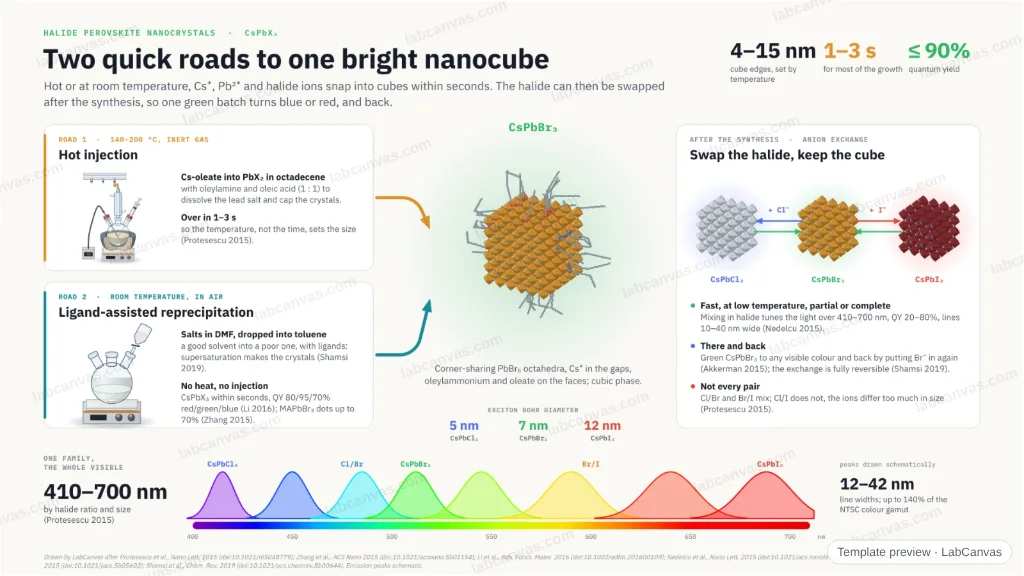
Two routes to the same bright CsPbX₃ nanocube: hot injection of Cs-oleate into lead halide at 140–200 °C, where growth is over within 1–3 s, and ligand-assisted reprecipitation, salts in DMF dropped into toluene in air at room temperature. The halide is then swapped after synthesis, reversibly, so one batch of green CsPbBr₃ becomes blue or red, and the family covers 410–700 nm with narrow lines and quantum yields up to 90%.
Updated 7 cited papers97 editable layers
At a glance
- Category
- Graphical abstracts
- Method
- Graphical abstract
- Starting materials
- Cs-oleate and PbX₂ in octadecene with oleylamine and oleic acid (hot injection); PbX₂ with CsX or MAX in DMF, dropped into toluene with ligands (LARP)
- Product
- Cubic CsPbX₃ nanocubes 4–15 nm across, emitting anywhere from 410 to 700 nm
- Key result
- 4–15 nm cubes, 410–700 nm, fwhm 12–42 nm, QY up to 90%, 140% of NTSC (Protesescu et al. 2015); QY up to 70% by LARP (Zhang et al. 2015); 80/95/70% red/green/blue at room temperature (Li et al. 2016)
- Figure
- 1920 × 1080 px (16:9), 97 editable layers, 6 generated objects
Step by step
- Hot injectionCs-oleate into PbX₂ in octadecene with oleylamine and oleic acid at 140–200 °C; most growth within 1–3 s, so the temperature sets the size, 4–15 nm (Protesescu et al. 2015)
- Reprecipitation (LARP)The salts in a good solvent (DMF) dropped into a poor one (toluene) with ligands, in air at room temperature, scalable to grams (Shamsi et al. 2019); MAPbX₃ dots with QY up to 70% (Zhang et al. 2015); CsPbX₃ within seconds (Li et al. 2016)
- The nanocubeCorner-sharing PbX₆ octahedra with Cs⁺ in the gaps, cubic phase, ligands on the faces; exciton Bohr diameters 5, 7 and 12 nm for Cl, Br and I (Protesescu et al. 2015)
- Swap the halideFast, low-temperature anion exchange tunes 410–700 nm with QY 20–80% and 10–40 nm line widths (Nedelcu et al. 2015), there and back (Akkerman et al. 2015); fully reversible (Shamsi et al. 2019)
Uses
- Graphical abstracts on halide perovskite nanocrystals
- Talks on colloidal synthesis routes and post-synthetic anion exchange
- Teaching quantum dots for displays and lighting
Papers this template follows
- Protesescu et al., “Nanocrystals of cesium lead halide perovskites (CsPbX₃, X = Cl, Br, and I): novel optoelectronic materials showing bright emission with wide color gamut”, Nano Lett. 2015. doi:10.1021/nl5048779method origin
- Zhang et al., “Brightly luminescent and color-tunable colloidal CH₃NH₃PbX₃ (X = Br, I, Cl) quantum dots: potential alternatives for display technology”, ACS Nano 2015. doi:10.1021/acsnano.5b01154method origin
- Li et al., “CsPbX₃ quantum dots for lighting and displays: room-temperature synthesis, photoluminescence superiorities, underlying origins and white light-emitting diodes”, Adv. Funct. Mater. 2016. doi:10.1002/adfm.201600109primary
- Nedelcu et al., “Fast anion-exchange in highly luminescent nanocrystals of cesium lead halide perovskites (CsPbX₃, X = Cl, Br, I)”, Nano Lett. 2015. doi:10.1021/acs.nanolett.5b02404primary
- Akkerman et al., “Tuning the optical properties of cesium lead halide perovskite nanocrystals by anion exchange reactions”, J. Am. Chem. Soc. 2015. doi:10.1021/jacs.5b05602primary
- Shamsi, Urban, Imran, De Trizio & Manna, “Metal halide perovskite nanocrystals: synthesis, post-synthesis modifications, and their optical properties”, Chem. Rev. 2019. doi:10.1021/acs.chemrev.8b00644review
- Kovalenko, Protesescu & Bodnarchuk, “Properties and potential optoelectronic applications of lead halide perovskite nanocrystals”, Science 2017. doi:10.1126/science.aam7093further reading
Drawn by LabCanvas after Protesescu et al., Nano Lett. 2015 (doi:10.1021/nl5048779); Zhang et al., ACS Nano 2015 (doi:10.1021/acsnano.5b01154); Li et al., Adv. Funct. Mater. 2016 (doi:10.1002/adfm.201600109); Nedelcu et al., Nano Lett. 2015 (doi:10.1021/acs.nanolett.5b02404); Akkerman et al., J. Am. Chem. Soc. 2015 (doi:10.1021/jacs.5b05602); Shamsi et al., Chem. Rev. 2019 (doi:10.1021/acs.chemrev.8b00644). Emission peaks schematic.
How templates are written and checked: editorial guidelines.
Questions
What does the “Perovskite nanocrystals: hot injection, room-temperature reprecipitation and halide exchange” template show?
Two routes to the same bright CsPbX₃ nanocube: hot injection of Cs-oleate into lead halide at 140–200 °C, where growth is over within 1–3 s, and ligand-assisted reprecipitation, salts in DMF dropped into toluene in air at room temperature. The halide is then swapped after synthesis, reversibly, so one batch of green CsPbBr₃ becomes blue or red, and the family covers 410–700 nm with narrow lines and quantum yields up to 90%.
What are the steps shown in “Perovskite nanocrystals: hot injection, room-temperature reprecipitation and halide exchange”?
1. Hot injection: Cs-oleate into PbX₂ in octadecene with oleylamine and oleic acid at 140–200 °C; most growth within 1–3 s, so the temperature sets the size, 4–15 nm (Protesescu et al. 2015). 2. Reprecipitation (LARP): The salts in a good solvent (DMF) dropped into a poor one (toluene) with ligands, in air at room temperature, scalable to grams (Shamsi et al. 2019); MAPbX₃ dots with QY up to 70% (Zhang et al. 2015); CsPbX₃ within seconds (Li et al. 2016). 3. The nanocube: Corner-sharing PbX₆ octahedra with Cs⁺ in the gaps, cubic phase, ligands on the faces; exciton Bohr diameters 5, 7 and 12 nm for Cl, Br and I (Protesescu et al. 2015). 4. Swap the halide: Fast, low-temperature anion exchange tunes 410–700 nm with QY 20–80% and 10–40 nm line widths (Nedelcu et al. 2015), there and back (Akkerman et al. 2015); fully reversible (Shamsi et al. 2019).
What are the starting materials and the product?
Starting materials: Cs-oleate and PbX₂ in octadecene with oleylamine and oleic acid (hot injection); PbX₂ with CsX or MAX in DMF, dropped into toluene with ligands (LARP). Product: Cubic CsPbX₃ nanocubes 4–15 nm across, emitting anywhere from 410 to 700 nm.
Which papers is “Perovskite nanocrystals: hot injection, room-temperature reprecipitation and halide exchange” based on?
Protesescu et al., “Nanocrystals of cesium lead halide perovskites (CsPbX₃, X = Cl, Br, and I): novel optoelectronic materials showing bright emission with wide color gamut”, Nano Lett. 2015 (doi:10.1021/nl5048779); Zhang et al., “Brightly luminescent and color-tunable colloidal CH₃NH₃PbX₃ (X = Br, I, Cl) quantum dots: potential alternatives for display technology”, ACS Nano 2015 (doi:10.1021/acsnano.5b01154); Li et al., “CsPbX₃ quantum dots for lighting and displays: room-temperature synthesis, photoluminescence superiorities, underlying origins and white light-emitting diodes”, Adv. Funct. Mater. 2016 (doi:10.1002/adfm.201600109); Nedelcu et al., “Fast anion-exchange in highly luminescent nanocrystals of cesium lead halide perovskites (CsPbX₃, X = Cl, Br, I)”, Nano Lett. 2015 (doi:10.1021/acs.nanolett.5b02404); Akkerman et al., “Tuning the optical properties of cesium lead halide perovskite nanocrystals by anion exchange reactions”, J. Am. Chem. Soc. 2015 (doi:10.1021/jacs.5b05602); Shamsi, Urban, Imran, De Trizio & Manna, “Metal halide perovskite nanocrystals: synthesis, post-synthesis modifications, and their optical properties”, Chem. Rev. 2019 (doi:10.1021/acs.chemrev.8b00644); Kovalenko, Protesescu & Bodnarchuk, “Properties and potential optoelectronic applications of lead halide perovskite nanocrystals”, Science 2017 (doi:10.1126/science.aam7093).
Can I edit the “Perovskite nanocrystals: hot injection, room-temperature reprecipitation and halide exchange” template?
Yes. Open it in the LabCanvas editor: all 97 layers are editable, including 6 generated objects (structures, plots, equipment) with their own settings. Change the text, colours and layout, then export PNG, TIFF or PDF at the width and DPI the journal asks for.
Do I need an account to use this template?
Not to view it here. To open and edit it, sign in to LabCanvas or create a free account (the free plan keeps up to 3 designs). Downloading the figure is part of LabCanvas Pro (US$19 a month or US$199 a year).