Graphical abstract template · Graphical abstracts · Graphical abstract
Perovskite solar-cell stability: ion migration, interfaces and encapsulation
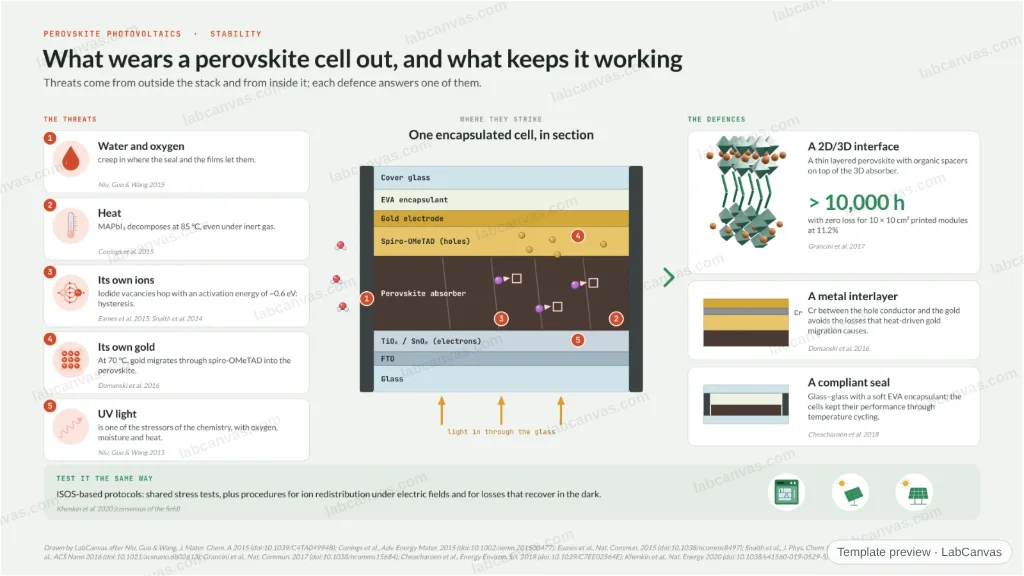
What degrades a perovskite solar cell and what protects it. Water, oxygen, UV light and heat attack from outside — methylammonium lead iodide decomposes at 85 °C even under inert gas — while iodide vacancies migrate inside the absorber (activation energy about 0.6 eV) and gold creeps through the hole conductor at 70 °C. A 2D/3D perovskite interface kept printed modules unchanged for more than 10,000 h, a chromium interlayer stops the gold, a compliant encapsulant survives temperature cycling, and ISOS protocols make the tests comparable.
Updated 8 cited papers137 editable layers
At a glance
- Category
- Graphical abstracts
- Method
- Graphical abstract
- Starting materials
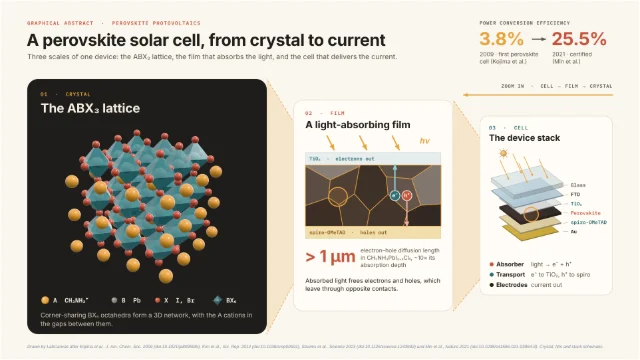
- A perovskite solar cell: glass/FTO, an electron contact, the perovskite, spiro-OMeTAD and gold
- Product
- A cell that keeps its efficiency under light, heat and humidity
- Key result
- Decomposition at 85 °C in inert atmosphere (Conings et al. 2015); iodide migration Ea 0.6 eV (Eames et al. 2015); Au migration at 70 °C (Domanski et al. 2016); > 10,000 h, 11.2% modules (Grancini et al. 2017)
- Figure
- 1920 × 1080 px (16:9), 137 editable layers, 8 generated objects
Step by step
- Threats from outsideOxygen and moisture, UV light and temperature (Niu et al. 2015); MAPbI₃ decomposes at 85 °C even in inert atmosphere (Conings et al. 2015)
- Threats from insideIodide vacancies migrate with an activation energy of 0.6 eV, a source of hysteresis (Eames et al. 2015; Snaith et al. 2014); gold diffuses through spiro-MeOTAD at 70 °C (Domanski et al. 2016)
- Engineer the interfaceA 2D/3D perovskite junction: 10 × 10 cm² modules stable > 10,000 h with zero loss (Grancini et al. 2017)
- Block the metalA Cr interlayer between hole conductor and gold avoids the heat-induced irreversible losses (Domanski et al. 2016)
- Seal itA compliant EVA encapsulant keeps performance through temperature cycling (Cheacharoen et al. 2018)
- Test it alikeISOS-based protocols, with procedures for ion redistribution and reversible degradation (Khenkin et al. 2020)
Uses
- Graphical abstracts on perovskite stability and degradation
- Talks on encapsulation and interface engineering
- Teaching why perovskite cells degrade
Papers this template follows
- Niu, Guo & Wang, “Review of recent progress in chemical stability of perovskite solar cells”, J. Mater. Chem. A 2015. doi:10.1039/C4TA04994Breview
- Conings et al., “Intrinsic thermal instability of methylammonium lead trihalide perovskite”, Adv. Energy Mater. 2015. doi:10.1002/aenm.201500477primary
- Eames, Frost, Barnes, O’Regan, Walsh & Islam, “Ionic transport in hybrid lead iodide perovskite solar cells”, Nat. Commun. 2015. doi:10.1038/ncomms8497primary
- Snaith et al., “Anomalous hysteresis in perovskite solar cells”, J. Phys. Chem. Lett. 2014. doi:10.1021/jz500113xprimary
- Domanski et al., “Not all that glitters is gold: metal-migration-induced degradation in perovskite solar cells”, ACS Nano 2016. doi:10.1021/acsnano.6b02613primary
- Grancini et al., “One-year stable perovskite solar cells by 2D/3D interface engineering”, Nat. Commun. 2017. doi:10.1038/ncomms15684primary
- Cheacharoen, Rolston, Harwood, Bush, Dauskardt & McGehee, “Design and understanding of encapsulated perovskite solar cells to withstand temperature cycling”, Energy Environ. Sci. 2018. doi:10.1039/C7EE02564Eprimary
- Khenkin et al., “Consensus statement for stability assessment and reporting for perovskite photovoltaics based on ISOS procedures”, Nat. Energy 2020. doi:10.1038/s41560-019-0529-5review
Drawn by LabCanvas after Niu, Guo & Wang, J. Mater. Chem. A 2015 (doi:10.1039/C4TA04994B); Conings et al., Adv. Energy Mater. 2015 (doi:10.1002/aenm.201500477); Eames et al., Nat. Commun. 2015 (doi:10.1038/ncomms8497); Snaith et al., J. Phys. Chem. Lett. 2014 (doi:10.1021/jz500113x); Domanski et al., ACS Nano 2016 (doi:10.1021/acsnano.6b02613); Grancini et al., Nat. Commun. 2017 (doi:10.1038/ncomms15684); Cheacharoen et al., Energy Environ. Sci. 2018 (doi:10.1039/C7EE02564E); Khenkin et al., Nat. Energy 2020 (doi:10.1038/s41560-019-0529-5). Stack and markers schematic.
How templates are written and checked: editorial guidelines.
Questions
What does the “Perovskite solar-cell stability: ion migration, interfaces and encapsulation” template show?
What degrades a perovskite solar cell and what protects it. Water, oxygen, UV light and heat attack from outside — methylammonium lead iodide decomposes at 85 °C even under inert gas — while iodide vacancies migrate inside the absorber (activation energy about 0.6 eV) and gold creeps through the hole conductor at 70 °C. A 2D/3D perovskite interface kept printed modules unchanged for more than 10,000 h, a chromium interlayer stops the gold, a compliant encapsulant survives temperature cycling, and ISOS protocols make the tests comparable.
What are the steps shown in “Perovskite solar-cell stability: ion migration, interfaces and encapsulation”?
1. Threats from outside: Oxygen and moisture, UV light and temperature (Niu et al. 2015); MAPbI₃ decomposes at 85 °C even in inert atmosphere (Conings et al. 2015). 2. Threats from inside: Iodide vacancies migrate with an activation energy of 0.6 eV, a source of hysteresis (Eames et al. 2015; Snaith et al. 2014); gold diffuses through spiro-MeOTAD at 70 °C (Domanski et al. 2016). 3. Engineer the interface: A 2D/3D perovskite junction: 10 × 10 cm² modules stable > 10,000 h with zero loss (Grancini et al. 2017). 4. Block the metal: A Cr interlayer between hole conductor and gold avoids the heat-induced irreversible losses (Domanski et al. 2016). 5. Seal it: A compliant EVA encapsulant keeps performance through temperature cycling (Cheacharoen et al. 2018). 6. Test it alike: ISOS-based protocols, with procedures for ion redistribution and reversible degradation (Khenkin et al. 2020).
What are the starting materials and the product?
Starting materials: A perovskite solar cell: glass/FTO, an electron contact, the perovskite, spiro-OMeTAD and gold. Product: A cell that keeps its efficiency under light, heat and humidity.
Which papers is “Perovskite solar-cell stability: ion migration, interfaces and encapsulation” based on?
Niu, Guo & Wang, “Review of recent progress in chemical stability of perovskite solar cells”, J. Mater. Chem. A 2015 (doi:10.1039/C4TA04994B); Conings et al., “Intrinsic thermal instability of methylammonium lead trihalide perovskite”, Adv. Energy Mater. 2015 (doi:10.1002/aenm.201500477); Eames, Frost, Barnes, O’Regan, Walsh & Islam, “Ionic transport in hybrid lead iodide perovskite solar cells”, Nat. Commun. 2015 (doi:10.1038/ncomms8497); Snaith et al., “Anomalous hysteresis in perovskite solar cells”, J. Phys. Chem. Lett. 2014 (doi:10.1021/jz500113x); Domanski et al., “Not all that glitters is gold: metal-migration-induced degradation in perovskite solar cells”, ACS Nano 2016 (doi:10.1021/acsnano.6b02613); Grancini et al., “One-year stable perovskite solar cells by 2D/3D interface engineering”, Nat. Commun. 2017 (doi:10.1038/ncomms15684); Cheacharoen, Rolston, Harwood, Bush, Dauskardt & McGehee, “Design and understanding of encapsulated perovskite solar cells to withstand temperature cycling”, Energy Environ. Sci. 2018 (doi:10.1039/C7EE02564E); Khenkin et al., “Consensus statement for stability assessment and reporting for perovskite photovoltaics based on ISOS procedures”, Nat. Energy 2020 (doi:10.1038/s41560-019-0529-5).
Can I edit the “Perovskite solar-cell stability: ion migration, interfaces and encapsulation” template?
Yes. Open it in the LabCanvas editor: all 137 layers are editable, including 8 generated objects (structures, plots, equipment) with their own settings. Change the text, colours and layout, then export PNG, TIFF or PDF at the width and DPI the journal asks for.
Do I need an account to use this template?
Not to view it here. To open and edit it, sign in to LabCanvas or create a free account (the free plan keeps up to 3 designs). Downloading the figure is part of LabCanvas Pro (US$19 a month or US$199 a year).