Graphical abstract template · Graphical abstracts · Graphical abstract
Photocatalytic water splitting: band edges, cocatalysts and the Z-scheme
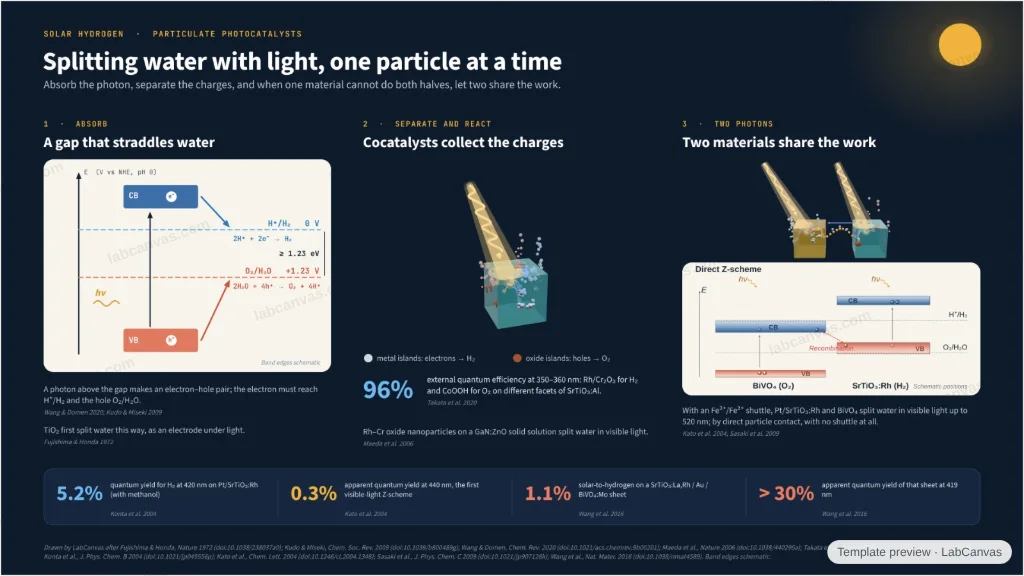
Particulate photocatalysts in three steps: a band gap whose edges straddle water’s two redox levels (at least 1.23 eV apart) absorbs the light; cocatalysts on different facets pull electrons to make H₂ and holes to make O₂ (96% external quantum efficiency in the UV on Al-doped SrTiO₃); and two visible-light absorbers coupled in a Z-scheme — SrTiO₃:Rh for hydrogen and BiVO₄ for oxygen — use two photons per electron, through an Fe³⁺/Fe²⁺ shuttle, by direct contact or through gold in a sheet with 1.1% solar-to-hydrogen efficiency.
Updated 9 cited papers73 editable layers
At a glance
- Category
- Graphical abstracts
- Method
- Graphical abstract
- Starting materials
- Water, sunlight and a semiconductor powder carrying cocatalysts
- Product
- H₂ and O₂ in a 2 : 1 ratio
- Key result
- EQE up to 96% at 350–360 nm (Takata et al. 2020); QY 5.2% at 420 nm for H₂ on Pt/SrTiO₃:Rh (Konta et al. 2004); AQY 0.3% at 440 nm (Kato et al. 2004); STH 1.1%, AQY > 30% at 419 nm (Wang et al. 2016); band edges schematic
- Figure
- 1920 × 1080 px (16:9), 73 editable layers, 1 generated objects
Step by step
- 1 · AbsorbPhotons above the band gap make electron–hole pairs (Wang & Domen 2020); the conduction band must lie above H⁺/H₂ (0 V) and the valence band below O₂/H₂O (+1.23 V vs NHE at pH 0)
- 2 · Separate and reactCocatalysts collect the carriers: Rh/Cr₂O₃ for H₂ and CoOOH for O₂ on different facets of SrTiO₃:Al gave up to 96% external quantum efficiency at 350–360 nm (Takata et al. 2020); Rh–Cr oxide on GaN:ZnO worked in visible light (Maeda et al. 2006)
- 3 · Two photons: the Z-schemeSrTiO₃:Rh makes H₂ and BiVO₄ makes O₂: with an Fe³⁺/Fe²⁺ relay, 0.3% apparent quantum yield at 440 nm (Kato et al. 2004); by direct contact (Sasaki et al. 2009); through gold in a sheet, 1.1% solar-to-hydrogen (Wang et al. 2016)
Uses
- Graphical abstracts on photocatalysis and solar hydrogen
- Teaching band alignment and Z-schemes
- Talks on cocatalysts and charge separation
Papers this template follows
- Fujishima & Honda, “Electrochemical photolysis of water at a semiconductor electrode”, Nature 1972. doi:10.1038/238037a0primary
- Kudo & Miseki, “Heterogeneous photocatalyst materials for water splitting”, Chem. Soc. Rev. 2009. doi:10.1039/b800489greview
- Wang & Domen, “Particulate photocatalysts for light-driven water splitting: mechanisms, challenges, and design strategies”, Chem. Rev. 2020. doi:10.1021/acs.chemrev.9b00201review
- Maeda, Teramura, Lu, Takata, Saito, Inoue & Domen, “Photocatalyst releasing hydrogen from water”, Nature 2006. doi:10.1038/440295aprimary
- Takata et al., “Photocatalytic water splitting with a quantum efficiency of almost unity”, Nature 2020. doi:10.1038/s41586-020-2278-9primary
- Konta, Ishii, Kato & Kudo, “Photocatalytic activities of noble metal ion doped SrTiO₃ under visible light irradiation”, J. Phys. Chem. B 2004. doi:10.1021/jp049556pprimary
- Kato, Hori, Konta, Shimodaira & Kudo, “Construction of Z-scheme type heterogeneous photocatalysis systems for water splitting into H₂ and O₂ under visible light irradiation”, Chem. Lett. 2004. doi:10.1246/cl.2004.1348primary
- Sasaki, Nemoto, Saito & Kudo, “Solar water splitting using powdered photocatalysts driven by Z-schematic interparticle electron transfer without an electron mediator”, J. Phys. Chem. C 2009. doi:10.1021/jp907128kprimary
- Wang et al., “Scalable water splitting on particulate photocatalyst sheets with a solar-to-hydrogen energy conversion efficiency exceeding 1%”, Nat. Mater. 2016. doi:10.1038/nmat4589primary
Drawn by LabCanvas after Fujishima & Honda, Nature 1972 (doi:10.1038/238037a0); Kudo & Miseki, Chem. Soc. Rev. 2009 (doi:10.1039/b800489g); Wang & Domen, Chem. Rev. 2020 (doi:10.1021/acs.chemrev.9b00201); Maeda et al., Nature 2006 (doi:10.1038/440295a); Takata et al., Nature 2020 (doi:10.1038/s41586-020-2278-9); Konta et al., J. Phys. Chem. B 2004 (doi:10.1021/jp049556p); Kato et al., Chem. Lett. 2004 (doi:10.1246/cl.2004.1348); Sasaki et al., J. Phys. Chem. C 2009 (doi:10.1021/jp907128k); Wang et al., Nat. Mater. 2016 (doi:10.1038/nmat4589). Band edges schematic.
How templates are written and checked: editorial guidelines.
Questions
What does the “Photocatalytic water splitting: band edges, cocatalysts and the Z-scheme” template show?
Particulate photocatalysts in three steps: a band gap whose edges straddle water’s two redox levels (at least 1.23 eV apart) absorbs the light; cocatalysts on different facets pull electrons to make H₂ and holes to make O₂ (96% external quantum efficiency in the UV on Al-doped SrTiO₃); and two visible-light absorbers coupled in a Z-scheme — SrTiO₃:Rh for hydrogen and BiVO₄ for oxygen — use two photons per electron, through an Fe³⁺/Fe²⁺ shuttle, by direct contact or through gold in a sheet with 1.1% solar-to-hydrogen efficiency.
What are the steps shown in “Photocatalytic water splitting: band edges, cocatalysts and the Z-scheme”?
1. 1 · Absorb: Photons above the band gap make electron–hole pairs (Wang & Domen 2020); the conduction band must lie above H⁺/H₂ (0 V) and the valence band below O₂/H₂O (+1.23 V vs NHE at pH 0). 2. 2 · Separate and react: Cocatalysts collect the carriers: Rh/Cr₂O₃ for H₂ and CoOOH for O₂ on different facets of SrTiO₃:Al gave up to 96% external quantum efficiency at 350–360 nm (Takata et al. 2020); Rh–Cr oxide on GaN:ZnO worked in visible light (Maeda et al. 2006). 3. 3 · Two photons: the Z-scheme: SrTiO₃:Rh makes H₂ and BiVO₄ makes O₂: with an Fe³⁺/Fe²⁺ relay, 0.3% apparent quantum yield at 440 nm (Kato et al. 2004); by direct contact (Sasaki et al. 2009); through gold in a sheet, 1.1% solar-to-hydrogen (Wang et al. 2016).
What are the starting materials and the product?
Starting materials: Water, sunlight and a semiconductor powder carrying cocatalysts. Product: H₂ and O₂ in a 2 : 1 ratio.
Which papers is “Photocatalytic water splitting: band edges, cocatalysts and the Z-scheme” based on?
Fujishima & Honda, “Electrochemical photolysis of water at a semiconductor electrode”, Nature 1972 (doi:10.1038/238037a0); Kudo & Miseki, “Heterogeneous photocatalyst materials for water splitting”, Chem. Soc. Rev. 2009 (doi:10.1039/b800489g); Wang & Domen, “Particulate photocatalysts for light-driven water splitting: mechanisms, challenges, and design strategies”, Chem. Rev. 2020 (doi:10.1021/acs.chemrev.9b00201); Maeda, Teramura, Lu, Takata, Saito, Inoue & Domen, “Photocatalyst releasing hydrogen from water”, Nature 2006 (doi:10.1038/440295a); Takata et al., “Photocatalytic water splitting with a quantum efficiency of almost unity”, Nature 2020 (doi:10.1038/s41586-020-2278-9); Konta, Ishii, Kato & Kudo, “Photocatalytic activities of noble metal ion doped SrTiO₃ under visible light irradiation”, J. Phys. Chem. B 2004 (doi:10.1021/jp049556p); Kato, Hori, Konta, Shimodaira & Kudo, “Construction of Z-scheme type heterogeneous photocatalysis systems for water splitting into H₂ and O₂ under visible light irradiation”, Chem. Lett. 2004 (doi:10.1246/cl.2004.1348); Sasaki, Nemoto, Saito & Kudo, “Solar water splitting using powdered photocatalysts driven by Z-schematic interparticle electron transfer without an electron mediator”, J. Phys. Chem. C 2009 (doi:10.1021/jp907128k); Wang et al., “Scalable water splitting on particulate photocatalyst sheets with a solar-to-hydrogen energy conversion efficiency exceeding 1%”, Nat. Mater. 2016 (doi:10.1038/nmat4589).
Can I edit the “Photocatalytic water splitting: band edges, cocatalysts and the Z-scheme” template?
Yes. Open it in the LabCanvas editor: all 73 layers are editable, including 1 generated objects (structures, plots, equipment) with their own settings. Change the text, colours and layout, then export PNG, TIFF or PDF at the width and DPI the journal asks for.
Do I need an account to use this template?
Not to view it here. To open and edit it, sign in to LabCanvas or create a free account (the free plan keeps up to 3 designs). Downloading the figure is part of LabCanvas Pro (US$19 a month or US$199 a year).





