Graphical abstract template · Graphical abstracts · Graphical abstract
Polymer recycling: mechanical, chemical and enzymatic routes compared
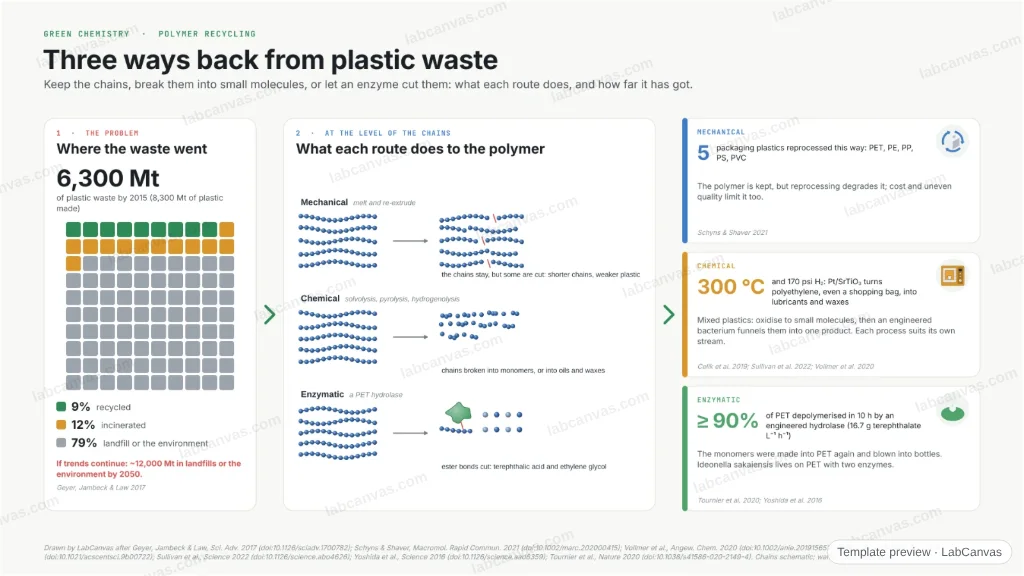
Of about 6,300 Mt of plastic waste made by 2015, 9% was recycled, 12% incinerated and 79% landfilled or left in the environment. Three ways to close the loop, seen at the level of the chains: melting and re-extruding keeps the polymer but degrades it; chemical routes break it into monomers or into oils and waxes (polyethylene to lubricants on Pt/SrTiO₃; mixed plastics oxidised and funnelled by a bacterium); and an engineered enzyme depolymerised at least 90% of PET in 10 hours, the monomers going back into bottles.
Updated 7 cited papers151 editable layers
At a glance
- Category
- Graphical abstracts
- Method
- Graphical abstract
- Starting materials
- Post-consumer plastic waste (PET, PE, PP, PS, PVC, mixtures)
- Product
- Recycled polymer, monomers, or oils and waxes
- Key result
- 9 / 12 / 79% of 6,300 Mt (Geyer et al. 2017); ≥ 90% in 10 h, 16.7 g L⁻¹ h⁻¹ (Tournier et al. 2020); 300 °C, 170 psi H₂ (Celik et al. 2019)
- Figure
- 1920 × 1080 px (16:9), 151 editable layers, 4 generated objects
Step by step
- The problem~6,300 Mt of plastic waste by 2015: ~9% recycled, 12% incinerated, 79% in landfills or the environment (Geyer et al. 2017)
- MechanicalMelt and re-extrude: the chains stay but degrade, with cost and uneven quality as further limits (Schyns & Shaver 2021)
- ChemicalBreak the chains: each process suits its own stream (Vollmer et al. 2020); polyethylene to lubricants and waxes on Pt/SrTiO₃ (Celik et al. 2019); mixed plastics oxidised then funnelled by P. putida (Sullivan et al. 2022)
- EnzymaticA PET hydrolase cuts the ester bonds: ≥ 90% depolymerisation in 10 h, monomers back into bottles (Tournier et al. 2020; Yoshida et al. 2016)
Uses
- Graphical abstracts on plastics recycling and the circular economy
- Teaching what recycling does to polymer chains
- Talks comparing mechanical, chemical and biological recycling
Papers this template follows
- Geyer, Jambeck & Law, “Production, use, and fate of all plastics ever made”, Sci. Adv. 2017. doi:10.1126/sciadv.1700782primary
- Schyns & Shaver, “Mechanical recycling of packaging plastics: a review”, Macromol. Rapid Commun. 2021. doi:10.1002/marc.202000415review
- Vollmer et al., “Beyond mechanical recycling: giving new life to plastic waste”, Angew. Chem. Int. Ed. 2020. doi:10.1002/anie.201915651review
- Celik et al., “Upcycling single-use polyethylene into high-quality liquid products”, ACS Cent. Sci. 2019. doi:10.1021/acscentsci.9b00722primary
- Sullivan et al., “Mixed plastics waste valorization through tandem chemical oxidation and biological funneling”, Science 2022. doi:10.1126/science.abo4626primary
- Yoshida et al., “A bacterium that degrades and assimilates poly(ethylene terephthalate)”, Science 2016. doi:10.1126/science.aad6359primary
- Tournier et al., “An engineered PET depolymerase to break down and recycle plastic bottles”, Nature 2020. doi:10.1038/s41586-020-2149-4primary
Drawn by LabCanvas after Geyer, Jambeck & Law, Sci. Adv. 2017 (doi:10.1126/sciadv.1700782); Schyns & Shaver, Macromol. Rapid Commun. 2021 (doi:10.1002/marc.202000415); Vollmer et al., Angew. Chem. 2020 (doi:10.1002/anie.201915651); Celik et al., ACS Cent. Sci. 2019 (doi:10.1021/acscentsci.9b00722); Sullivan et al., Science 2022 (doi:10.1126/science.abo4626); Yoshida et al., Science 2016 (doi:10.1126/science.aad6359); Tournier et al., Nature 2020 (doi:10.1038/s41586-020-2149-4). Chains schematic; waffle from Geyer et al.
How templates are written and checked: editorial guidelines.
Questions
What does the “Polymer recycling: mechanical, chemical and enzymatic routes compared” template show?
Of about 6,300 Mt of plastic waste made by 2015, 9% was recycled, 12% incinerated and 79% landfilled or left in the environment. Three ways to close the loop, seen at the level of the chains: melting and re-extruding keeps the polymer but degrades it; chemical routes break it into monomers or into oils and waxes (polyethylene to lubricants on Pt/SrTiO₃; mixed plastics oxidised and funnelled by a bacterium); and an engineered enzyme depolymerised at least 90% of PET in 10 hours, the monomers going back into bottles.
What are the steps shown in “Polymer recycling: mechanical, chemical and enzymatic routes compared”?
1. The problem: ~6,300 Mt of plastic waste by 2015: ~9% recycled, 12% incinerated, 79% in landfills or the environment (Geyer et al. 2017). 2. Mechanical: Melt and re-extrude: the chains stay but degrade, with cost and uneven quality as further limits (Schyns & Shaver 2021). 3. Chemical: Break the chains: each process suits its own stream (Vollmer et al. 2020); polyethylene to lubricants and waxes on Pt/SrTiO₃ (Celik et al. 2019); mixed plastics oxidised then funnelled by P. putida (Sullivan et al. 2022). 4. Enzymatic: A PET hydrolase cuts the ester bonds: ≥ 90% depolymerisation in 10 h, monomers back into bottles (Tournier et al. 2020; Yoshida et al. 2016).
What are the starting materials and the product?
Starting materials: Post-consumer plastic waste (PET, PE, PP, PS, PVC, mixtures). Product: Recycled polymer, monomers, or oils and waxes.
Which papers is “Polymer recycling: mechanical, chemical and enzymatic routes compared” based on?
Geyer, Jambeck & Law, “Production, use, and fate of all plastics ever made”, Sci. Adv. 2017 (doi:10.1126/sciadv.1700782); Schyns & Shaver, “Mechanical recycling of packaging plastics: a review”, Macromol. Rapid Commun. 2021 (doi:10.1002/marc.202000415); Vollmer et al., “Beyond mechanical recycling: giving new life to plastic waste”, Angew. Chem. Int. Ed. 2020 (doi:10.1002/anie.201915651); Celik et al., “Upcycling single-use polyethylene into high-quality liquid products”, ACS Cent. Sci. 2019 (doi:10.1021/acscentsci.9b00722); Sullivan et al., “Mixed plastics waste valorization through tandem chemical oxidation and biological funneling”, Science 2022 (doi:10.1126/science.abo4626); Yoshida et al., “A bacterium that degrades and assimilates poly(ethylene terephthalate)”, Science 2016 (doi:10.1126/science.aad6359); Tournier et al., “An engineered PET depolymerase to break down and recycle plastic bottles”, Nature 2020 (doi:10.1038/s41586-020-2149-4).
Can I edit the “Polymer recycling: mechanical, chemical and enzymatic routes compared” template?
Yes. Open it in the LabCanvas editor: all 151 layers are editable, including 4 generated objects (structures, plots, equipment) with their own settings. Change the text, colours and layout, then export PNG, TIFF or PDF at the width and DPI the journal asks for.
Do I need an account to use this template?
Not to view it here. To open and edit it, sign in to LabCanvas or create a free account (the free plan keeps up to 3 designs). Downloading the figure is part of LabCanvas Pro (US$19 a month or US$199 a year).