Graphical abstract template · Graphical abstracts · Graphical abstract
Polyol synthesis of silver: the seed decides between nanocubes and nanowires
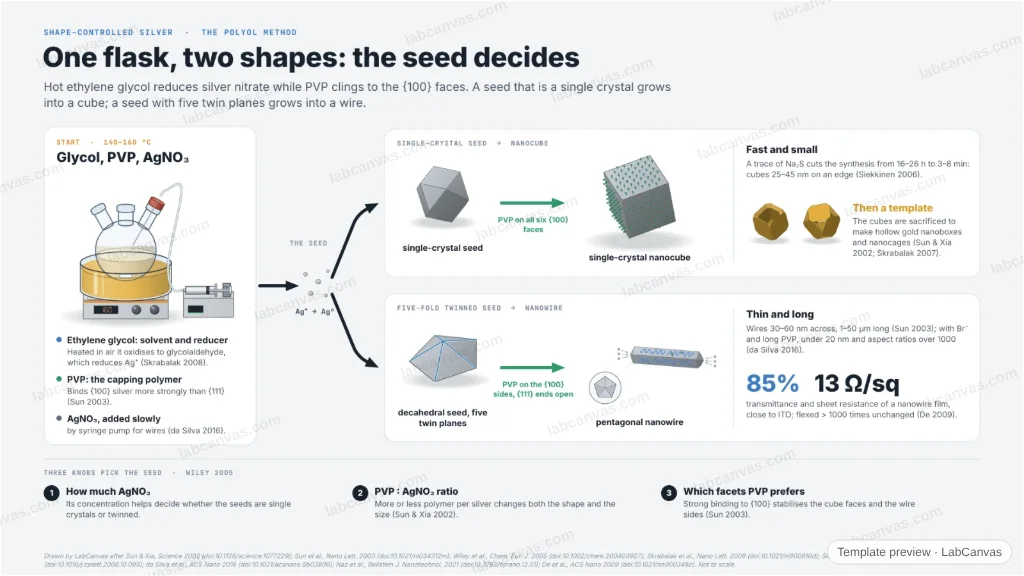
One flask of hot ethylene glycol, PVP and silver nitrate gives two very different products, and the seed decides which: a single-crystal seed grows into a nanocube with PVP on all its {100} faces, a five-fold twinned decahedron into a pentagonal nanowire whose {100} sides are capped while the {111} ends keep growing. Cubes go on to become templates for hollow gold; wires become flexible transparent electrodes at 85% transmittance and 13 Ω/sq.
Updated 9 cited papers71 editable layers
At a glance
- Category
- Graphical abstracts
- Method
- Graphical abstract
- Starting materials
- AgNO₃ in ethylene glycol with PVP (and a trace of Na₂S for cubes, or Cl⁻/Br⁻ for wires), at 140–160 °C
- Product
- Single-crystal silver nanocubes or penta-twinned silver nanowires
- Key result
- Wires 30–60 nm × 1–50 µm (Sun et al. 2003); < 20 nm, aspect > 1000 (da Silva et al. 2016); 25–45 nm cubes in 3–8 min (Siekkinen et al. 2006); films 85% T at 13 Ω/sq (De et al. 2009), 92.5% at ~20 Ω/sq on PET (Naz et al. 2021)
- Figure
- 1920 × 1080 px (16:9), 71 editable layers, 7 generated objects
Step by step
- Glycol reduces silverEthylene glycol heated in air oxidises to glycolaldehyde, which reduces Ag⁺ (Skrabalak et al. 2008); PVP caps the growing crystals
- The seed decidesAgNO₃ concentration, the PVP : AgNO₃ ratio and PVP–facet binding make seeds single crystals or decahedral twins; the seed and its PVP cover set the shape (Wiley et al. 2005)
- Single crystal → cubeMonodisperse single-crystal nanocubes (Sun & Xia 2002); a trace of Na₂S gives 25–45 nm cubes in 3–8 min instead of 16–26 h (Siekkinen et al. 2006)
- Twinned → wirePentagonal, five-fold twinned wires: PVP passivates the {100} sides, the {111} ends stay open (Sun et al. 2003); Br⁻ and PVP give sub-20 nm wires, aspect ratio > 1000 (da Silva et al. 2016)
- UsesCubes as sacrificial templates for gold nanoboxes and nanocages (Sun & Xia 2002; Skrabalak et al. 2007); wire films at 85% and 13 Ω/sq, close to ITO (De et al. 2009)
Uses
- Graphical abstracts on shape-controlled metal nanocrystals
- Teaching seeds, twinning and facet-selective capping
- Talks on silver-nanowire transparent electrodes
Papers this template follows
- Sun & Xia, “Shape-controlled synthesis of gold and silver nanoparticles”, Science 2002. doi:10.1126/science.1077229method origin
- Sun, Mayers, Herricks & Xia, “Polyol synthesis of uniform silver nanowires: a plausible growth mechanism and the supporting evidence”, Nano Lett. 2003. doi:10.1021/nl034312mprimary
- Wiley, Sun, Mayers & Xia, “Shape-controlled synthesis of metal nanostructures: the case of silver”, Chem. Eur. J. 2005. doi:10.1002/chem.200400927review
- Skrabalak, Wiley, Kim, Formo & Xia, “On the polyol synthesis of silver nanostructures: glycolaldehyde as a reducing agent”, Nano Lett. 2008. doi:10.1021/nl800910dprimary
- Siekkinen, McLellan, Chen & Xia, “Rapid synthesis of small silver nanocubes by mediating polyol reduction with a trace amount of sodium sulfide or sodium hydrosulfide”, Chem. Phys. Lett. 2006. doi:10.1016/j.cplett.2006.10.095primary
- Skrabalak, Au, Li & Xia, “Facile synthesis of Ag nanocubes and Au nanocages”, Nat. Protoc. 2007. doi:10.1038/nprot.2007.326primary
- da Silva et al., “Facile synthesis of sub-20 nm silver nanowires through a bromide-mediated polyol method”, ACS Nano 2016. doi:10.1021/acsnano.6b03806primary
- Naz et al., “High-yield synthesis of silver nanowires for transparent conducting PET films”, Beilstein J. Nanotechnol. 2021. doi:10.3762/bjnano.12.51primary
- De et al., “Silver nanowire networks as flexible, transparent, conducting films: extremely high DC to optical conductivity ratios”, ACS Nano 2009. doi:10.1021/nn900348cprimary
Drawn by LabCanvas after Sun & Xia, Science 2002 (doi:10.1126/science.1077229); Sun et al., Nano Lett. 2003 (doi:10.1021/nl034312m); Wiley et al., Chem. Eur. J. 2005 (doi:10.1002/chem.200400927); Skrabalak et al., Nano Lett. 2008 (doi:10.1021/nl800910d); Siekkinen et al., Chem. Phys. Lett. 2006 (doi:10.1016/j.cplett.2006.10.095); da Silva et al., ACS Nano 2016 (doi:10.1021/acsnano.6b03806); Naz et al., Beilstein J. Nanotechnol. 2021 (doi:10.3762/bjnano.12.51); De et al., ACS Nano 2009 (doi:10.1021/nn900348c). Not to scale.
How templates are written and checked: editorial guidelines.
Questions
What does the “Polyol synthesis of silver: the seed decides between nanocubes and nanowires” template show?
One flask of hot ethylene glycol, PVP and silver nitrate gives two very different products, and the seed decides which: a single-crystal seed grows into a nanocube with PVP on all its {100} faces, a five-fold twinned decahedron into a pentagonal nanowire whose {100} sides are capped while the {111} ends keep growing. Cubes go on to become templates for hollow gold; wires become flexible transparent electrodes at 85% transmittance and 13 Ω/sq.
What are the steps shown in “Polyol synthesis of silver: the seed decides between nanocubes and nanowires”?
1. Glycol reduces silver: Ethylene glycol heated in air oxidises to glycolaldehyde, which reduces Ag⁺ (Skrabalak et al. 2008); PVP caps the growing crystals. 2. The seed decides: AgNO₃ concentration, the PVP : AgNO₃ ratio and PVP–facet binding make seeds single crystals or decahedral twins; the seed and its PVP cover set the shape (Wiley et al. 2005). 3. Single crystal → cube: Monodisperse single-crystal nanocubes (Sun & Xia 2002); a trace of Na₂S gives 25–45 nm cubes in 3–8 min instead of 16–26 h (Siekkinen et al. 2006). 4. Twinned → wire: Pentagonal, five-fold twinned wires: PVP passivates the {100} sides, the {111} ends stay open (Sun et al. 2003); Br⁻ and PVP give sub-20 nm wires, aspect ratio > 1000 (da Silva et al. 2016). 5. Uses: Cubes as sacrificial templates for gold nanoboxes and nanocages (Sun & Xia 2002; Skrabalak et al. 2007); wire films at 85% and 13 Ω/sq, close to ITO (De et al. 2009).
What are the starting materials and the product?
Starting materials: AgNO₃ in ethylene glycol with PVP (and a trace of Na₂S for cubes, or Cl⁻/Br⁻ for wires), at 140–160 °C. Product: Single-crystal silver nanocubes or penta-twinned silver nanowires.
Which papers is “Polyol synthesis of silver: the seed decides between nanocubes and nanowires” based on?
Sun & Xia, “Shape-controlled synthesis of gold and silver nanoparticles”, Science 2002 (doi:10.1126/science.1077229); Sun, Mayers, Herricks & Xia, “Polyol synthesis of uniform silver nanowires: a plausible growth mechanism and the supporting evidence”, Nano Lett. 2003 (doi:10.1021/nl034312m); Wiley, Sun, Mayers & Xia, “Shape-controlled synthesis of metal nanostructures: the case of silver”, Chem. Eur. J. 2005 (doi:10.1002/chem.200400927); Skrabalak, Wiley, Kim, Formo & Xia, “On the polyol synthesis of silver nanostructures: glycolaldehyde as a reducing agent”, Nano Lett. 2008 (doi:10.1021/nl800910d); Siekkinen, McLellan, Chen & Xia, “Rapid synthesis of small silver nanocubes by mediating polyol reduction with a trace amount of sodium sulfide or sodium hydrosulfide”, Chem. Phys. Lett. 2006 (doi:10.1016/j.cplett.2006.10.095); Skrabalak, Au, Li & Xia, “Facile synthesis of Ag nanocubes and Au nanocages”, Nat. Protoc. 2007 (doi:10.1038/nprot.2007.326); da Silva et al., “Facile synthesis of sub-20 nm silver nanowires through a bromide-mediated polyol method”, ACS Nano 2016 (doi:10.1021/acsnano.6b03806); Naz et al., “High-yield synthesis of silver nanowires for transparent conducting PET films”, Beilstein J. Nanotechnol. 2021 (doi:10.3762/bjnano.12.51); De et al., “Silver nanowire networks as flexible, transparent, conducting films: extremely high DC to optical conductivity ratios”, ACS Nano 2009 (doi:10.1021/nn900348c).
Can I edit the “Polyol synthesis of silver: the seed decides between nanocubes and nanowires” template?
Yes. Open it in the LabCanvas editor: all 71 layers are editable, including 7 generated objects (structures, plots, equipment) with their own settings. Change the text, colours and layout, then export PNG, TIFF or PDF at the width and DPI the journal asks for.
Do I need an account to use this template?
Not to view it here. To open and edit it, sign in to LabCanvas or create a free account (the free plan keeps up to 3 designs). Downloading the figure is part of LabCanvas Pro (US$19 a month or US$199 a year).