Graphical abstract template · Graphical abstracts · Graphical abstract
Porous organic cages and HOFs: pores made of molecules
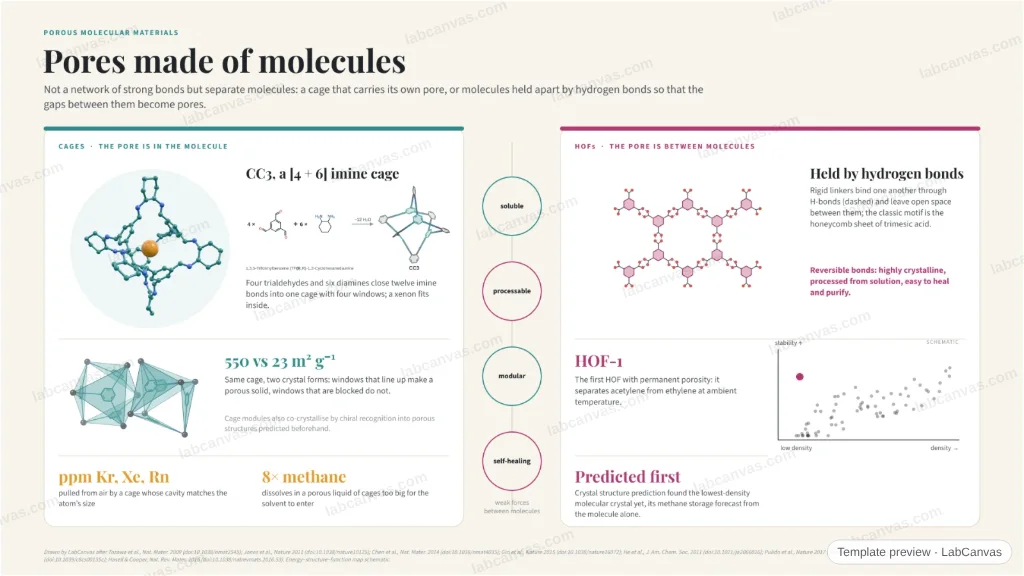
A diptych of porous molecular materials. Cages carry their pore inside one molecule (CC3 in 3D with a xenon guest, its [4 + 6] synthesis, cages meeting window to window): they sort krypton and xenon at parts per million, dissolve into porous liquids that hold eight times more methane, and mix like modules. Hydrogen-bonded organic frameworks make pores between molecules: the first permanently porous HOF separates acetylene from ethylene, and energy–structure–function maps predicted a record-low-density crystal. Between them: weak forces, so both dissolve, process and heal.
Updated 8 cited papers123 editable layers
At a glance
- Category
- Graphical abstracts
- Method
- Graphical abstract
- Starting materials
- Discrete organic molecules: imine cages from aldehydes and diamines, and rigid H-bonding linkers
- Product
- Porous molecular crystals and liquids: cage solids, porous liquids and HOFs
- Key result
- Polymorphs of 550 vs 23 m² g⁻¹ (Tozawa et al. 2009); ppm Kr/Xe/Rn capture (Chen et al. 2014); ~500× more empty cavities, 8× methane solubility (Giri et al. 2015)
- Figure
- 1920 × 1080 px (16:9), 123 editable layers, 3 generated objects
Step by step
- Pores inside a moleculeCovalent organic cages assemble into microporous crystals; window connectivity decides porous (550 m² g⁻¹) or non-porous (23 m² g⁻¹) polymorphs of one cage (Tozawa et al. 2009)
- Mix and predictCage modules co-crystallise by chiral recognition into predicted porous structures (Jones et al. 2011)
- Sort and flowA cage separates Kr, Xe and Rn from air at ppm levels by size match (Chen et al. 2014); dissolved cages make porous liquids with eightfold methane solubility (Giri et al. 2015)
- Pores between moleculesHOF-1, the first permanently porous HOF, separates C₂H₂ from C₂H₄ at ambient temperature (He et al. 2011); energy–structure–function maps found the lowest-density molecular crystal (Pulido et al. 2017)
- Weak bonds, easy processingReversible H-bonds give HOFs crystallinity, solution processability and easy healing (Lin et al. 2019); cages are soluble, modular, molecular pores (Hasell & Cooper 2016)
Uses
- Graphical abstracts on porous molecular materials
- Talks on organic cages, porous liquids and HOFs
- Teaching intrinsic versus extrinsic porosity
Papers this template follows
- Tozawa et al., “Porous organic cages”, Nat. Mater. 2009. doi:10.1038/nmat2545method origin
- Jones et al., “Modular and predictable assembly of porous organic molecular crystals”, Nature 2011. doi:10.1038/nature10125primary
- Chen et al., “Separation of rare gases and chiral molecules by selective binding in porous organic cages”, Nat. Mater. 2014. doi:10.1038/nmat4035primary
- Giri et al., “Liquids with permanent porosity”, Nature 2015. doi:10.1038/nature16072primary
- He et al., “A microporous hydrogen-bonded organic framework for highly selective C2H2/C2H4 separation at ambient temperature”, J. Am. Chem. Soc. 2011. doi:10.1021/ja2066016primary
- Pulido et al., “Functional materials discovery using energy–structure–function maps”, Nature 2017. doi:10.1038/nature21419primary
- Lin et al., “Multifunctional porous hydrogen-bonded organic framework materials”, Chem. Soc. Rev. 2019. doi:10.1039/c8cs00155creview
- Hasell & Cooper, “Porous organic cages: soluble, modular and molecular pores”, Nat. Rev. Mater. 2016. doi:10.1038/natrevmats.2016.53review
Drawn by LabCanvas after Tozawa et al., Nat. Mater. 2009 (doi:10.1038/nmat2545); Jones et al., Nature 2011 (doi:10.1038/nature10125); Chen et al., Nat. Mater. 2014 (doi:10.1038/nmat4035); Giri et al., Nature 2015 (doi:10.1038/nature16072); He et al., J. Am. Chem. Soc. 2011 (doi:10.1021/ja2066016); Pulido et al., Nature 2017 (doi:10.1038/nature21419); Lin et al., Chem. Soc. Rev. 2019 (doi:10.1039/c8cs00155c); Hasell & Cooper, Nat. Rev. Mater. 2016 (doi:10.1038/natrevmats.2016.53). Energy–structure–function map schematic.
How templates are written and checked: editorial guidelines.
Questions
What does the “Porous organic cages and HOFs: pores made of molecules” template show?
A diptych of porous molecular materials. Cages carry their pore inside one molecule (CC3 in 3D with a xenon guest, its [4 + 6] synthesis, cages meeting window to window): they sort krypton and xenon at parts per million, dissolve into porous liquids that hold eight times more methane, and mix like modules. Hydrogen-bonded organic frameworks make pores between molecules: the first permanently porous HOF separates acetylene from ethylene, and energy–structure–function maps predicted a record-low-density crystal. Between them: weak forces, so both dissolve, process and heal.
What are the steps shown in “Porous organic cages and HOFs: pores made of molecules”?
1. Pores inside a molecule: Covalent organic cages assemble into microporous crystals; window connectivity decides porous (550 m² g⁻¹) or non-porous (23 m² g⁻¹) polymorphs of one cage (Tozawa et al. 2009). 2. Mix and predict: Cage modules co-crystallise by chiral recognition into predicted porous structures (Jones et al. 2011). 3. Sort and flow: A cage separates Kr, Xe and Rn from air at ppm levels by size match (Chen et al. 2014); dissolved cages make porous liquids with eightfold methane solubility (Giri et al. 2015). 4. Pores between molecules: HOF-1, the first permanently porous HOF, separates C₂H₂ from C₂H₄ at ambient temperature (He et al. 2011); energy–structure–function maps found the lowest-density molecular crystal (Pulido et al. 2017). 5. Weak bonds, easy processing: Reversible H-bonds give HOFs crystallinity, solution processability and easy healing (Lin et al. 2019); cages are soluble, modular, molecular pores (Hasell & Cooper 2016).
What are the starting materials and the product?
Starting materials: Discrete organic molecules: imine cages from aldehydes and diamines, and rigid H-bonding linkers. Product: Porous molecular crystals and liquids: cage solids, porous liquids and HOFs.
Which papers is “Porous organic cages and HOFs: pores made of molecules” based on?
Tozawa et al., “Porous organic cages”, Nat. Mater. 2009 (doi:10.1038/nmat2545); Jones et al., “Modular and predictable assembly of porous organic molecular crystals”, Nature 2011 (doi:10.1038/nature10125); Chen et al., “Separation of rare gases and chiral molecules by selective binding in porous organic cages”, Nat. Mater. 2014 (doi:10.1038/nmat4035); Giri et al., “Liquids with permanent porosity”, Nature 2015 (doi:10.1038/nature16072); He et al., “A microporous hydrogen-bonded organic framework for highly selective C2H2/C2H4 separation at ambient temperature”, J. Am. Chem. Soc. 2011 (doi:10.1021/ja2066016); Pulido et al., “Functional materials discovery using energy–structure–function maps”, Nature 2017 (doi:10.1038/nature21419); Lin et al., “Multifunctional porous hydrogen-bonded organic framework materials”, Chem. Soc. Rev. 2019 (doi:10.1039/c8cs00155c); Hasell & Cooper, “Porous organic cages: soluble, modular and molecular pores”, Nat. Rev. Mater. 2016 (doi:10.1038/natrevmats.2016.53).
Can I edit the “Porous organic cages and HOFs: pores made of molecules” template?
Yes. Open it in the LabCanvas editor: all 123 layers are editable, including 3 generated objects (structures, plots, equipment) with their own settings. Change the text, colours and layout, then export PNG, TIFF or PDF at the width and DPI the journal asks for.
Do I need an account to use this template?
Not to view it here. To open and edit it, sign in to LabCanvas or create a free account (the free plan keeps up to 3 designs). Downloading the figure is part of LabCanvas Pro (US$19 a month or US$199 a year).