Graphical abstract template · Graphical abstracts · Graphical abstract
Quantum dots: the size sets the colour (quantum confinement and the Brus equation)
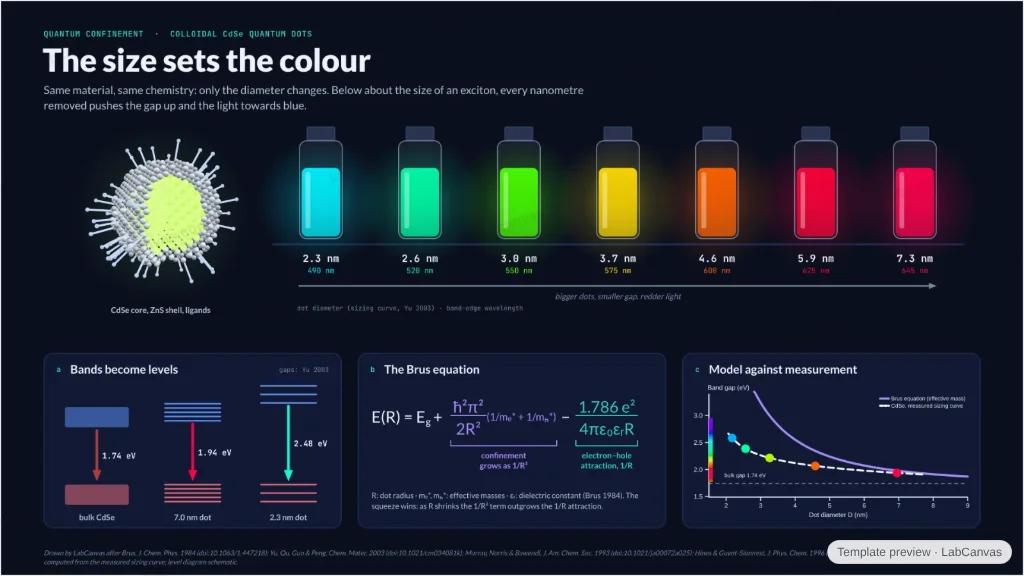
Seven vials of CdSe quantum dots glow from blue-green to red as the dots grow from 2.3 to 7.4 nm. Under them, why: squeezing an electron and hole into a crystal smaller than their natural orbit turns bands into discrete levels and widens the gap, the Brus equation adds a 1/R² confinement term and a 1/R attraction, and a plot sets the equation against the measured CdSe sizing curve.
Updated 4 cited papers161 editable layers
At a glance
- Category
- Graphical abstracts
- Method
- Graphical abstract
- Starting materials
- Colloidal CdSe nanocrystals (hot injection), optionally capped with ZnS
- Product
- Quantum dots whose band-edge colour is set by their diameter
- Key result
- Gap 2.48 eV at 2.3 nm and 1.94 eV at 7.0 nm, against 1.74 eV in bulk CdSe (sizing curve of Yu et al. 2003); Brus with bulk parameters gives 4.24 eV at 2.3 nm (computed)
- Figure
- 1920 × 1080 px (16:9), 161 editable layers
Step by step
- Bands become levelsIn a crystal smaller than the exciton, the electron and hole are confined: continuous bands split into discrete levels and the gap widens (Brus 1984)
- The Brus equationE(R) = E_g + ħ²π²/(2R²)(1/mₑ* + 1/mₕ*) − 1.786 e²/(4πε₀εᵣR): confinement as 1/R², attraction as 1/R (Brus 1984)
- Measured, not just modelledCdSe diameter against first exciton peak, D(λ) (Yu et al. 2003): 2.3 nm at 500 nm, 3.0 nm at 550 nm, 4.6 nm at 600 nm, 7.0 nm at 640 nm; the simple model overestimates the gap of the smallest dots
- Making themNearly monodisperse CdSe by hot injection (Murray et al. 1993); a ZnS shell for bright emission (Hines & Guyot-Sionnest 1996)
Uses
- Graphical abstracts on quantum dots and quantum confinement
- Teaching the particle in a box and the Brus equation
- Talks on colour-tunable emitters
Papers this template follows
- Brus, “Electron–electron and electron–hole interactions in small semiconductor crystallites: the size dependence of the lowest excited electronic state”, J. Chem. Phys. 1984. doi:10.1063/1.447218method origin
- Yu, Qu, Guo & Peng, “Experimental determination of the extinction coefficient of CdTe, CdSe, and CdS nanocrystals”, Chem. Mater. 2003. doi:10.1021/cm034081kprimary
- Murray, Norris & Bawendi, “Synthesis and characterization of nearly monodisperse CdE (E = S, Se, Te) semiconductor nanocrystallites”, J. Am. Chem. Soc. 1993. doi:10.1021/ja00072a025primary
- Hines & Guyot-Sionnest, “Synthesis and characterization of strongly luminescing ZnS-capped CdSe nanocrystals”, J. Phys. Chem. 1996. doi:10.1021/jp9530562primary
Drawn by LabCanvas after Brus, J. Chem. Phys. 1984 (doi:10.1063/1.447218); Yu, Qu, Guo & Peng, Chem. Mater. 2003 (doi:10.1021/cm034081k); Murray, Norris & Bawendi, J. Am. Chem. Soc. 1993 (doi:10.1021/ja00072a025); Hines & Guyot-Sionnest, J. Phys. Chem. 1996 (doi:10.1021/jp9530562). Sizes and colours computed from the measured sizing curve; level diagram schematic.
How templates are written and checked: editorial guidelines.
Questions
What does the “Quantum dots: the size sets the colour (quantum confinement and the Brus equation)” template show?
Seven vials of CdSe quantum dots glow from blue-green to red as the dots grow from 2.3 to 7.4 nm. Under them, why: squeezing an electron and hole into a crystal smaller than their natural orbit turns bands into discrete levels and widens the gap, the Brus equation adds a 1/R² confinement term and a 1/R attraction, and a plot sets the equation against the measured CdSe sizing curve.
What are the steps shown in “Quantum dots: the size sets the colour (quantum confinement and the Brus equation)”?
1. Bands become levels: In a crystal smaller than the exciton, the electron and hole are confined: continuous bands split into discrete levels and the gap widens (Brus 1984). 2. The Brus equation: E(R) = E_g + ħ²π²/(2R²)(1/mₑ* + 1/mₕ*) − 1.786 e²/(4πε₀εᵣR): confinement as 1/R², attraction as 1/R (Brus 1984). 3. Measured, not just modelled: CdSe diameter against first exciton peak, D(λ) (Yu et al. 2003): 2.3 nm at 500 nm, 3.0 nm at 550 nm, 4.6 nm at 600 nm, 7.0 nm at 640 nm; the simple model overestimates the gap of the smallest dots. 4. Making them: Nearly monodisperse CdSe by hot injection (Murray et al. 1993); a ZnS shell for bright emission (Hines & Guyot-Sionnest 1996).
What are the starting materials and the product?
Starting materials: Colloidal CdSe nanocrystals (hot injection), optionally capped with ZnS. Product: Quantum dots whose band-edge colour is set by their diameter.
Which papers is “Quantum dots: the size sets the colour (quantum confinement and the Brus equation)” based on?
Brus, “Electron–electron and electron–hole interactions in small semiconductor crystallites: the size dependence of the lowest excited electronic state”, J. Chem. Phys. 1984 (doi:10.1063/1.447218); Yu, Qu, Guo & Peng, “Experimental determination of the extinction coefficient of CdTe, CdSe, and CdS nanocrystals”, Chem. Mater. 2003 (doi:10.1021/cm034081k); Murray, Norris & Bawendi, “Synthesis and characterization of nearly monodisperse CdE (E = S, Se, Te) semiconductor nanocrystallites”, J. Am. Chem. Soc. 1993 (doi:10.1021/ja00072a025); Hines & Guyot-Sionnest, “Synthesis and characterization of strongly luminescing ZnS-capped CdSe nanocrystals”, J. Phys. Chem. 1996 (doi:10.1021/jp9530562).
Can I edit the “Quantum dots: the size sets the colour (quantum confinement and the Brus equation)” template?
Yes. Open it in the LabCanvas editor: all 161 layers are editable. Change the text, colours and layout, then export PNG, TIFF or PDF at the width and DPI the journal asks for.
Do I need an account to use this template?
Not to view it here. To open and edit it, sign in to LabCanvas or create a free account (the free plan keeps up to 3 designs). Downloading the figure is part of LabCanvas Pro (US$19 a month or US$199 a year).