Graphical abstract template · Graphical abstracts · Graphical abstract
Single- and dual-atom catalysts: from a framework to the M–N₄ site
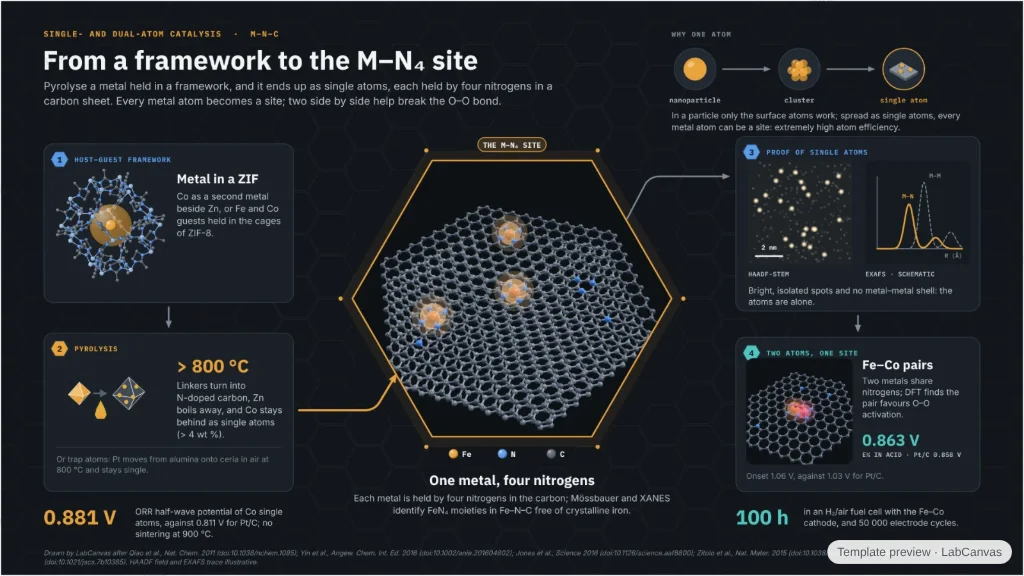
A hub graphical abstract of atomically dispersed catalysts: a metal held as a guest in a zeolitic imidazolate framework is pyrolysed into nitrogen-doped carbon, leaving single metal atoms in M–N₄ sites (a live 3D model at the centre). To the right, how single atoms are proved (HAADF-STEM bright spots, no metal–metal shell in EXAFS) and the next step, Fe–Co dual sites that split the O–O bond for acidic oxygen reduction.
Updated 6 cited papers781 editable layers
At a glance
- Category
- Graphical abstracts
- Method
- Graphical abstract
- Starting materials
- A metal held as a guest in a zeolitic imidazolate framework (bimetallic Zn/Co, or Fe and Co guests in ZIF-8)
- Product
- Single metal atoms in M–N₄ sites of nitrogen-doped carbon, and Fe–Co dual sites
- Key result
- Co single atoms: E½ 0.881 V vs 0.811 V for Pt/C, > 4 wt %, stable to 900 °C (Yin et al. 2016); Fe–Co dual sites: E½ 0.863 V vs 0.858 V for Pt/C, 50 000 cycles (Wang et al. 2017)
- Figure
- 1920 × 1080 px (16:9), 781 editable layers, 5 generated objects
Step by step
- Why one atomIsolated Pt atoms on iron oxide use every metal atom: extremely high atom efficiency, active and stable for CO oxidation (Qiao et al. 2011)
- Host–guest frameworkThe metal sits in a zeolitic imidazolate framework, as a second metal (Zn/Co) or a guest (Fe, Co) (Yin et al. 2016; Wang et al. 2017)
- PyrolysisThe linker carbonises into N-doped carbon and reduces the metal; Zn evaporates above 800 °C, leaving Co single atoms at over 4 wt % (Yin et al. 2016). Atom trapping on ceria at 800 °C is another route (Jones et al. 2016)
- ProofAberration-corrected electron microscopy and EXAFS confirm atomic dispersion (Yin et al. 2016); Mössbauer and XANES identify FeN₄ moieties (Zitolo et al. 2015)
- The pairFe–Co dual sites: acidic ORR half-wave potential 0.863 V against 0.858 V for Pt/C, 50 000 cycles and 100 h in an H₂/air fuel cell; the dual sites favour O–O activation (Wang et al. 2017)
Uses
- Graphical abstracts on single-atom and dual-atom electrocatalysts
- Talks on platinum-free fuel-cell cathodes and M–N–C sites
- Teaching atom utilisation and how single atoms are characterised
Papers this template follows
- Qiao et al., “Single-atom catalysis of CO oxidation using Pt1/FeOx”, Nat. Chem. 2011. doi:10.1038/nchem.1095method origin
- Yin et al., “Single cobalt atoms with precise N-coordination as superior oxygen reduction reaction catalysts”, Angew. Chem. Int. Ed. 2016. doi:10.1002/anie.201604802primary
- Jones et al., “Thermally stable single-atom platinum-on-ceria catalysts via atom trapping”, Science 2016. doi:10.1126/science.aaf8800primary
- Zitolo et al., “Identification of catalytic sites for oxygen reduction in iron- and nitrogen-doped graphene materials”, Nat. Mater. 2015. doi:10.1038/nmat4367primary
- Wang et al., “Design of N-coordinated dual-metal sites: a stable and active Pt-free catalyst for acidic oxygen reduction reaction”, J. Am. Chem. Soc. 2017. doi:10.1021/jacs.7b10385primary
- Ji et al., “Chemical synthesis of single atomic site catalysts”, Chem. Rev. 2020. doi:10.1021/acs.chemrev.9b00818review
Drawn by LabCanvas after Qiao et al., Nat. Chem. 2011 (doi:10.1038/nchem.1095); Yin et al., Angew. Chem. Int. Ed. 2016 (doi:10.1002/anie.201604802); Jones et al., Science 2016 (doi:10.1126/science.aaf8800); Zitolo et al., Nat. Mater. 2015 (doi:10.1038/nmat4367); Wang et al., J. Am. Chem. Soc. 2017 (doi:10.1021/jacs.7b10385). HAADF field and EXAFS trace illustrative.
How templates are written and checked: editorial guidelines.
Questions
What does the “Single- and dual-atom catalysts: from a framework to the M–N₄ site” template show?
A hub graphical abstract of atomically dispersed catalysts: a metal held as a guest in a zeolitic imidazolate framework is pyrolysed into nitrogen-doped carbon, leaving single metal atoms in M–N₄ sites (a live 3D model at the centre). To the right, how single atoms are proved (HAADF-STEM bright spots, no metal–metal shell in EXAFS) and the next step, Fe–Co dual sites that split the O–O bond for acidic oxygen reduction.
What are the steps shown in “Single- and dual-atom catalysts: from a framework to the M–N₄ site”?
1. Why one atom: Isolated Pt atoms on iron oxide use every metal atom: extremely high atom efficiency, active and stable for CO oxidation (Qiao et al. 2011). 2. Host–guest framework: The metal sits in a zeolitic imidazolate framework, as a second metal (Zn/Co) or a guest (Fe, Co) (Yin et al. 2016; Wang et al. 2017). 3. Pyrolysis: The linker carbonises into N-doped carbon and reduces the metal; Zn evaporates above 800 °C, leaving Co single atoms at over 4 wt % (Yin et al. 2016). Atom trapping on ceria at 800 °C is another route (Jones et al. 2016). 4. Proof: Aberration-corrected electron microscopy and EXAFS confirm atomic dispersion (Yin et al. 2016); Mössbauer and XANES identify FeN₄ moieties (Zitolo et al. 2015). 5. The pair: Fe–Co dual sites: acidic ORR half-wave potential 0.863 V against 0.858 V for Pt/C, 50 000 cycles and 100 h in an H₂/air fuel cell; the dual sites favour O–O activation (Wang et al. 2017).
What are the starting materials and the product?
Starting materials: A metal held as a guest in a zeolitic imidazolate framework (bimetallic Zn/Co, or Fe and Co guests in ZIF-8). Product: Single metal atoms in M–N₄ sites of nitrogen-doped carbon, and Fe–Co dual sites.
Which papers is “Single- and dual-atom catalysts: from a framework to the M–N₄ site” based on?
Qiao et al., “Single-atom catalysis of CO oxidation using Pt1/FeOx”, Nat. Chem. 2011 (doi:10.1038/nchem.1095); Yin et al., “Single cobalt atoms with precise N-coordination as superior oxygen reduction reaction catalysts”, Angew. Chem. Int. Ed. 2016 (doi:10.1002/anie.201604802); Jones et al., “Thermally stable single-atom platinum-on-ceria catalysts via atom trapping”, Science 2016 (doi:10.1126/science.aaf8800); Zitolo et al., “Identification of catalytic sites for oxygen reduction in iron- and nitrogen-doped graphene materials”, Nat. Mater. 2015 (doi:10.1038/nmat4367); Wang et al., “Design of N-coordinated dual-metal sites: a stable and active Pt-free catalyst for acidic oxygen reduction reaction”, J. Am. Chem. Soc. 2017 (doi:10.1021/jacs.7b10385); Ji et al., “Chemical synthesis of single atomic site catalysts”, Chem. Rev. 2020 (doi:10.1021/acs.chemrev.9b00818).
Can I edit the “Single- and dual-atom catalysts: from a framework to the M–N₄ site” template?
Yes. Open it in the LabCanvas editor: all 781 layers are editable, including 5 generated objects (structures, plots, equipment) with their own settings. Change the text, colours and layout, then export PNG, TIFF or PDF at the width and DPI the journal asks for.
Do I need an account to use this template?
Not to view it here. To open and edit it, sign in to LabCanvas or create a free account (the free plan keeps up to 3 designs). Downloading the figure is part of LabCanvas Pro (US$19 a month or US$199 a year).