Graphical abstract template · Graphical abstracts · Graphical abstract
Solvothermal vs hydrothermal synthesis: one autoclave, two kinds of solvent
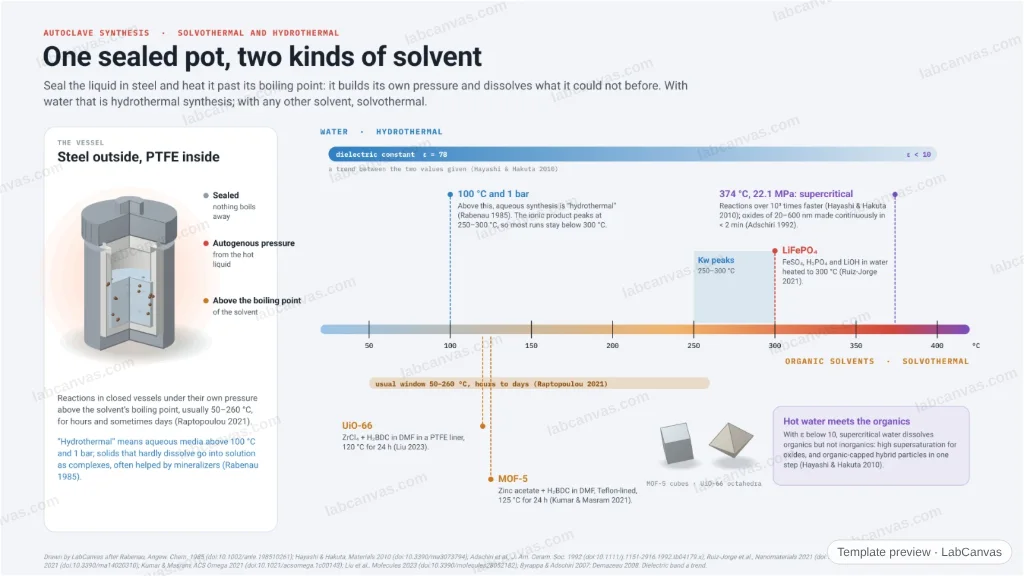
The sealed, PTFE-lined autoclave set on a temperature ruler. Above it, water: hydrothermal synthesis starts above 100 °C and 1 bar, water’s dielectric constant falls from 78 to below 10, its ionic product peaks at 250–300 °C, and past the critical point (374 °C, 22.1 MPa) reactions run over 10³ times faster, making oxide particles continuously in under two minutes; LiFePO₄ forms at 300 °C. Below it, organic solvents: solvothermal synthesis above the solvent’s boiling point under autogenous pressure, usually 50–260 °C, with MOF-5 and UiO-66 made in DMF at 120–125 °C.
Updated 10 cited papers75 editable layers
At a glance
- Category
- Graphical abstracts
- Method
- Graphical abstract
- Starting materials
- Salts or oxides in water (hydrothermal), or salts and organic linkers in DMF and other solvents (solvothermal), sealed in a PTFE-lined steel autoclave
- Product
- Crystalline oxides, phosphates and frameworks grown at temperatures above the solvent’s boiling point
- Key result
- ε(water) 78 → < 10; Kw maximum 250–300 °C; 374 °C, 22.1 MPa; rates > 10³× in supercritical water (Hayashi & Hakuta 2010); < 2 min, 20–600 nm (Adschiri et al. 1992)
- Figure
- 1920 × 1080 px (16:9), 75 editable layers, 3 generated objects
Step by step
- Seal and heatA closed vessel above the solvent’s boiling point builds its own (autogenous) pressure; usually polar solvents, 50–260 °C, hours to days (Raptopoulou 2021)
- Water changes as it heatsHydrothermal means aqueous media above 100 °C and 1 bar (Rabenau 1985); the dielectric constant falls from 78 to below 10, the ionic product peaks at 250–300 °C (Hayashi & Hakuta 2010)
- Past the critical pointAt 374 °C and 22.1 MPa water turns supercritical: reactions over 10³ times faster (Hayashi & Hakuta 2010); oxide particles of 20–600 nm continuously in under 2 min (Adschiri et al. 1992)
- Real recipesLiFePO₄ from FeSO₄, H₃PO₄ and LiOH in water at 300 °C (Ruiz-Jorge et al. 2021); MOF-5 in DMF at 125 °C for 24 h (Kumar & Masram 2021); UiO-66 in DMF at 120 °C for 24 h (Liu et al. 2023)
Uses
- Graphical abstracts on hydrothermal and solvothermal synthesis
- Teaching how water changes near its critical point
- Talks on autoclave synthesis of oxides, battery materials and MOFs
Papers this template follows
- Rabenau, “The role of hydrothermal synthesis in preparative chemistry”, Angew. Chem. Int. Ed. Engl. 1985. doi:10.1002/anie.198510261review
- Hayashi & Hakuta, “Hydrothermal synthesis of metal oxide nanoparticles in supercritical water”, Materials 2010. doi:10.3390/ma3073794review
- Adschiri, Kanazawa & Arai, “Rapid and continuous hydrothermal crystallization of metal oxide particles in supercritical water”, J. Am. Ceram. Soc. 1992. doi:10.1111/j.1151-2916.1992.tb04179.xmethod origin
- Ruiz-Jorge et al., “Effect of the heating rate to prevent the generation of iron oxides during the hydrothermal synthesis of LiFePO₄”, Nanomaterials 2021. doi:10.3390/nano11092412primary
- Raptopoulou, “Metal-organic frameworks: synthetic methods and potential applications”, Materials 2021. doi:10.3390/ma14020310review
- Kumar & Masram, “Sustainable synthesis of MOF-5@GO nanocomposites for efficient removal of rhodamine B from water”, ACS Omega 2021. doi:10.1021/acsomega.1c00143primary
- Liu, Lyu & Bai, “One-step synthesis of Al-doped UiO-66 nanoparticle for enhanced removal of organic dyes from wastewater”, Molecules 2023. doi:10.3390/molecules28052182primary
- Byrappa & Adschiri, “Hydrothermal technology for nanotechnology”, Prog. Cryst. Growth Charact. Mater. 2007. doi:10.1016/j.pcrysgrow.2007.04.001review
- Demazeau, “Solvothermal reactions: an original route for the synthesis of novel materials”, J. Mater. Sci. 2008. doi:10.1007/s10853-007-2024-9review
- Eddaoudi et al., “Systematic design of pore size and functionality in isoreticular MOFs and their application in methane storage”, Science 2002. doi:10.1126/science.1067208further reading
Drawn by LabCanvas after Rabenau, Angew. Chem. 1985 (doi:10.1002/anie.198510261); Hayashi & Hakuta, Materials 2010 (doi:10.3390/ma3073794); Adschiri et al., J. Am. Ceram. Soc. 1992 (doi:10.1111/j.1151-2916.1992.tb04179.x); Ruiz-Jorge et al., Nanomaterials 2021 (doi:10.3390/nano11092412); Raptopoulou, Materials 2021 (doi:10.3390/ma14020310); Kumar & Masram, ACS Omega 2021 (doi:10.1021/acsomega.1c00143); Liu et al., Molecules 2023 (doi:10.3390/molecules28052182); Byrappa & Adschiri 2007; Demazeau 2008. Dielectric band a trend.
How templates are written and checked: editorial guidelines.
Questions
What does the “Solvothermal vs hydrothermal synthesis: one autoclave, two kinds of solvent” template show?
The sealed, PTFE-lined autoclave set on a temperature ruler. Above it, water: hydrothermal synthesis starts above 100 °C and 1 bar, water’s dielectric constant falls from 78 to below 10, its ionic product peaks at 250–300 °C, and past the critical point (374 °C, 22.1 MPa) reactions run over 10³ times faster, making oxide particles continuously in under two minutes; LiFePO₄ forms at 300 °C. Below it, organic solvents: solvothermal synthesis above the solvent’s boiling point under autogenous pressure, usually 50–260 °C, with MOF-5 and UiO-66 made in DMF at 120–125 °C.
What are the steps shown in “Solvothermal vs hydrothermal synthesis: one autoclave, two kinds of solvent”?
1. Seal and heat: A closed vessel above the solvent’s boiling point builds its own (autogenous) pressure; usually polar solvents, 50–260 °C, hours to days (Raptopoulou 2021). 2. Water changes as it heats: Hydrothermal means aqueous media above 100 °C and 1 bar (Rabenau 1985); the dielectric constant falls from 78 to below 10, the ionic product peaks at 250–300 °C (Hayashi & Hakuta 2010). 3. Past the critical point: At 374 °C and 22.1 MPa water turns supercritical: reactions over 10³ times faster (Hayashi & Hakuta 2010); oxide particles of 20–600 nm continuously in under 2 min (Adschiri et al. 1992). 4. Real recipes: LiFePO₄ from FeSO₄, H₃PO₄ and LiOH in water at 300 °C (Ruiz-Jorge et al. 2021); MOF-5 in DMF at 125 °C for 24 h (Kumar & Masram 2021); UiO-66 in DMF at 120 °C for 24 h (Liu et al. 2023).
What are the starting materials and the product?
Starting materials: Salts or oxides in water (hydrothermal), or salts and organic linkers in DMF and other solvents (solvothermal), sealed in a PTFE-lined steel autoclave. Product: Crystalline oxides, phosphates and frameworks grown at temperatures above the solvent’s boiling point.
Which papers is “Solvothermal vs hydrothermal synthesis: one autoclave, two kinds of solvent” based on?
Rabenau, “The role of hydrothermal synthesis in preparative chemistry”, Angew. Chem. Int. Ed. Engl. 1985 (doi:10.1002/anie.198510261); Hayashi & Hakuta, “Hydrothermal synthesis of metal oxide nanoparticles in supercritical water”, Materials 2010 (doi:10.3390/ma3073794); Adschiri, Kanazawa & Arai, “Rapid and continuous hydrothermal crystallization of metal oxide particles in supercritical water”, J. Am. Ceram. Soc. 1992 (doi:10.1111/j.1151-2916.1992.tb04179.x); Ruiz-Jorge et al., “Effect of the heating rate to prevent the generation of iron oxides during the hydrothermal synthesis of LiFePO₄”, Nanomaterials 2021 (doi:10.3390/nano11092412); Raptopoulou, “Metal-organic frameworks: synthetic methods and potential applications”, Materials 2021 (doi:10.3390/ma14020310); Kumar & Masram, “Sustainable synthesis of MOF-5@GO nanocomposites for efficient removal of rhodamine B from water”, ACS Omega 2021 (doi:10.1021/acsomega.1c00143); Liu, Lyu & Bai, “One-step synthesis of Al-doped UiO-66 nanoparticle for enhanced removal of organic dyes from wastewater”, Molecules 2023 (doi:10.3390/molecules28052182); Byrappa & Adschiri, “Hydrothermal technology for nanotechnology”, Prog. Cryst. Growth Charact. Mater. 2007 (doi:10.1016/j.pcrysgrow.2007.04.001); Demazeau, “Solvothermal reactions: an original route for the synthesis of novel materials”, J. Mater. Sci. 2008 (doi:10.1007/s10853-007-2024-9); Eddaoudi et al., “Systematic design of pore size and functionality in isoreticular MOFs and their application in methane storage”, Science 2002 (doi:10.1126/science.1067208).
Can I edit the “Solvothermal vs hydrothermal synthesis: one autoclave, two kinds of solvent” template?
Yes. Open it in the LabCanvas editor: all 75 layers are editable, including 3 generated objects (structures, plots, equipment) with their own settings. Change the text, colours and layout, then export PNG, TIFF or PDF at the width and DPI the journal asks for.
Do I need an account to use this template?
Not to view it here. To open and edit it, sign in to LabCanvas or create a free account (the free plan keeps up to 3 designs). Downloading the figure is part of LabCanvas Pro (US$19 a month or US$199 a year).