Graphical abstract template · Graphical abstracts · Graphical abstract
Stimuli-responsive drug release: pH, redox, enzyme, light, heat and magnetic triggers
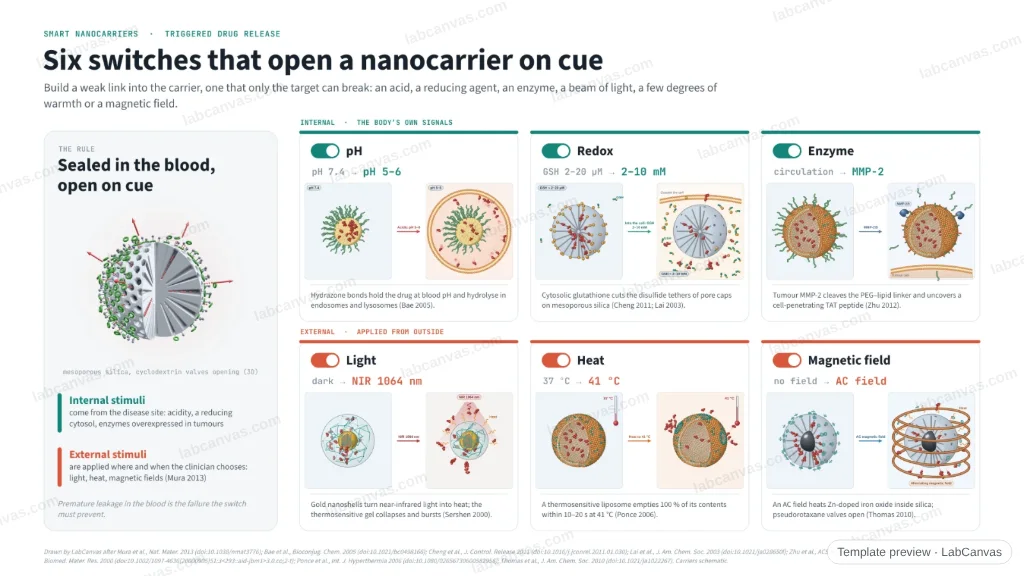
Six switches that open a nanocarrier on cue. Inside the body: acidic endosomes (pH 5–6) cut hydrazone bonds, cytosolic glutathione (2–10 mM) cuts disulfides, tumour MMP-2 cleaves a PEG linker. From outside: near-infrared light heats gold nanoshells in a gel, 41 °C empties a thermosensitive liposome in seconds and an alternating magnetic field opens molecular valves. A live 3D silica carrier with opening gates.
Updated 8 cited papers86 editable layers
At a glance
- Category
- Graphical abstracts
- Method
- Graphical abstract
- Starting materials
- Nanocarriers built with a weak link: acid-labile bonds, disulfides, enzyme-cleavable peptides, thermosensitive lipids and gels, magnetic cores
- Product
- Carriers that hold their drug in the blood and release it at the target
- Key result
- pH 7.4 → 5–6; GSH 2–20 µM → 2–10 mM; 100 % release in 10–20 s at 41 °C
- Figure
- 1920 × 1080 px (16:9), 86 editable layers, 6 generated objects
Step by step
- pHHydrazone-linked drug stable at pH 7.4, released in endosomes and lysosomes at pH 5–6 (Bae et al. 2005)
- RedoxGlutathione 2–10 mM inside cells vs 2–20 µM outside (Cheng et al. 2011); disulfide-tethered caps come off mesoporous silica (Lai et al. 2003)
- EnzymeTumour MMP-2 cleaves a PEG–lipid linker and exposes the TAT peptide (Zhu et al. 2012)
- LightNear-infrared light heats gold nanoshells in a thermosensitive hydrogel, which collapses and bursts out its cargo (Sershen et al. 2000)
- HeatA temperature-sensitive liposome releases 100 % of its contents in 10–20 s at 41 °C (Ponce et al. 2006)
- Magnetic fieldAn AC field heats Zn-doped iron oxide inside mesoporous silica; pseudorotaxane gates open and doxorubicin leaves (Thomas et al. 2010)
Uses
- Graphical abstracts on stimuli-responsive and smart drug-delivery systems
- Reviews comparing internal and external triggers
- Teaching how carriers are made to open on cue
Papers this template follows
- Mura, Nicolas & Couvreur, “Stimuli-responsive nanocarriers for drug delivery”, Nat. Mater. 2013. doi:10.1038/nmat3776review
- Bae et al., “Preparation and biological characterization of polymeric micelle drug carriers with intracellular pH-triggered drug release property”, Bioconjug. Chem. 2005. doi:10.1021/bc0498166primary
- Cheng et al., “Glutathione-responsive nano-vehicles as a promising platform for targeted intracellular drug and gene delivery”, J. Control. Release 2011. doi:10.1016/j.jconrel.2011.01.030review
- Lai et al., “A mesoporous silica nanosphere-based carrier system with chemically removable CdS nanoparticle caps for stimuli-responsive controlled release of neurotransmitters and drug molecules”, J. Am. Chem. Soc. 2003. doi:10.1021/ja028650lprimary
- Zhu, Kate & Torchilin, “Matrix metalloprotease 2-responsive multifunctional liposomal nanocarrier for enhanced tumor targeting”, ACS Nano 2012. doi:10.1021/nn300524fprimary
- Sershen et al., “Temperature-sensitive polymer-nanoshell composites for photothermally modulated drug delivery”, J. Biomed. Mater. Res. 2000. doi:10.1002/1097-4636(20000905)51:3<293::aid-jbm1>3.0.co;2-tprimary
- Ponce et al., “Hyperthermia mediated liposomal drug delivery”, Int. J. Hyperthermia 2006. doi:10.1080/02656730600582956primary
- Thomas et al., “Noninvasive remote-controlled release of drug molecules in vitro using magnetic actuation of mechanized nanoparticles”, J. Am. Chem. Soc. 2010. doi:10.1021/ja1022267primary
Drawn by LabCanvas after Mura et al., Nat. Mater. 2013 (doi:10.1038/nmat3776); Bae et al., Bioconjug. Chem. 2005 (doi:10.1021/bc0498166); Cheng et al., J. Control. Release 2011 (doi:10.1016/j.jconrel.2011.01.030); Lai et al., J. Am. Chem. Soc. 2003 (doi:10.1021/ja028650l); Zhu et al., ACS Nano 2012 (doi:10.1021/nn300524f); Sershen et al., J. Biomed. Mater. Res. 2000 (doi:10.1002/1097-4636(20000905)51:3<293::aid-jbm1>3.0.co;2-t); Ponce et al., Int. J. Hyperthermia 2006 (doi:10.1080/02656730600582956); Thomas et al., J. Am. Chem. Soc. 2010 (doi:10.1021/ja1022267). Carriers schematic.
How templates are written and checked: editorial guidelines.
Questions
What does the “Stimuli-responsive drug release: pH, redox, enzyme, light, heat and magnetic triggers” template show?
Six switches that open a nanocarrier on cue. Inside the body: acidic endosomes (pH 5–6) cut hydrazone bonds, cytosolic glutathione (2–10 mM) cuts disulfides, tumour MMP-2 cleaves a PEG linker. From outside: near-infrared light heats gold nanoshells in a gel, 41 °C empties a thermosensitive liposome in seconds and an alternating magnetic field opens molecular valves. A live 3D silica carrier with opening gates.
What are the steps shown in “Stimuli-responsive drug release: pH, redox, enzyme, light, heat and magnetic triggers”?
1. pH: Hydrazone-linked drug stable at pH 7.4, released in endosomes and lysosomes at pH 5–6 (Bae et al. 2005). 2. Redox: Glutathione 2–10 mM inside cells vs 2–20 µM outside (Cheng et al. 2011); disulfide-tethered caps come off mesoporous silica (Lai et al. 2003). 3. Enzyme: Tumour MMP-2 cleaves a PEG–lipid linker and exposes the TAT peptide (Zhu et al. 2012). 4. Light: Near-infrared light heats gold nanoshells in a thermosensitive hydrogel, which collapses and bursts out its cargo (Sershen et al. 2000). 5. Heat: A temperature-sensitive liposome releases 100 % of its contents in 10–20 s at 41 °C (Ponce et al. 2006). 6. Magnetic field: An AC field heats Zn-doped iron oxide inside mesoporous silica; pseudorotaxane gates open and doxorubicin leaves (Thomas et al. 2010).
What are the starting materials and the product?
Starting materials: Nanocarriers built with a weak link: acid-labile bonds, disulfides, enzyme-cleavable peptides, thermosensitive lipids and gels, magnetic cores. Product: Carriers that hold their drug in the blood and release it at the target.
Which papers is “Stimuli-responsive drug release: pH, redox, enzyme, light, heat and magnetic triggers” based on?
Mura, Nicolas & Couvreur, “Stimuli-responsive nanocarriers for drug delivery”, Nat. Mater. 2013 (doi:10.1038/nmat3776); Bae et al., “Preparation and biological characterization of polymeric micelle drug carriers with intracellular pH-triggered drug release property”, Bioconjug. Chem. 2005 (doi:10.1021/bc0498166); Cheng et al., “Glutathione-responsive nano-vehicles as a promising platform for targeted intracellular drug and gene delivery”, J. Control. Release 2011 (doi:10.1016/j.jconrel.2011.01.030); Lai et al., “A mesoporous silica nanosphere-based carrier system with chemically removable CdS nanoparticle caps for stimuli-responsive controlled release of neurotransmitters and drug molecules”, J. Am. Chem. Soc. 2003 (doi:10.1021/ja028650l); Zhu, Kate & Torchilin, “Matrix metalloprotease 2-responsive multifunctional liposomal nanocarrier for enhanced tumor targeting”, ACS Nano 2012 (doi:10.1021/nn300524f); Sershen et al., “Temperature-sensitive polymer-nanoshell composites for photothermally modulated drug delivery”, J. Biomed. Mater. Res. 2000 (doi:10.1002/1097-4636(20000905)51:3<293::aid-jbm1>3.0.co;2-t); Ponce et al., “Hyperthermia mediated liposomal drug delivery”, Int. J. Hyperthermia 2006 (doi:10.1080/02656730600582956); Thomas et al., “Noninvasive remote-controlled release of drug molecules in vitro using magnetic actuation of mechanized nanoparticles”, J. Am. Chem. Soc. 2010 (doi:10.1021/ja1022267).
Can I edit the “Stimuli-responsive drug release: pH, redox, enzyme, light, heat and magnetic triggers” template?
Yes. Open it in the LabCanvas editor: all 86 layers are editable, including 6 generated objects (structures, plots, equipment) with their own settings. Change the text, colours and layout, then export PNG, TIFF or PDF at the width and DPI the journal asks for.
Do I need an account to use this template?
Not to view it here. To open and edit it, sign in to LabCanvas or create a free account (the free plan keeps up to 3 designs). Downloading the figure is part of LabCanvas Pro (US$19 a month or US$199 a year).