Graphical abstract template · Graphical abstracts · Graphical abstract
TMD phase engineering and heterostructures: 2H, 1T, stacked and stitched
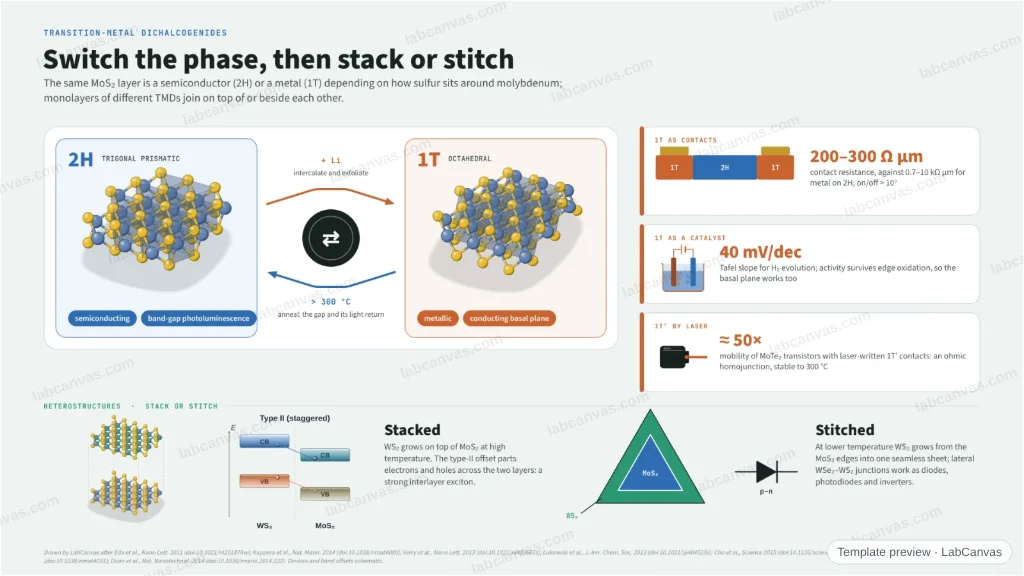
A phase switch and a quilt: semiconducting 2H-MoS₂ (trigonal prismatic) turns into metallic 1T (octahedral) on lithium intercalation and back on annealing; the metallic phase makes low-resistance contacts, catalyses hydrogen evolution and can be written by laser into MoTe₂. Below, monolayers are stacked into type-II bilayers with an interlayer exciton, or stitched edge to edge into lateral p–n junctions.
Updated 8 cited papers74 editable layers
At a glance
- Category
- Graphical abstracts
- Method
- Graphical abstract
- Starting materials
- Semiconducting 2H-MoS₂ and its relatives (WS₂, MoSe₂, WSe₂, MoTe₂)
- Product
- Metallic 1T and 1T′ regions, and vertical and lateral TMD heterostructures
- Key result
- Contacts 200–300 Ω µm vs 0.7–10 kΩ µm (Kappera et al. 2014); HER Tafel 40 mV/dec (Voiry et al. 2013), 10 mA cm⁻² at −187 mV (Lukowski et al. 2013); MoTe₂ mobility ~50× (Cho et al. 2015)
- Figure
- 1920 × 1080 px (16:9), 74 editable layers, 6 generated objects
Step by step
- Throw the switchLi intercalation turns 2H-MoS₂ into a metastable metallic phase; annealing restores the semiconductor, with band-gap photoluminescence above 300 °C (Eda et al. 2011)
- 1T contactsLocally induced 1T electrodes cut contact resistance from 0.7–10 kΩ µm to 200–300 Ω µm; on/off > 10⁷ (Kappera et al. 2014)
- 1T catalystsMetallic 1T-MoS₂ nanosheets evolve H₂ with Tafel slopes of 40–43 mV/dec; the basal plane, not only the edges, is active (Voiry et al. 2013; Lukowski et al. 2013)
- Laser-written 1T′A laser patterns 1T′ contacts into 2H-MoTe₂: an ohmic homojunction stable to 300 °C, ~50× the mobility (Cho et al. 2015)
- Stack or stitchWS₂ grows on top of MoS₂ (type II, interlayer exciton) at high temperature or at its edges (lateral p–n junctions) at low temperature (Gong et al. 2014); lateral WSe₂–WS₂ diodes and inverters (Duan et al. 2014)
Uses
- Graphical abstracts on TMD polymorphs and phase engineering
- Talks on 2D contacts, 2D electrocatalysts and TMD heterostructures
- Teaching trigonal prismatic vs octahedral coordination and band alignment
Papers this template follows
- Eda et al., “Photoluminescence from chemically exfoliated MoS2”, Nano Lett. 2011. doi:10.1021/nl201874wprimary
- Kappera et al., “Phase-engineered low-resistance contacts for ultrathin MoS2 transistors”, Nat. Mater. 2014. doi:10.1038/nmat4080primary
- Voiry et al., “Conducting MoS2 nanosheets as catalysts for hydrogen evolution reaction”, Nano Lett. 2013. doi:10.1021/nl403661sprimary
- Lukowski et al., “Enhanced hydrogen evolution catalysis from chemically exfoliated metallic MoS2 nanosheets”, J. Am. Chem. Soc. 2013. doi:10.1021/ja404523sprimary
- Cho et al., “Phase patterning for ohmic homojunction contact in MoTe2”, Science 2015. doi:10.1126/science.aab3175primary
- Gong et al., “Vertical and in-plane heterostructures from WS2/MoS2 monolayers”, Nat. Mater. 2014. doi:10.1038/nmat4091primary
- Duan et al., “Lateral epitaxial growth of two-dimensional layered semiconductor heterojunctions”, Nat. Nanotechnol. 2014. doi:10.1038/nnano.2014.222primary
- Chhowalla et al., “The chemistry of two-dimensional layered transition metal dichalcogenide nanosheets”, Nat. Chem. 2013. doi:10.1038/nchem.1589review
Drawn by LabCanvas after Eda et al., Nano Lett. 2011 (doi:10.1021/nl201874w); Kappera et al., Nat. Mater. 2014 (doi:10.1038/nmat4080); Voiry et al., Nano Lett. 2013 (doi:10.1021/nl403661s); Lukowski et al., J. Am. Chem. Soc. 2013 (doi:10.1021/ja404523s); Cho et al., Science 2015 (doi:10.1126/science.aab3175); Gong et al., Nat. Mater. 2014 (doi:10.1038/nmat4091); Duan et al., Nat. Nanotechnol. 2014 (doi:10.1038/nnano.2014.222). Devices and band offsets schematic.
How templates are written and checked: editorial guidelines.
Questions
What does the “TMD phase engineering and heterostructures: 2H, 1T, stacked and stitched” template show?
A phase switch and a quilt: semiconducting 2H-MoS₂ (trigonal prismatic) turns into metallic 1T (octahedral) on lithium intercalation and back on annealing; the metallic phase makes low-resistance contacts, catalyses hydrogen evolution and can be written by laser into MoTe₂. Below, monolayers are stacked into type-II bilayers with an interlayer exciton, or stitched edge to edge into lateral p–n junctions.
What are the steps shown in “TMD phase engineering and heterostructures: 2H, 1T, stacked and stitched”?
1. Throw the switch: Li intercalation turns 2H-MoS₂ into a metastable metallic phase; annealing restores the semiconductor, with band-gap photoluminescence above 300 °C (Eda et al. 2011). 2. 1T contacts: Locally induced 1T electrodes cut contact resistance from 0.7–10 kΩ µm to 200–300 Ω µm; on/off > 10⁷ (Kappera et al. 2014). 3. 1T catalysts: Metallic 1T-MoS₂ nanosheets evolve H₂ with Tafel slopes of 40–43 mV/dec; the basal plane, not only the edges, is active (Voiry et al. 2013; Lukowski et al. 2013). 4. Laser-written 1T′: A laser patterns 1T′ contacts into 2H-MoTe₂: an ohmic homojunction stable to 300 °C, ~50× the mobility (Cho et al. 2015). 5. Stack or stitch: WS₂ grows on top of MoS₂ (type II, interlayer exciton) at high temperature or at its edges (lateral p–n junctions) at low temperature (Gong et al. 2014); lateral WSe₂–WS₂ diodes and inverters (Duan et al. 2014).
What are the starting materials and the product?
Starting materials: Semiconducting 2H-MoS₂ and its relatives (WS₂, MoSe₂, WSe₂, MoTe₂). Product: Metallic 1T and 1T′ regions, and vertical and lateral TMD heterostructures.
Which papers is “TMD phase engineering and heterostructures: 2H, 1T, stacked and stitched” based on?
Eda et al., “Photoluminescence from chemically exfoliated MoS2”, Nano Lett. 2011 (doi:10.1021/nl201874w); Kappera et al., “Phase-engineered low-resistance contacts for ultrathin MoS2 transistors”, Nat. Mater. 2014 (doi:10.1038/nmat4080); Voiry et al., “Conducting MoS2 nanosheets as catalysts for hydrogen evolution reaction”, Nano Lett. 2013 (doi:10.1021/nl403661s); Lukowski et al., “Enhanced hydrogen evolution catalysis from chemically exfoliated metallic MoS2 nanosheets”, J. Am. Chem. Soc. 2013 (doi:10.1021/ja404523s); Cho et al., “Phase patterning for ohmic homojunction contact in MoTe2”, Science 2015 (doi:10.1126/science.aab3175); Gong et al., “Vertical and in-plane heterostructures from WS2/MoS2 monolayers”, Nat. Mater. 2014 (doi:10.1038/nmat4091); Duan et al., “Lateral epitaxial growth of two-dimensional layered semiconductor heterojunctions”, Nat. Nanotechnol. 2014 (doi:10.1038/nnano.2014.222); Chhowalla et al., “The chemistry of two-dimensional layered transition metal dichalcogenide nanosheets”, Nat. Chem. 2013 (doi:10.1038/nchem.1589).
Can I edit the “TMD phase engineering and heterostructures: 2H, 1T, stacked and stitched” template?
Yes. Open it in the LabCanvas editor: all 74 layers are editable, including 6 generated objects (structures, plots, equipment) with their own settings. Change the text, colours and layout, then export PNG, TIFF or PDF at the width and DPI the journal asks for.
Do I need an account to use this template?
Not to view it here. To open and edit it, sign in to LabCanvas or create a free account (the free plan keeps up to 3 designs). Downloading the figure is part of LabCanvas Pro (US$19 a month or US$199 a year).





