Graphical abstract template · Graphical abstracts · Graphical abstract
Van der Waals heterostructures: stack, twist and read the moiré
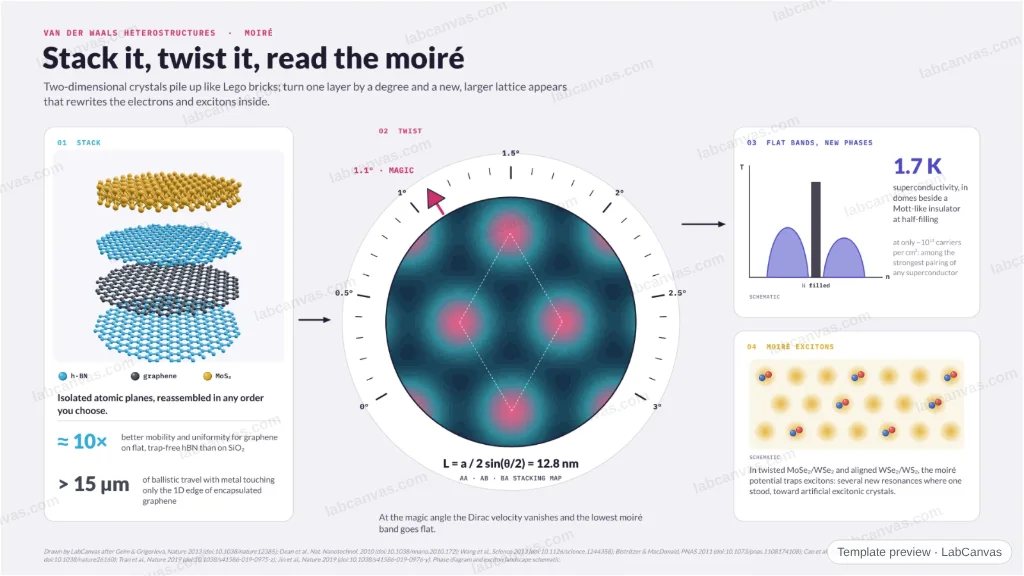
A twist-dial graphical abstract: 2D crystals stacked like Lego (live 3D), on hBN and with edge contacts; a gauge turning two graphene layers to the 1.1° magic angle, where the moiré period reaches 12.8 nm and the bands go flat; and what the twist unlocks: a correlated insulator and superconductivity up to 1.7 K, and excitons trapped in the moiré potential of twisted semiconductor bilayers.
Updated 9 cited papers125 editable layers
At a glance
- Category
- Graphical abstracts
- Method
- Graphical abstract
- Starting materials
- Exfoliated 2D crystals: graphene, hBN and transition-metal dichalcogenides
- Product
- Stacked and twisted heterostructures with moiré superlattices
- Key result
- Tc up to 1.7 K at ~1.1° (Cao et al. 2018); ballistic over > 15 µm (Wang et al. 2013); mobility ~10× on hBN vs SiO₂ (Dean et al. 2010); moiré period 12.8 nm at 1.1° (computed)
- Figure
- 1920 × 1080 px (16:9), 125 editable layers, 1 generated objects
Step by step
- StackAtomic planes reassembled layer by layer in a chosen sequence (Geim & Grigorieva 2013); on hBN, mobility and inhomogeneity almost 10× better than on SiO₂ (Dean et al. 2010); 1D edge contacts give ballistic transport over > 15 µm (Wang et al. 2013)
- TwistA twist θ makes a moiré superlattice of period a/(2 sin θ/2), 12.8 nm at 1.1°; at magic angles the Dirac velocity vanishes and the lowest band goes flat (Bistritzer & MacDonald 2011)
- CorrelateFlat bands host insulating states at half-filling (Cao et al. 2018a) and, doped away from them, superconductivity up to 1.7 K in dome-shaped regions (Cao et al. 2018b)
- Trap excitonsInterlayer excitons confined in the moiré potential of MoSe₂/WSe₂ and WSe₂/WS₂ bilayers (Tran et al. 2019; Jin et al. 2019)
Uses
- Graphical abstracts on van der Waals heterostructures and twistronics
- Talks on magic-angle graphene and moiré excitons
- Teaching moiré periods, flat bands and 2D device assembly
Papers this template follows
- Geim & Grigorieva, “Van der Waals heterostructures”, Nature 2013. doi:10.1038/nature12385review
- Dean et al., “Boron nitride substrates for high-quality graphene electronics”, Nat. Nanotechnol. 2010. doi:10.1038/nnano.2010.172primary
- Wang et al., “One-dimensional electrical contact to a two-dimensional material”, Science 2013. doi:10.1126/science.1244358primary
- Bistritzer & MacDonald, “Moiré bands in twisted double-layer graphene”, PNAS 2011. doi:10.1073/pnas.1108174108method origin
- Cao et al., “Correlated insulator behaviour at half-filling in magic-angle graphene superlattices”, Nature 2018. doi:10.1038/nature26154primary
- Cao et al., “Unconventional superconductivity in magic-angle graphene superlattices”, Nature 2018. doi:10.1038/nature26160primary
- Tran et al., “Evidence for moiré excitons in van der Waals heterostructures”, Nature 2019. doi:10.1038/s41586-019-0975-zprimary
- Jin et al., “Observation of moiré excitons in WSe2/WS2 heterostructure superlattices”, Nature 2019. doi:10.1038/s41586-019-0976-yprimary
- Kim et al., “van der Waals heterostructures with high accuracy rotational alignment”, Nano Lett. 2016. doi:10.1021/acs.nanolett.5b05263further reading
Drawn by LabCanvas after Geim & Grigorieva, Nature 2013 (doi:10.1038/nature12385); Dean et al., Nat. Nanotechnol. 2010 (doi:10.1038/nnano.2010.172); Wang et al., Science 2013 (doi:10.1126/science.1244358); Bistritzer & MacDonald, PNAS 2011 (doi:10.1073/pnas.1108174108); Cao et al., Nature 2018 (doi:10.1038/nature26154; doi:10.1038/nature26160); Tran et al., Nature 2019 (doi:10.1038/s41586-019-0975-z); Jin et al., Nature 2019 (doi:10.1038/s41586-019-0976-y). Phase diagram and exciton landscape schematic.
How templates are written and checked: editorial guidelines.
Questions
What does the “Van der Waals heterostructures: stack, twist and read the moiré” template show?
A twist-dial graphical abstract: 2D crystals stacked like Lego (live 3D), on hBN and with edge contacts; a gauge turning two graphene layers to the 1.1° magic angle, where the moiré period reaches 12.8 nm and the bands go flat; and what the twist unlocks: a correlated insulator and superconductivity up to 1.7 K, and excitons trapped in the moiré potential of twisted semiconductor bilayers.
What are the steps shown in “Van der Waals heterostructures: stack, twist and read the moiré”?
1. Stack: Atomic planes reassembled layer by layer in a chosen sequence (Geim & Grigorieva 2013); on hBN, mobility and inhomogeneity almost 10× better than on SiO₂ (Dean et al. 2010); 1D edge contacts give ballistic transport over > 15 µm (Wang et al. 2013). 2. Twist: A twist θ makes a moiré superlattice of period a/(2 sin θ/2), 12.8 nm at 1.1°; at magic angles the Dirac velocity vanishes and the lowest band goes flat (Bistritzer & MacDonald 2011). 3. Correlate: Flat bands host insulating states at half-filling (Cao et al. 2018a) and, doped away from them, superconductivity up to 1.7 K in dome-shaped regions (Cao et al. 2018b). 4. Trap excitons: Interlayer excitons confined in the moiré potential of MoSe₂/WSe₂ and WSe₂/WS₂ bilayers (Tran et al. 2019; Jin et al. 2019).
What are the starting materials and the product?
Starting materials: Exfoliated 2D crystals: graphene, hBN and transition-metal dichalcogenides. Product: Stacked and twisted heterostructures with moiré superlattices.
Which papers is “Van der Waals heterostructures: stack, twist and read the moiré” based on?
Geim & Grigorieva, “Van der Waals heterostructures”, Nature 2013 (doi:10.1038/nature12385); Dean et al., “Boron nitride substrates for high-quality graphene electronics”, Nat. Nanotechnol. 2010 (doi:10.1038/nnano.2010.172); Wang et al., “One-dimensional electrical contact to a two-dimensional material”, Science 2013 (doi:10.1126/science.1244358); Bistritzer & MacDonald, “Moiré bands in twisted double-layer graphene”, PNAS 2011 (doi:10.1073/pnas.1108174108); Cao et al., “Correlated insulator behaviour at half-filling in magic-angle graphene superlattices”, Nature 2018 (doi:10.1038/nature26154); Cao et al., “Unconventional superconductivity in magic-angle graphene superlattices”, Nature 2018 (doi:10.1038/nature26160); Tran et al., “Evidence for moiré excitons in van der Waals heterostructures”, Nature 2019 (doi:10.1038/s41586-019-0975-z); Jin et al., “Observation of moiré excitons in WSe2/WS2 heterostructure superlattices”, Nature 2019 (doi:10.1038/s41586-019-0976-y); Kim et al., “van der Waals heterostructures with high accuracy rotational alignment”, Nano Lett. 2016 (doi:10.1021/acs.nanolett.5b05263).
Can I edit the “Van der Waals heterostructures: stack, twist and read the moiré” template?
Yes. Open it in the LabCanvas editor: all 125 layers are editable, including 1 generated objects (structures, plots, equipment) with their own settings. Change the text, colours and layout, then export PNG, TIFF or PDF at the width and DPI the journal asks for.
Do I need an account to use this template?
Not to view it here. To open and edit it, sign in to LabCanvas or create a free account (the free plan keeps up to 3 designs). Downloading the figure is part of LabCanvas Pro (US$19 a month or US$199 a year).