Graphical abstract template · Graphical abstracts · Graphical abstract
Why nano is different: surface atoms, magic-number clusters and melting-point depression
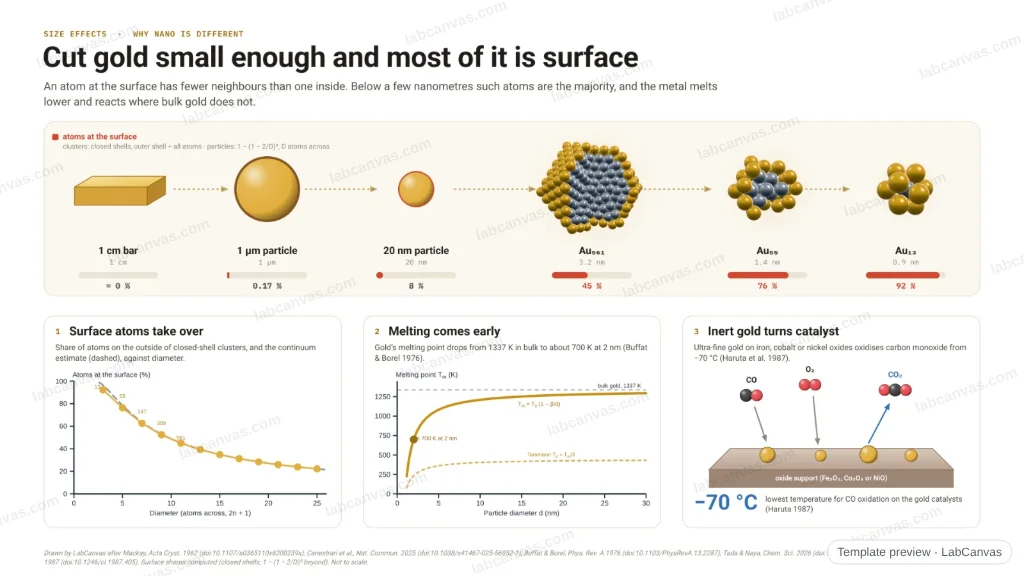
Cut a gold bar down to 13 atoms and the share of atoms at the surface climbs from almost none to 92 %. Live 3D Mackay icosahedra show the closed shells of 561, 55 and 13 atoms; below, the surface share against size, gold melting hundreds of kelvin lower at 2 nm, and gold particles that oxidise carbon monoxide at −70 °C.
Updated 5 cited papers101 editable layers
At a glance
- Category
- Graphical abstracts
- Method
- Graphical abstract
- Starting materials
- Gold, from a bar to clusters of 561, 55 and 13 atoms
- Product
- How surface atoms change melting and chemistry at the nanoscale
- Key result
- Surface share 92 % (Au₁₃), 76 % (Au₅₅), 45 % (Au₅₆₁); gold Tm ≈ 700 K at 2 nm vs 1337 K bulk; CO oxidation from −70 °C
- Figure
- 1920 × 1080 px (16:9), 101 editable layers
Step by step
- Surface atoms take overClosed-shell clusters: 45 % of 561 atoms, 76 % of 55 and 92 % of 13 sit at the surface (Mackay 1962 cluster series, computed); about 8 % at 20 nm and 0.17 % at 1 µm (continuum estimate, computed)
- Magic numbersClosed icosahedral shells of 13, 55, 147, 309 and 561 atoms, each shell adding 10n² + 2 atoms (Mackay 1962)
- Melting fallsGold melts at about 700 K at 2 nm, against 1337 K in bulk, falling rapidly below about 10 nm (Buffat & Borel 1976, as quoted by Tada & Naya 2026)
- New chemistryUltra-fine gold on Fe, Co or Ni oxides oxidises CO at temperatures as low as −70 °C (Haruta et al. 1987)
Uses
- Graphical abstracts and lectures on nanoscale size effects
- Teaching surface-to-volume ratio and magic numbers
- Introductions to nanocatalysis
Papers this template follows
- Mackay, “A dense non-crystallographic packing of equal spheres”, Acta Cryst. 1962. doi:10.1107/s0365110x6200239xmethod origin
- Canestrari, Nelli & Ferrando, “General theory for packing icosahedral shells into multi-component aggregates”, Nat. Commun. 2025. doi:10.1038/s41467-025-56952-1review
- Buffat & Borel, “Size effect on the melting temperature of gold particles”, Phys. Rev. A 1976. doi:10.1103/PhysRevA.13.2287primary
- Tada & Naya, “Nanosize effects in metal oxide-supported gold catalysts”, Chem. Sci. 2026. doi:10.1039/d6sc04087jreview
- Haruta, Kobayashi, Sano & Yamada, “Novel gold catalysts for the oxidation of carbon monoxide at a temperature far below 0 °C”, Chem. Lett. 1987. doi:10.1246/cl.1987.405primary
Drawn by LabCanvas after Mackay, Acta Cryst. 1962 (doi:10.1107/s0365110x6200239x); Canestrari et al., Nat. Commun. 2025 (doi:10.1038/s41467-025-56952-1); Buffat & Borel, Phys. Rev. A 1976 (doi:10.1103/PhysRevA.13.2287); Tada & Naya, Chem. Sci. 2026 (doi:10.1039/d6sc04087j); Haruta et al., Chem. Lett. 1987 (doi:10.1246/cl.1987.405). Surface shares computed (closed shells; 1 − (1 − 2/D)³ beyond). Not to scale.
How templates are written and checked: editorial guidelines.
Questions
What does the “Why nano is different: surface atoms, magic-number clusters and melting-point depression” template show?
Cut a gold bar down to 13 atoms and the share of atoms at the surface climbs from almost none to 92 %. Live 3D Mackay icosahedra show the closed shells of 561, 55 and 13 atoms; below, the surface share against size, gold melting hundreds of kelvin lower at 2 nm, and gold particles that oxidise carbon monoxide at −70 °C.
What are the steps shown in “Why nano is different: surface atoms, magic-number clusters and melting-point depression”?
1. Surface atoms take over: Closed-shell clusters: 45 % of 561 atoms, 76 % of 55 and 92 % of 13 sit at the surface (Mackay 1962 cluster series, computed); about 8 % at 20 nm and 0.17 % at 1 µm (continuum estimate, computed). 2. Magic numbers: Closed icosahedral shells of 13, 55, 147, 309 and 561 atoms, each shell adding 10n² + 2 atoms (Mackay 1962). 3. Melting falls: Gold melts at about 700 K at 2 nm, against 1337 K in bulk, falling rapidly below about 10 nm (Buffat & Borel 1976, as quoted by Tada & Naya 2026). 4. New chemistry: Ultra-fine gold on Fe, Co or Ni oxides oxidises CO at temperatures as low as −70 °C (Haruta et al. 1987).
What are the starting materials and the product?
Starting materials: Gold, from a bar to clusters of 561, 55 and 13 atoms. Product: How surface atoms change melting and chemistry at the nanoscale.
Which papers is “Why nano is different: surface atoms, magic-number clusters and melting-point depression” based on?
Mackay, “A dense non-crystallographic packing of equal spheres”, Acta Cryst. 1962 (doi:10.1107/s0365110x6200239x); Canestrari, Nelli & Ferrando, “General theory for packing icosahedral shells into multi-component aggregates”, Nat. Commun. 2025 (doi:10.1038/s41467-025-56952-1); Buffat & Borel, “Size effect on the melting temperature of gold particles”, Phys. Rev. A 1976 (doi:10.1103/PhysRevA.13.2287); Tada & Naya, “Nanosize effects in metal oxide-supported gold catalysts”, Chem. Sci. 2026 (doi:10.1039/d6sc04087j); Haruta, Kobayashi, Sano & Yamada, “Novel gold catalysts for the oxidation of carbon monoxide at a temperature far below 0 °C”, Chem. Lett. 1987 (doi:10.1246/cl.1987.405).
Can I edit the “Why nano is different: surface atoms, magic-number clusters and melting-point depression” template?
Yes. Open it in the LabCanvas editor: all 101 layers are editable. Change the text, colours and layout, then export PNG, TIFF or PDF at the width and DPI the journal asks for.
Do I need an account to use this template?
Not to view it here. To open and edit it, sign in to LabCanvas or create a free account (the free plan keeps up to 3 designs). Downloading the figure is part of LabCanvas Pro (US$19 a month or US$199 a year).





