Graphical abstract template · Graphical abstracts · Graphical abstract
Zeolite synthesis: structure-directing agents and the road from gel to crystal
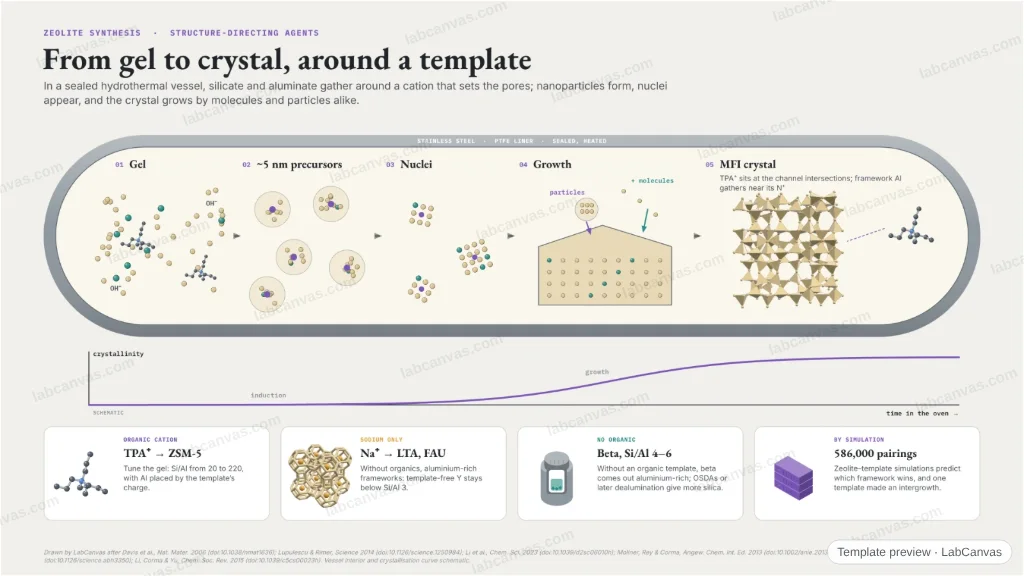
A cutaway autoclave runs across the page: a silicate–aluminate gel with tetrapropylammonium, ~5 nm precursor nanoparticles, nuclei, a crystal face that grows by both silica molecules and attaching precursors, and the MFI crystal (live 3D) with the organic cation at its channel intersections, over a schematic crystallisation curve. Below, how the structure-directing agent picks the framework: TPA⁺ for ZSM-5, sodium for low-silica LTA and FAU, no organic for beta, and templates designed from 586,000 simulations.
Updated 7 cited papers248 editable layers
At a glance
- Category
- Graphical abstracts
- Method
- Graphical abstract
- Starting materials
- An aqueous silicate–aluminate gel with a structure-directing cation (organic TPA⁺, or Na⁺)
- Product
- Crystalline zeolites whose framework, composition and Al siting follow the SDA
- Key result
- ZSM-5 Si/Al 20–220 with TPA⁺ (Li et al. 2023); ~5 nm precursor units (Davis et al. 2006); > 586,000 zeolite–template simulations (Schwalbe-Koda et al. 2021)
- Figure
- 1920 × 1080 px (16:9), 248 editable layers, 6 generated objects
Step by step
- Gel and SDASilica (TEOS) hydrolysed in aqueous TPA hydroxide (Davis et al. 2006); the SDA’s positive charge is balanced by framework Al, and ZSM-5 forms with Si/Al from 20 to 220 as the gel is tuned (Li et al. 2023)
- PrecursorsNanoparticles form spontaneously; ~5 nm units aggregate and evolve into TPA-silicalite-1 (Davis et al. 2006)
- GrowthPrecursors attach to the crystal surface, rearrange, and the crystal grows by adding silica molecules too: classical and non-classical growth together (Lupulescu & Rimer 2014)
- The SDA in the crystalAl pairs gather near the N⁺ of TPA⁺ at the intersections of the straight and sinusoidal channels (Li et al. 2023)
- Choosing the frameworkBeta without OSDA has Si/Al 4–6, template-free Y < 3 (Li et al. 2023); rational SDA design (Moliner et al. 2013); 586,000 simulations rationalise phase competition and design an intergrowth (Schwalbe-Koda et al. 2021)
Uses
- Graphical abstracts on zeolite and molecular-sieve synthesis
- Talks on structure-directing agents and crystallisation mechanisms
- Teaching nucleation and growth of porous crystals
Papers this template follows
- Cundy & Cox, “The hydrothermal synthesis of zeolites: history and development from the earliest days to the present time”, Chem. Rev. 2003. doi:10.1021/cr020060ireview
- Davis et al., “Mechanistic principles of nanoparticle evolution to zeolite crystals”, Nat. Mater. 2006. doi:10.1038/nmat1636primary
- Lupulescu & Rimer, “In situ imaging of silicalite-1 surface growth reveals the mechanism of crystallization”, Science 2014. doi:10.1126/science.1250984primary
- Li, Gao, Yan & Yu, “Regulation of the Si/Al ratios and Al distributions of zeolites and their impact on properties”, Chem. Sci. 2023. doi:10.1039/d2sc06010hreview
- Moliner, Rey & Corma, “Towards the rational design of efficient organic structure-directing agents for zeolite synthesis”, Angew. Chem. Int. Ed. 2013. doi:10.1002/anie.201304713review
- Schwalbe-Koda et al., “A priori control of zeolite phase competition and intergrowth with high-throughput simulations”, Science 2021. doi:10.1126/science.abh3350primary
- Li, Corma & Yu, “Synthesis of new zeolite structures”, Chem. Soc. Rev. 2015. doi:10.1039/c5cs00023hreview
Drawn by LabCanvas after Davis et al., Nat. Mater. 2006 (doi:10.1038/nmat1636); Lupulescu & Rimer, Science 2014 (doi:10.1126/science.1250984); Li et al., Chem. Sci. 2023 (doi:10.1039/d2sc06010h); Moliner, Rey & Corma, Angew. Chem. Int. Ed. 2013 (doi:10.1002/anie.201304713); Schwalbe-Koda et al., Science 2021 (doi:10.1126/science.abh3350); Li, Corma & Yu, Chem. Soc. Rev. 2015 (doi:10.1039/c5cs00023h). Vessel interior and crystallisation curve schematic.
How templates are written and checked: editorial guidelines.
Questions
What does the “Zeolite synthesis: structure-directing agents and the road from gel to crystal” template show?
A cutaway autoclave runs across the page: a silicate–aluminate gel with tetrapropylammonium, ~5 nm precursor nanoparticles, nuclei, a crystal face that grows by both silica molecules and attaching precursors, and the MFI crystal (live 3D) with the organic cation at its channel intersections, over a schematic crystallisation curve. Below, how the structure-directing agent picks the framework: TPA⁺ for ZSM-5, sodium for low-silica LTA and FAU, no organic for beta, and templates designed from 586,000 simulations.
What are the steps shown in “Zeolite synthesis: structure-directing agents and the road from gel to crystal”?
1. Gel and SDA: Silica (TEOS) hydrolysed in aqueous TPA hydroxide (Davis et al. 2006); the SDA’s positive charge is balanced by framework Al, and ZSM-5 forms with Si/Al from 20 to 220 as the gel is tuned (Li et al. 2023). 2. Precursors: Nanoparticles form spontaneously; ~5 nm units aggregate and evolve into TPA-silicalite-1 (Davis et al. 2006). 3. Growth: Precursors attach to the crystal surface, rearrange, and the crystal grows by adding silica molecules too: classical and non-classical growth together (Lupulescu & Rimer 2014). 4. The SDA in the crystal: Al pairs gather near the N⁺ of TPA⁺ at the intersections of the straight and sinusoidal channels (Li et al. 2023). 5. Choosing the framework: Beta without OSDA has Si/Al 4–6, template-free Y < 3 (Li et al. 2023); rational SDA design (Moliner et al. 2013); 586,000 simulations rationalise phase competition and design an intergrowth (Schwalbe-Koda et al. 2021).
What are the starting materials and the product?
Starting materials: An aqueous silicate–aluminate gel with a structure-directing cation (organic TPA⁺, or Na⁺). Product: Crystalline zeolites whose framework, composition and Al siting follow the SDA.
Which papers is “Zeolite synthesis: structure-directing agents and the road from gel to crystal” based on?
Cundy & Cox, “The hydrothermal synthesis of zeolites: history and development from the earliest days to the present time”, Chem. Rev. 2003 (doi:10.1021/cr020060i); Davis et al., “Mechanistic principles of nanoparticle evolution to zeolite crystals”, Nat. Mater. 2006 (doi:10.1038/nmat1636); Lupulescu & Rimer, “In situ imaging of silicalite-1 surface growth reveals the mechanism of crystallization”, Science 2014 (doi:10.1126/science.1250984); Li, Gao, Yan & Yu, “Regulation of the Si/Al ratios and Al distributions of zeolites and their impact on properties”, Chem. Sci. 2023 (doi:10.1039/d2sc06010h); Moliner, Rey & Corma, “Towards the rational design of efficient organic structure-directing agents for zeolite synthesis”, Angew. Chem. Int. Ed. 2013 (doi:10.1002/anie.201304713); Schwalbe-Koda et al., “A priori control of zeolite phase competition and intergrowth with high-throughput simulations”, Science 2021 (doi:10.1126/science.abh3350); Li, Corma & Yu, “Synthesis of new zeolite structures”, Chem. Soc. Rev. 2015 (doi:10.1039/c5cs00023h).
Can I edit the “Zeolite synthesis: structure-directing agents and the road from gel to crystal” template?
Yes. Open it in the LabCanvas editor: all 248 layers are editable, including 6 generated objects (structures, plots, equipment) with their own settings. Change the text, colours and layout, then export PNG, TIFF or PDF at the width and DPI the journal asks for.
Do I need an account to use this template?
Not to view it here. To open and edit it, sign in to LabCanvas or create a free account (the free plan keeps up to 3 designs). Downloading the figure is part of LabCanvas Pro (US$19 a month or US$199 a year).