Sodium-ion battery materials: hard carbon, Prussian blue and layered oxides
A sodium-ion battery works like a lithium-ion battery, rocking Na⁺ between two hosts, but sodium makes up about 2.65% of the Earth’s crust against about 0.0065% for lithium (Li P. et al. 2026). Because Na⁺ (0.102 nm) is larger than Li⁺ (0.076 nm), graphite stores almost no sodium (<35 mAh g⁻¹), so the anode is hard carbon with 300–400 mAh g⁻¹ (Zhou & Shen 2025). Cathodes come in three families: layered oxides, Prussian blue analogues and polyanions such as Na₄Fe₃(PO₄)₂P₂O₇ (Shen Q. et al. 2026); the cells trade some energy density for cost, low-temperature performance and safety.
Contents
Sodium-ion battery materials at a glance
| Formula | Na⁺ host materials: hard carbon anode; layered oxide, Prussian blue analogue or polyanion cathode (Zhou & Shen 2025; Shen Q. et al. 2026) |
|---|---|
| Working principle | “Rocking chair”, like lithium-ion (Li P. et al. 2026) |
| Crustal abundance | Na ~2.65%, Li ~0.0065% (Li P. et al. 2026); about 400 times more sodium (calculated) |
| Ionic radius | Na⁺ 0.102 nm, Li⁺ 0.076 nm (Li P. et al. 2026; Zhou & Shen 2025); Na⁺ about 1.3 times larger (calculated) |
| Graphite with Na | <35 mAh g⁻¹; Na–graphite intercalation compounds have a positive formation energy (Zhou & Shen 2025) |
| Hard carbon anode | 300–400 mAh g⁻¹: sloping region 2.0–0.1 V and plateau below 0.1 V vs Na/Na⁺ (Zhou & Shen 2025) |
| Hard carbon structure | Pseudo-graphitic domains with d = 0.36–0.40 nm and closed pores below 1 nm (Zhou & Shen 2025) |
| Current collectors | Aluminium foil on both electrodes; no copper needed on the anode (Li P. et al. 2026) |
| Layered oxide cathodes | Higher energy density and conductivity; sensitive to air and humidity, prone to microcracks (Shen Q. et al. 2026; Ma Q. et al. 2026) |
| Prussian blue analogues | Open framework, low cost, scalable synthesis; limited by lattice water, defects and low volumetric energy density (Jang et al. 2026; Shen Q. et al. 2026) |
| Polyanion (NFPP) | Na₄Fe₃(PO₄)₂P₂O₇: ~3.2 V, 129 mAh g⁻¹ theoretical, stable beyond 10,000 cycles (Shen Q. et al. 2026) |
| Example cell | Ah-level hard carbon pouch cell: 163 Wh kg⁻¹ (stack level) at 25 °C, 107 Wh kg⁻¹ at −50 °C (Li P. et al. 2026) |
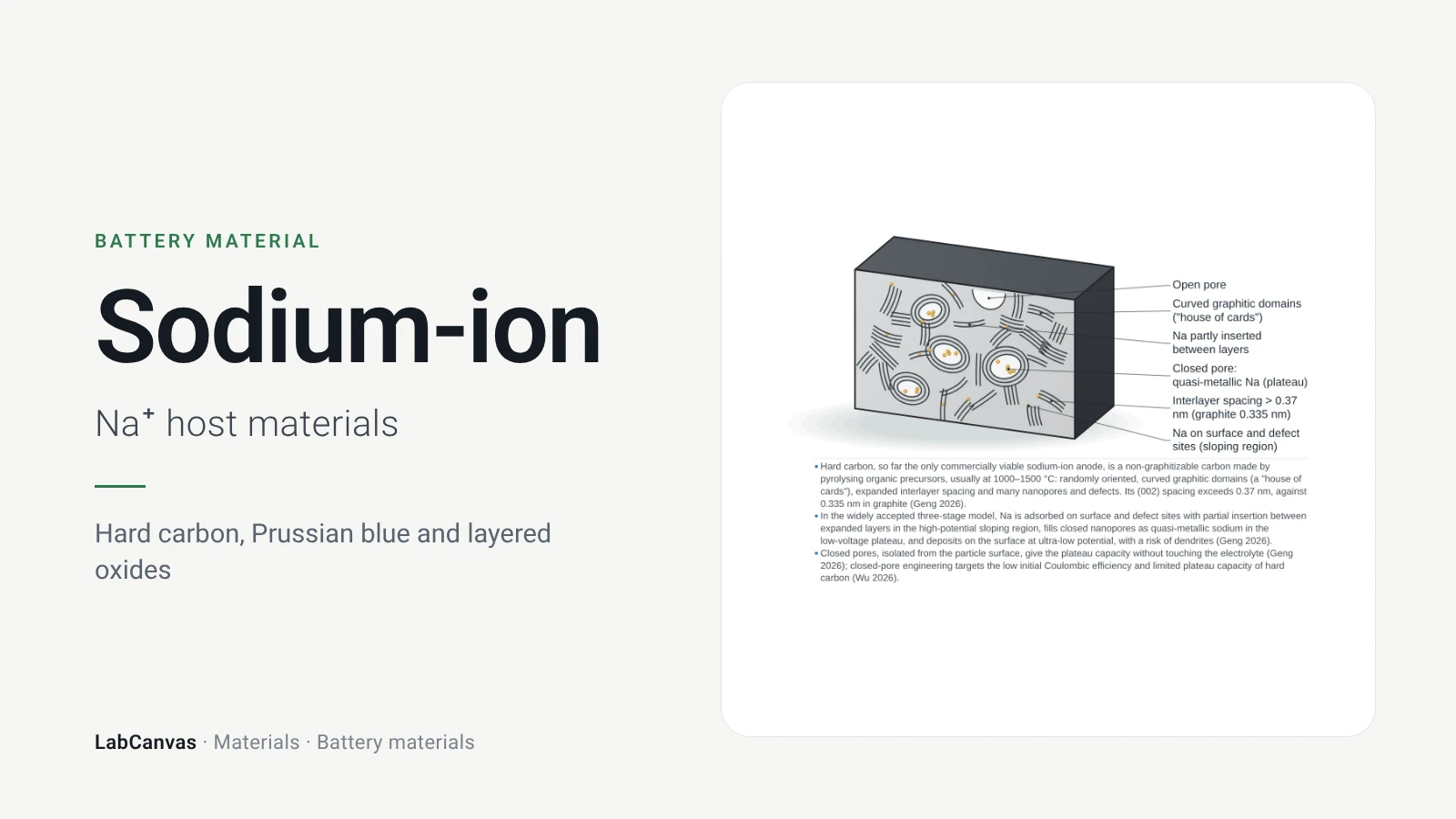
Sodium-ion battery materials structure diagram

Sodium-ion battery materials structure drawing (high-resolution SVG)
Why sodium?
Lithium makes up only about 0.0065% of the Earth’s crust and is unevenly distributed; sodium makes up about 2.65% (Li P. et al. 2026), roughly 400 times more (calculated). Sodium-ion batteries (SIBs) use the same “rocking-chair” principle as lithium-ion batteries, so much of the manufacturing know-how carries over (Li P. et al. 2026; Shen Q. et al. 2026).
Because aluminium is compatible with sodium electrochemistry, both electrodes can sit on aluminium foil, avoiding the cost and weight of the copper anode foil of lithium-ion cells (Li P. et al. 2026). Although Na⁺ is larger than Li⁺, solvated sodium ions have a smaller Stokes radius and a lower desolvation barrier, which helps at low temperature (Li P. et al. 2026).
The trade-off is energy: low energy density is the main challenge of SIBs (Zhou & Shen 2025), so they target large-scale energy storage, low-speed vehicles and two-wheelers, base stations and entry-level electric vehicles (Zhou & Shen 2025). See the battery materials hub for the lithium-ion materials they compete with.
The anode: why hard carbon, not graphite
Graphite’s 0.335 nm layer spacing suits Li⁺ (0.076 nm) and gives 372 mAh g⁻¹, but Na⁺ (0.102 nm) gives less than 35 mAh g⁻¹ (Zhou & Shen 2025). Calculations show that sodium–graphite intercalation compounds have a positive formation energy: unlike lithium, and unlike the larger potassium, sodium does not form a stable compound with graphite (Zhou & Shen 2025).
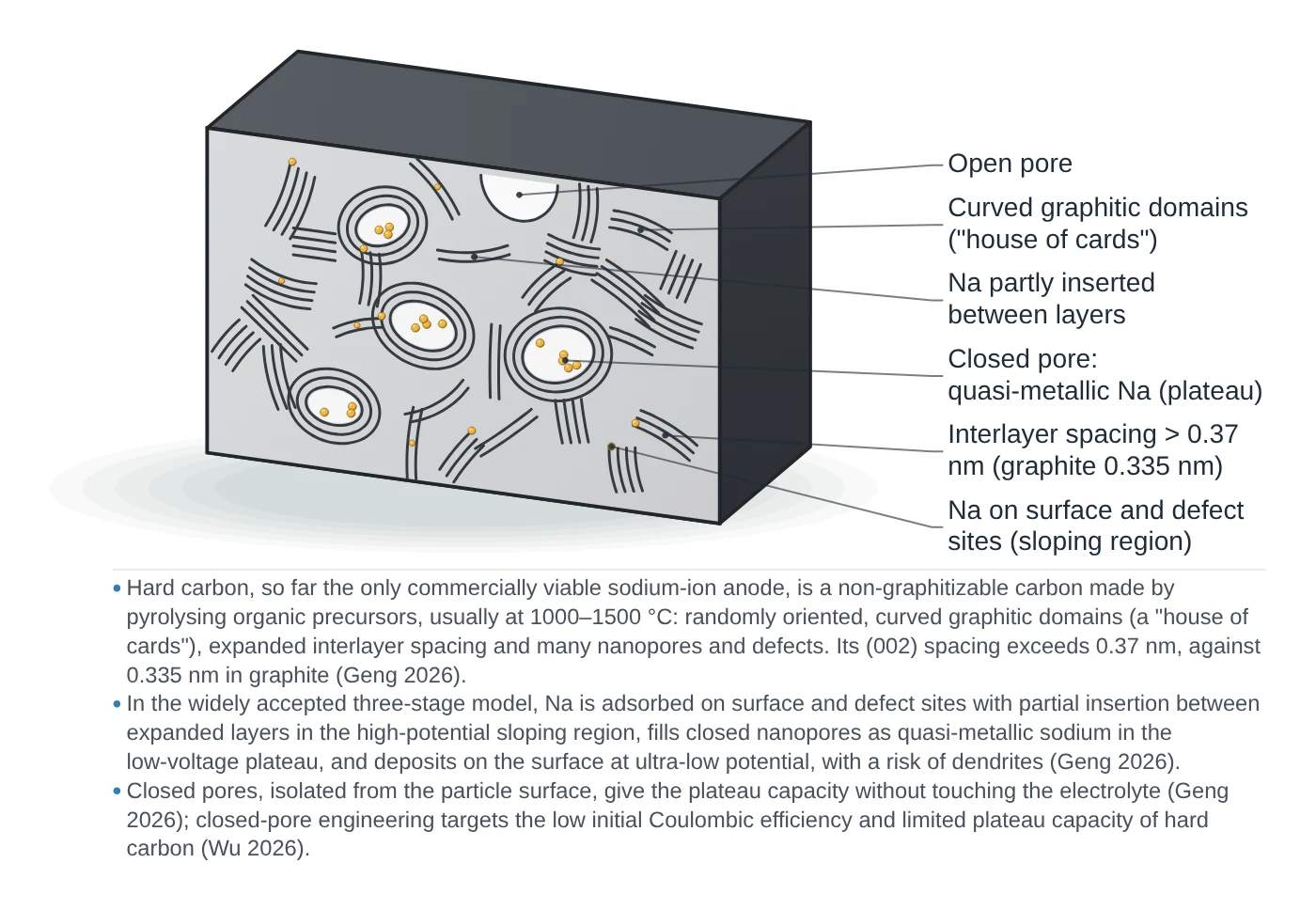
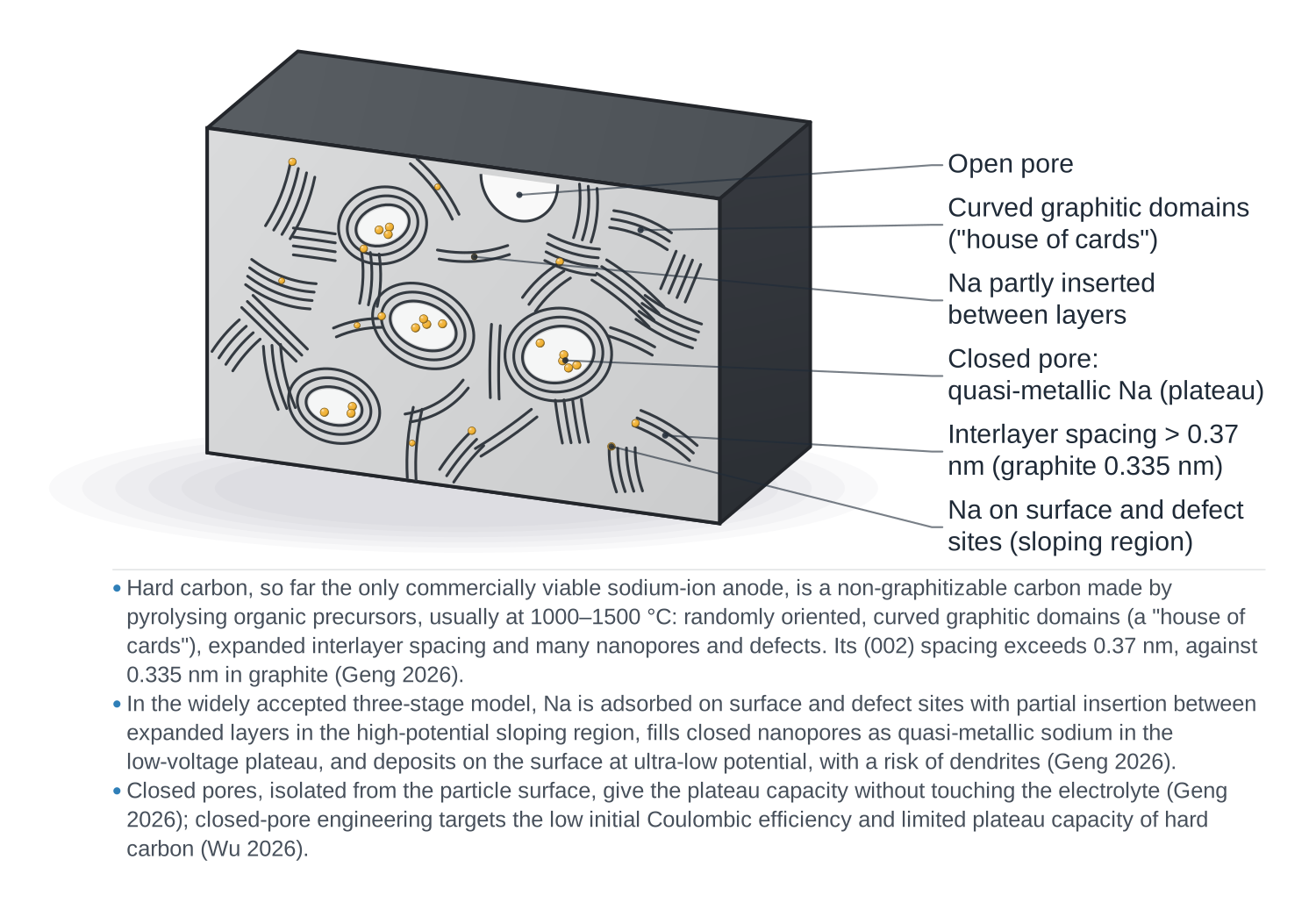
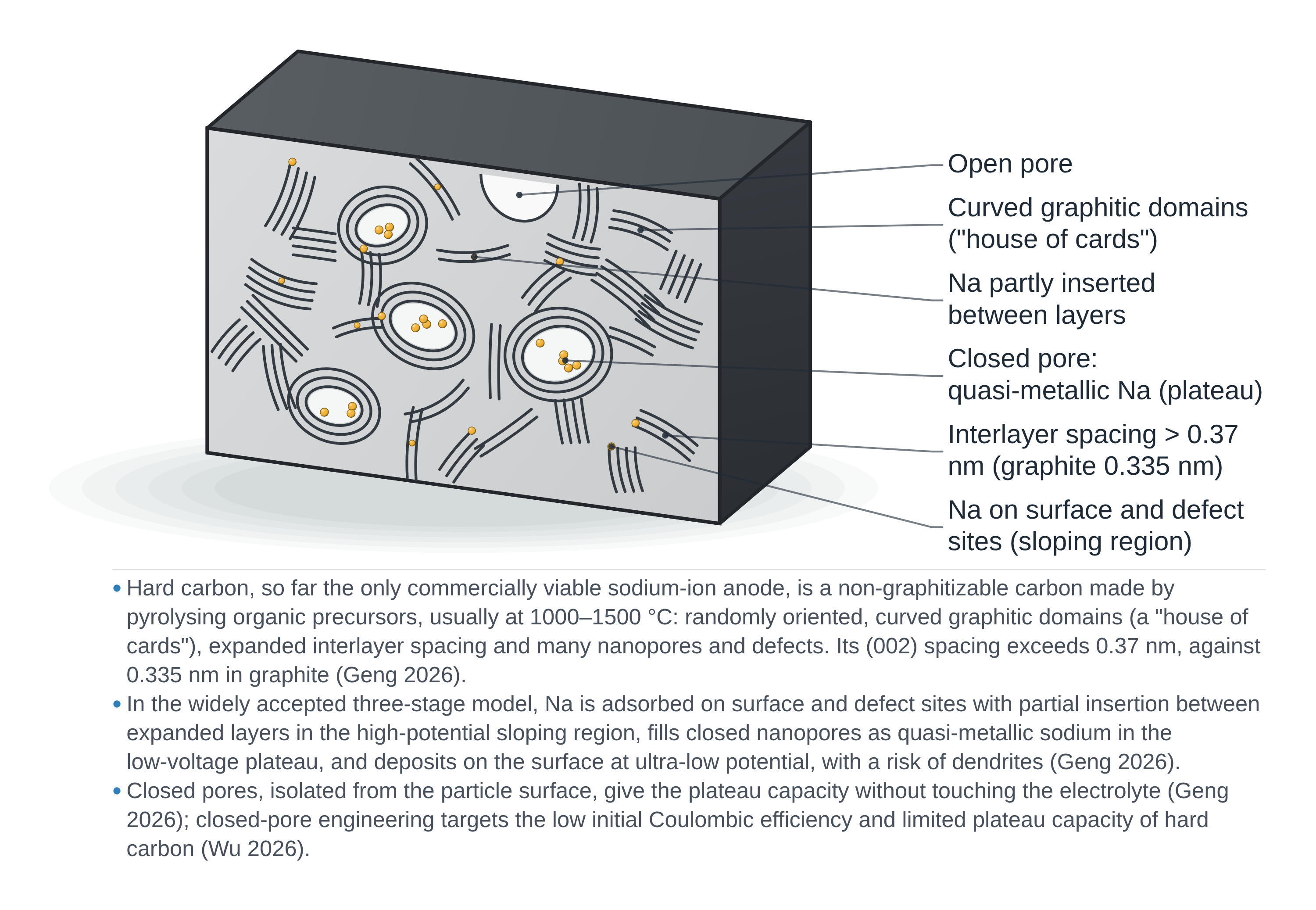
Hard carbon, a disordered carbon made by carbonising precursors such as biomass or anthracite, is the standard SIB anode at 300–400 mAh g⁻¹ (Zhou & Shen 2025). Its voltage curve has two parts:
- a sloping region (2.0–0.1 V vs Na/Na⁺) from sodium adsorbed at defects and surfaces;
- a plateau below 0.1 V from sodium filling closed pores (best below 1 nm) and intercalating into pseudo-graphitic domains with layer spacings of 0.36–0.40 nm (Zhou & Shen 2025).
More defects add sloping capacity but trap sodium irreversibly and lower the initial Coulombic efficiency (Zhou & Shen 2025).
Cathodes: layered oxides, Prussian blue and polyanions
- Layered transition-metal oxides (NaₓTMO₂) stand out for cost and electrochemical performance and give the highest energy density among SIB cathodes, but they are sensitive to air and humidity, crack along microcracks during cycling and are less safe at high voltage (Ma Q. et al. 2026; Shen Q. et al. 2026).
- Prussian blue analogues (PBAs) have an open framework, low cost and a scalable synthesis (Jang et al. 2026); their performance is limited by crystal (lattice) water, structural defects and a relatively low volumetric energy density (Shen Q. et al. 2026).
- Polyanion compounds are safe and stable. NASICON-type frameworks give three-dimensional Na⁺ diffusion, a strong inductive effect and excellent thermal stability, and vanadium fluorophosphates such as Na₃V₂(PO₄)₂F₃ (NVPF) work at high voltage (Cai et al. 2026). Iron-based Na₄Fe₃(PO₄)₂P₂O₇ (NFPP) delivers about 3.2 V and 129 mAh g⁻¹ with stability beyond 10,000 cycles and contains no V, Co, Ni or Cr (Shen Q. et al. 2026). The energy density of polyanions is limited by their heavy formula units (Li P. et al. 2026).
Sodium-ion vs LFP and commercialisation
Lithium iron phosphate (LiFePO₄) cells are the main competitor of sodium-ion cells; SIBs serve as a complement and substitute, and SIBs with iron-based NFPP cathodes are more cost-effective than LiFePO₄ (Shen Q. et al. 2026). Sodium-ion cells store less energy per kilogram than lithium-ion cells (Zhou & Shen 2025), but remain usable at low temperature: an Ah-level pouch cell with a hard carbon anode gave 163 Wh kg⁻¹ (stack level) at 25 °C and still 107 Wh kg⁻¹ at −50 °C (Li P. et al. 2026).
NFPP is at a critical stage of industrialisation, with many companies developing it, and is expected to follow the manufacturing route of LiFePO₄ (Shen Q. et al. 2026). PBA and layered oxide cathodes are also being moved toward practical deployment (Jang et al. 2026; Ma Q. et al. 2026).
How to draw a sodium-ion battery
For a paper, slide or poster, draw a rocking-chair cell with Na⁺ shuttling between a cathode (layered oxide sheets, a Prussian blue cage or a polyanion framework) and a hard carbon anode, both on aluminium foil. For the anode, show hard carbon as curved, stacked graphene fragments (pseudo-graphitic domains) enclosing small closed pores, with sodium adsorbed at defects (sloping region) and clustered in pores (plateau). In LabCanvas, the figure editor's Library has battery objects, including hard carbon, that you can edit and label, and the 3D Studio has battery models for a cell-level view; export the figure as a high-resolution image.
Sodium-ion cathode families compared
| Cathode family | Example | Strength | Weakness | Source |
|---|---|---|---|---|
| Layered oxide | NaₓTMO₂ | Higher energy density, good conductivity | Air and humidity sensitivity, microcracks | Ma Q. et al. 2026; Shen Q. et al. 2026 |
| Prussian blue analogue | PBA framework | Open framework, low cost, easy synthesis | Lattice water, defects, low volumetric energy density | Jang et al. 2026; Shen Q. et al. 2026 |
| Polyanion (NASICON) | Na₃V₂(PO₄)₂F₃ (NVPF) | High voltage, 3D Na⁺ diffusion, thermal stability | Contains vanadium | Cai et al. 2026; Shen Q. et al. 2026 |
| Polyanion (iron) | Na₄Fe₃(PO₄)₂P₂O₇ (NFPP) | ~3.2 V, >10,000 cycles, cheap elements | Low electronic conductivity, impurities | Shen Q. et al. 2026 |
Related materials
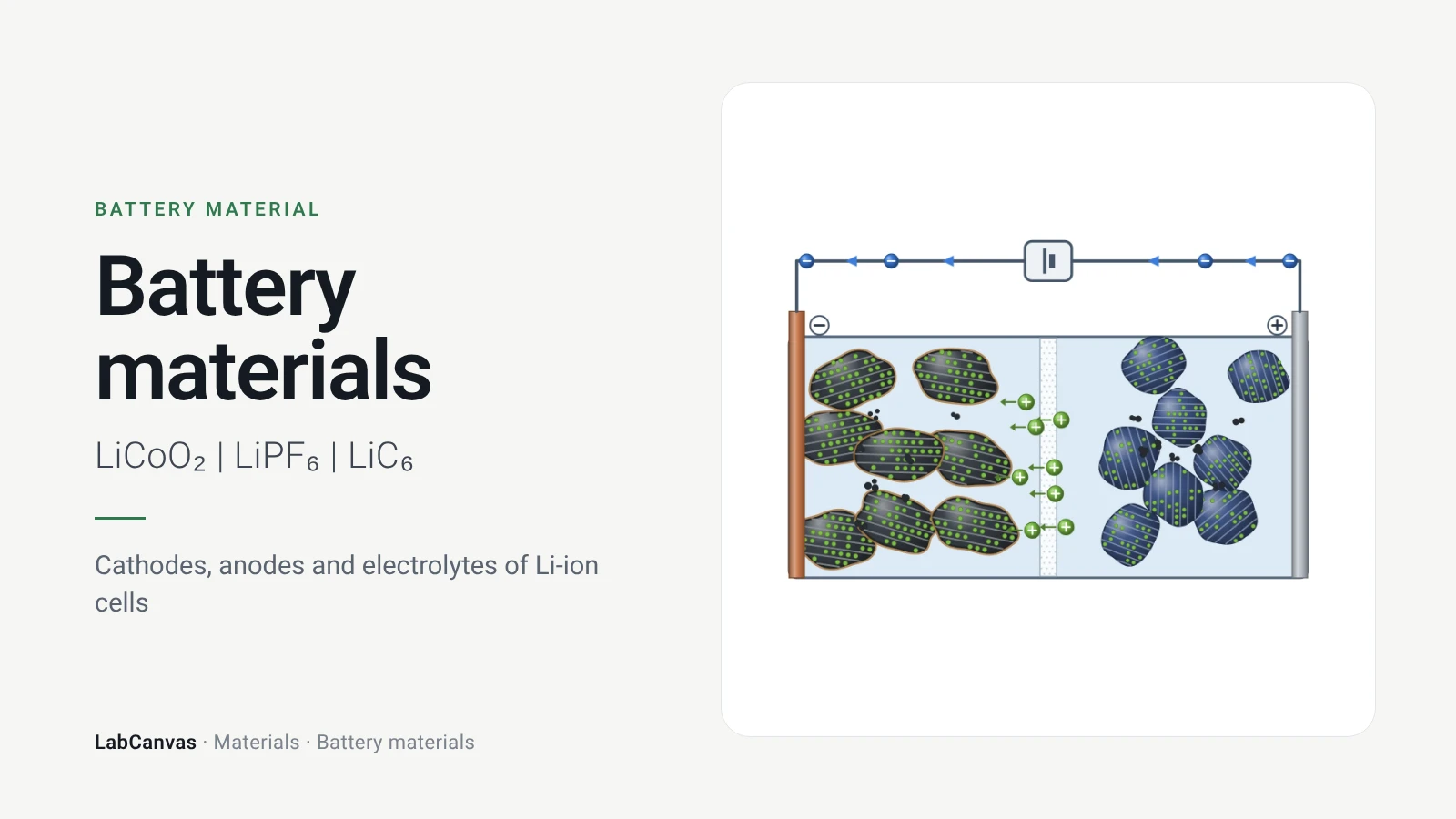
Battery materials
How a lithium-ion cell works and what is inside it: layered, spinel and olivine cathodes, graphite, silicon and lithium anodes, liquid and solid electrolytes.
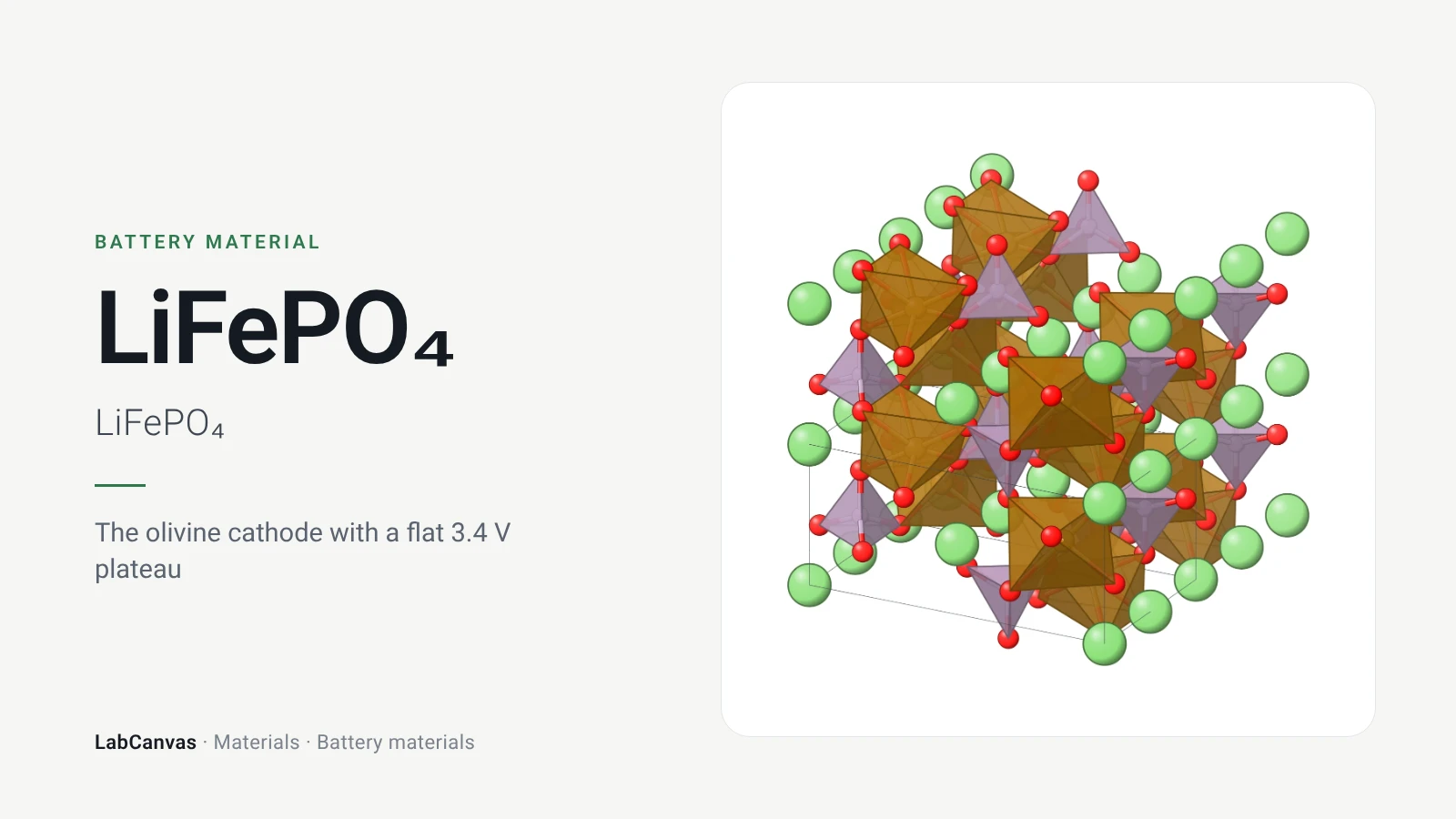
LiFePO₄ (LFP)
LiFePO₄ (LFP) cathode: olivine structure (Pnma), 1D lithium channels, the flat 3.4 V two-phase plateau, 170 mAh/g, carbon coating and why LFP is safe.
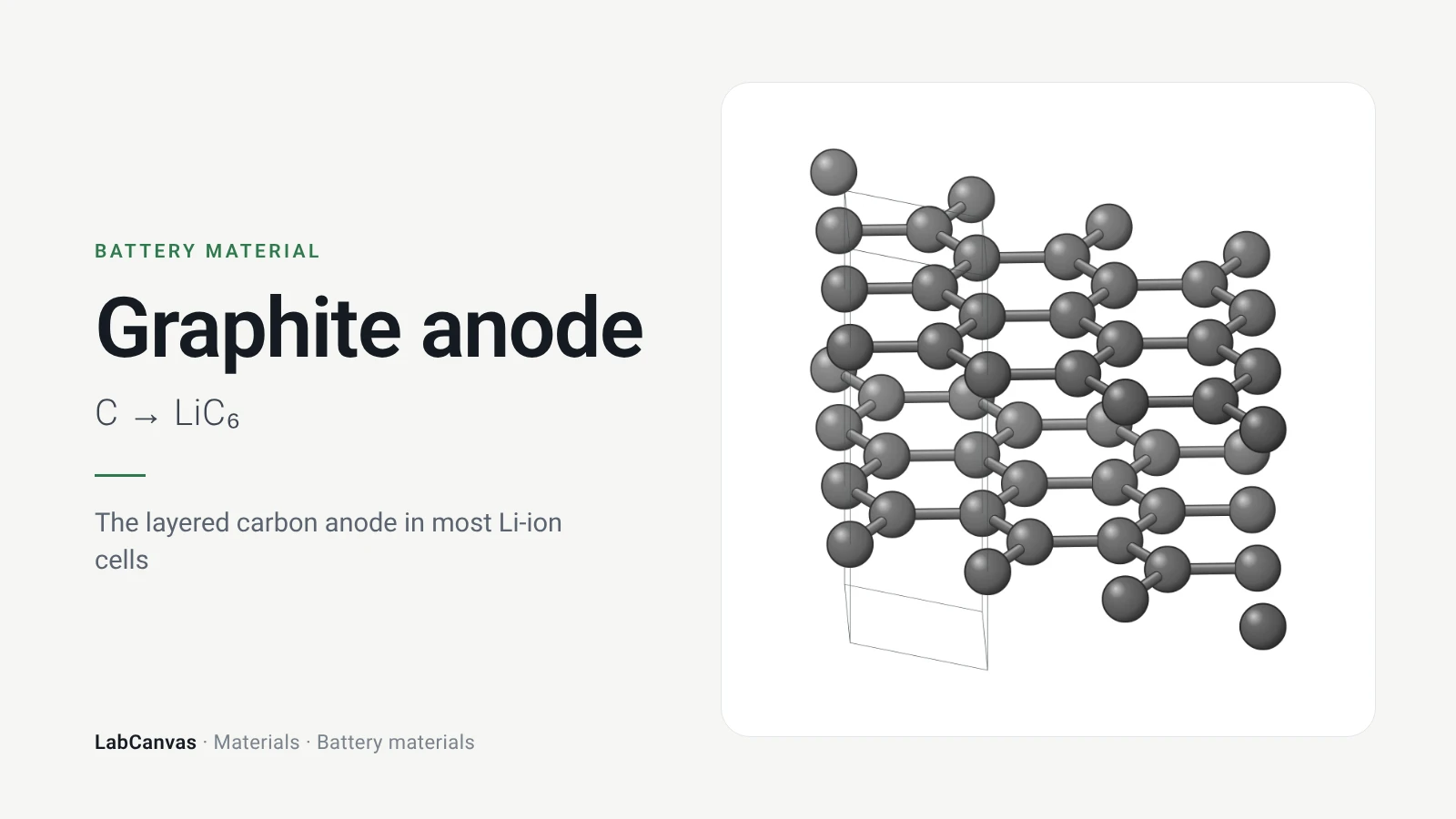
Graphite anode
Graphite anode in lithium-ion batteries: LiC₆ and 372 mAh/g, staging, intercalation near 0.1 V, the SEI from ethylene carbonate and lithium plating.
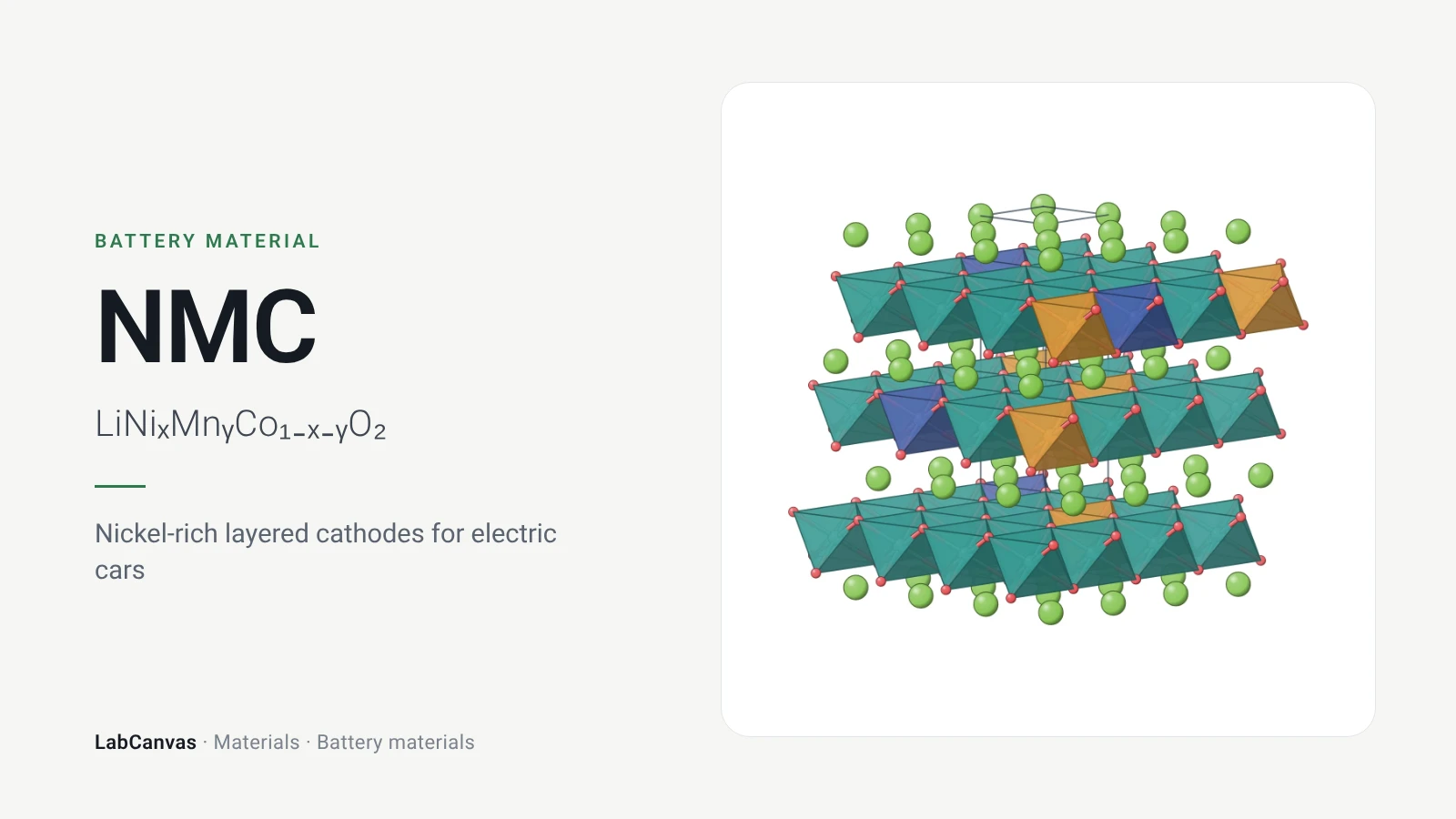
NMC (LiNiₓMnᵧCo₁₋ₓ₋ᵧO₂)
NMC cathodes (LiNiₓMnᵧCo₁₋ₓ₋ᵧO₂): layered structure, NMC111 to 811, why more nickel means more capacity but less stability, and the fixes.
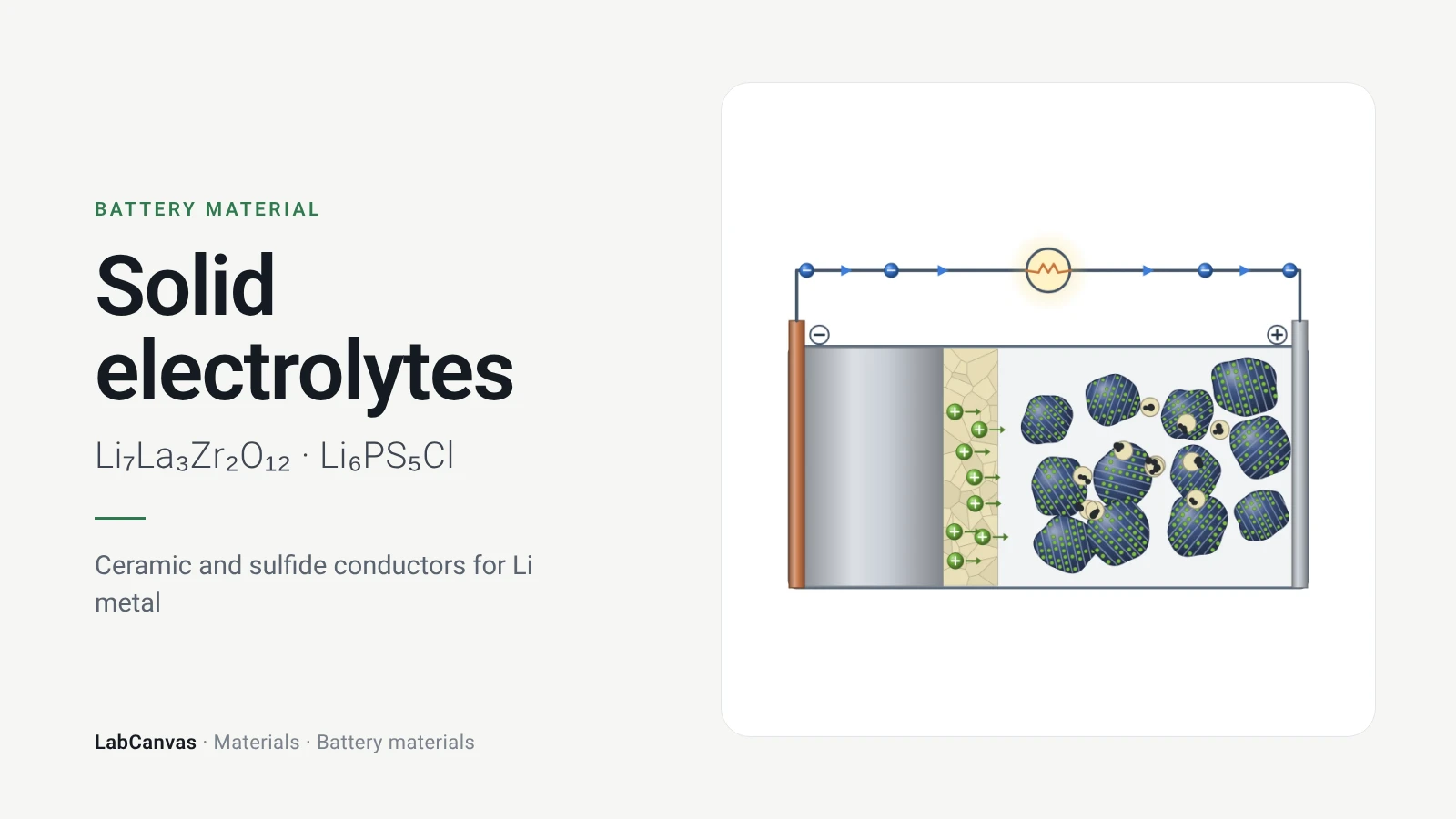
Solid electrolytes (LLZO, argyrodite)
Solid electrolytes for solid-state batteries: garnet LLZO (cubic vs tetragonal, Al/Ga/Ta doping), argyrodite Li₆PS₅Cl, LGPS, PEO, dendrites and Li metal.
More on LabCanvas
- Sodium-ion and potassium-ion batteries: Editable figure template
- More figure templates in this category: Ready-made, cited figures to edit
- Crystal structure figure software compared: VESTA, Mercury, CrystalMaker, Avogadro and LabCanvas
- Supercapacitor calculator: Free tool: capacitance, energy and power from cycling data
- Faradaic efficiency calculator: Free tool
- Battery figure templates: Cited, editable battery figures
- XRD Scherrer crystallite size calculator: Free tool
- Molar mass calculator: Free tool
- Journal figure size guide: Column widths and resolutions for 38 journals
- 3D models gallery: Turn MOFs, COFs, perovskites and more in 3D
Frequently asked questions
Why are sodium-ion batteries cheaper?
Sodium is about 400 times more abundant in the Earth’s crust than lithium (~2.65% vs ~0.0065%; ratio calculated) (Li P. et al. 2026), both electrodes can use aluminium foil instead of copper on the anode, and iron-based cathodes such as NFPP avoid Co, Ni and V (Shen Q. et al. 2026).
Why can’t graphite be used in sodium-ion batteries?
Sodium–graphite intercalation compounds are thermodynamically unstable (positive formation energy), so graphite stores less than 35 mAh g⁻¹ of sodium, against 372 mAh g⁻¹ of lithium (Zhou & Shen 2025).
What is hard carbon?
A disordered carbon made by carbonising precursors such as biomass or anthracite. Its defects, pseudo-graphitic domains (0.36–0.40 nm spacing) and closed pores store 300–400 mAh g⁻¹ of sodium (Zhou & Shen 2025).
Why does hard carbon have a sloping region and a plateau?
The sloping region (2.0–0.1 V) comes from sodium adsorbed at defects and surfaces; the plateau below 0.1 V from sodium filling closed pores and intercalating into pseudo-graphitic domains (Zhou & Shen 2025).
What is a Prussian blue cathode?
A cathode made of a Prussian blue analogue (PBA), a compound with an open framework that hosts Na⁺. It is cheap and easy to make at scale, but crystal water and defects limit its stability (Jang et al. 2026; Shen Q. et al. 2026).
Layered oxide vs polyanion cathode for sodium-ion?
Layered oxides give more energy and better conductivity but are air-sensitive and crack; polyanions such as NFPP and NVPF give long life, thermal stability and safety at lower energy density (Shen Q. et al. 2026; Cai et al. 2026).
Is sodium-ion better than LFP?
Not on energy density: sodium-ion cells store less energy than lithium-ion cells (Zhou & Shen 2025). They compete on cost and low-temperature performance; NFPP sodium-ion cells are more cost-effective than LiFePO₄ (Shen Q. et al. 2026), and one hard carbon pouch cell kept 107 Wh kg⁻¹ at −50 °C (Li P. et al. 2026).
How big is a sodium ion compared with a lithium ion?
Na⁺ has an ionic radius of 0.102 nm and Li⁺ 0.076 nm (Li P. et al. 2026), so sodium is about 1.3 times larger (calculated), which is why it does not fit well between graphite layers.
References
- Y. Zhou, Z. Shen. From sodium storage mechanism to design of high-capacity carbon-based anode: a review. Materials 2025, 18, 2248. doi:10.3390/ma18102248
- P. Li, X. Wang, W. Xu, Y. Zhou, L. Huang, J. Chen. Research progress on optimization strategies for low-temperature performance of sodium-ion batteries. Materials 2026, 19, 3634. doi:10.3390/ma19173634
- Q. Shen et al.. Cost-effective Na₄Fe₃(PO₄)₂P₂O₇ cathode materials for sodium-ion batteries in large-scale energy storage applications. Small Sci. 2026, 6, e70316. doi:10.1002/smsc.70316
- S. Jang, Y. Kim, C. Jo. Recent advances in structural and interfacial chemistry of Prussian blue analogues for sodium-ion batteries. Nanoscale 2026, advance article. doi:10.1039/d6nr02961b
- Q. Ma et al.. Layered oxide cathodes for sodium-ion batteries: origins of microcracks and countermeasures. Chem. Sci. 2026, 17, 10329–10354. doi:10.1039/d6sc02126c
- T. Cai, D. Yu, X. Zhang, S. Zhao, L. Wang. Anion chemistry: structure, electrochemistry and stability of NASICON cathodes. Nano-Micro Lett. 2026, 18. doi:10.1007/s40820-026-02241-5
Draw Sodium-ion battery materials for your paper or slides
LabCanvas is a browser workspace for scientific figures: framework clusters, linkers and nets, crystal structures in 2D and 3D, graphs and posters, all editable.
Edit the Sodium-ion battery materials figure