Literature map template: map papers on a free whiteboard
A free literature map template: a key paper in the middle, earlier work, methods, competing results and follow-ups around it, with labelled arrows. No account.
Contents
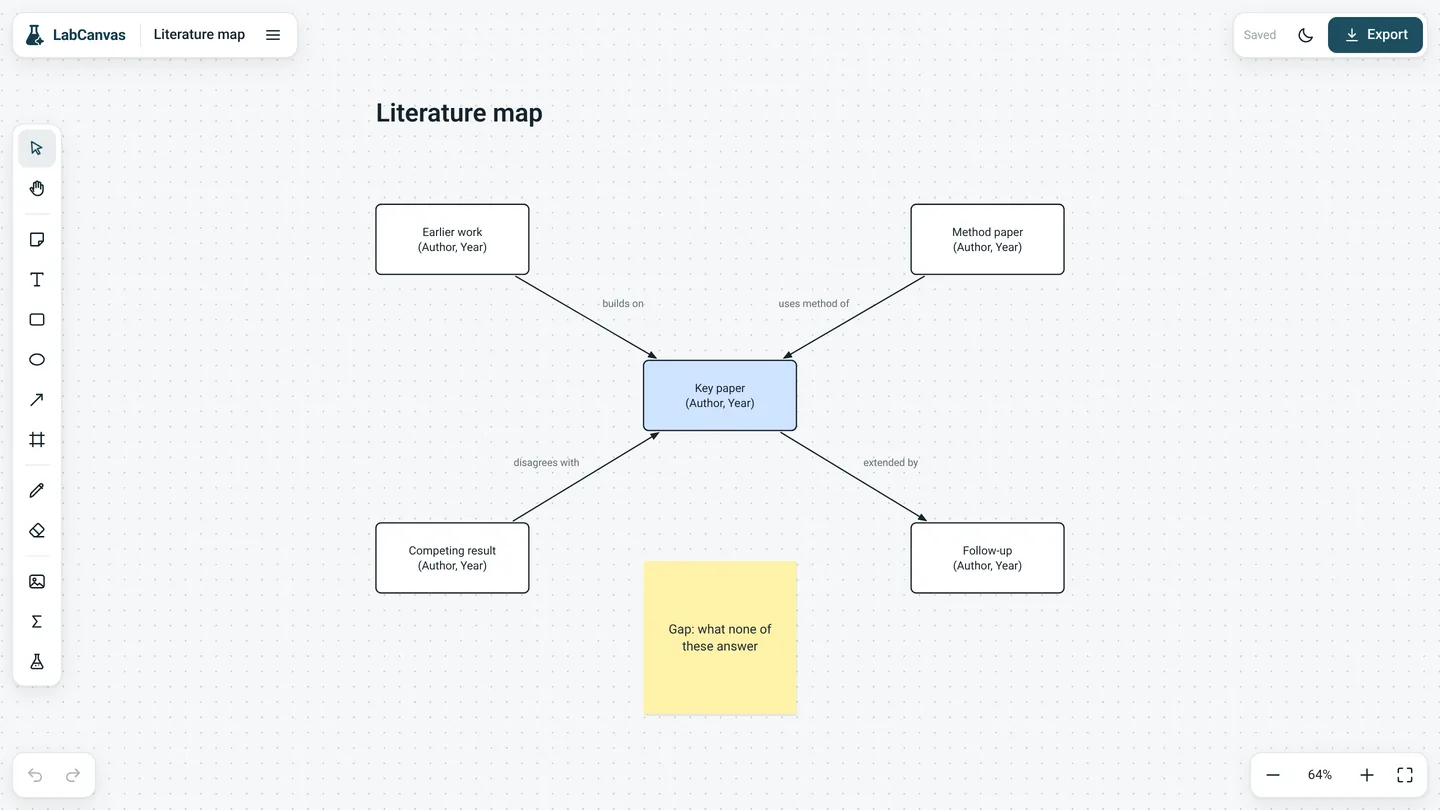
A literature map shows how the papers in a field relate: which one builds on which, where the methods come from, and where results disagree. Seeing it at once makes the gap your work fills easier to name, in a thesis chapter, a grant or a review. This board starts with one key paper and four related ones, each joined by an arrow with its relation written beside it, and a note for the gap.
What’s on the board
| Part | What it is for |
|---|---|
| Key paper | The paper your question starts from, as Author, Year. |
| Earlier work | What the key paper builds on. |
| Method paper | Where a technique the key paper uses comes from. |
| Competing result | A paper that disagrees, with the arrow labelled "disagrees with". |
| Follow-up | Later work that extends the key paper. |
| Gap | A sticky note for what none of these papers answer. |
Everything on it is an ordinary note, box, arrow or equation: change the text, move it, recolour it or delete it. The whiteboard guide has every tool and shortcut.
How to use it
- Click Open this board.
- Double-click each box and type the paper: first author, year and a few words on what it shows.
- Duplicate a box (Ctrl+D or ⌘D) for each new paper and drag it where it belongs.
- Draw an arrow (A) from one paper to another and add a text label (T) beside it: "builds on", "replicates", "contradicts".
- Colour the boxes by theme or by method, and group a cluster of papers in a frame (F).
- Write the gap in the yellow note, then export the map as a PNG for your thesis notes or slides.
Tips for a useful literature map
- Start from one paper, not a topic: the one you would cite first. Add papers as you read them.
- Name the relation on every arrow. An unlabelled line says only that two papers are related.
- Keep the year in each box, so the map also reads as a timeline from left to right if you arrange it that way.
- Mark disagreement in its own colour: that is where open questions usually are.
Other ready-made boards
- Research brainstorm: online mind map for research
- Experiment plan: experiment plan template
- Journal club and lab meeting: whiteboard for lab meetings and journal clubs
- Chemistry whiteboard: online chemistry whiteboard
- Maths and physics whiteboard: online whiteboard for maths and physics
- Kanban for lab projects: Kanban board for research
Or open a blank whiteboard and start from scratch.
Frequently asked questions
Does it import references from Zotero or a .bib file?
No. The whiteboard has no reference import: type the papers into the boxes yourself, or paste text and pictures (for example a key figure) onto the board.
Is it free, and do I need an account?
Yes, it is free, and there is no account or sign-up. Open this board starts a new literature map board in your browser straight away.
Where is my board saved?
In your own browser (IndexedDB), automatically, on your device; nothing is uploaded. Boards you opened before stay as they were: the template opens as a new board. To keep a copy or move the board to another computer, save it as a .whiteboard.json file from the board menu and open it there.
Can I share the board with my group?
There is no sharing link or live editing together. Send the .whiteboard.json file, which anyone can open in their own browser, or export the board as a PNG picture for slides, an e-mail or the lab chat.
Try it in LabCanvas
The whiteboard is free and needs no account: it opens straight away in your browser.
Open Whiteboard free in your browserKeep reading
Mind map for research: a free brainstorming whiteboard
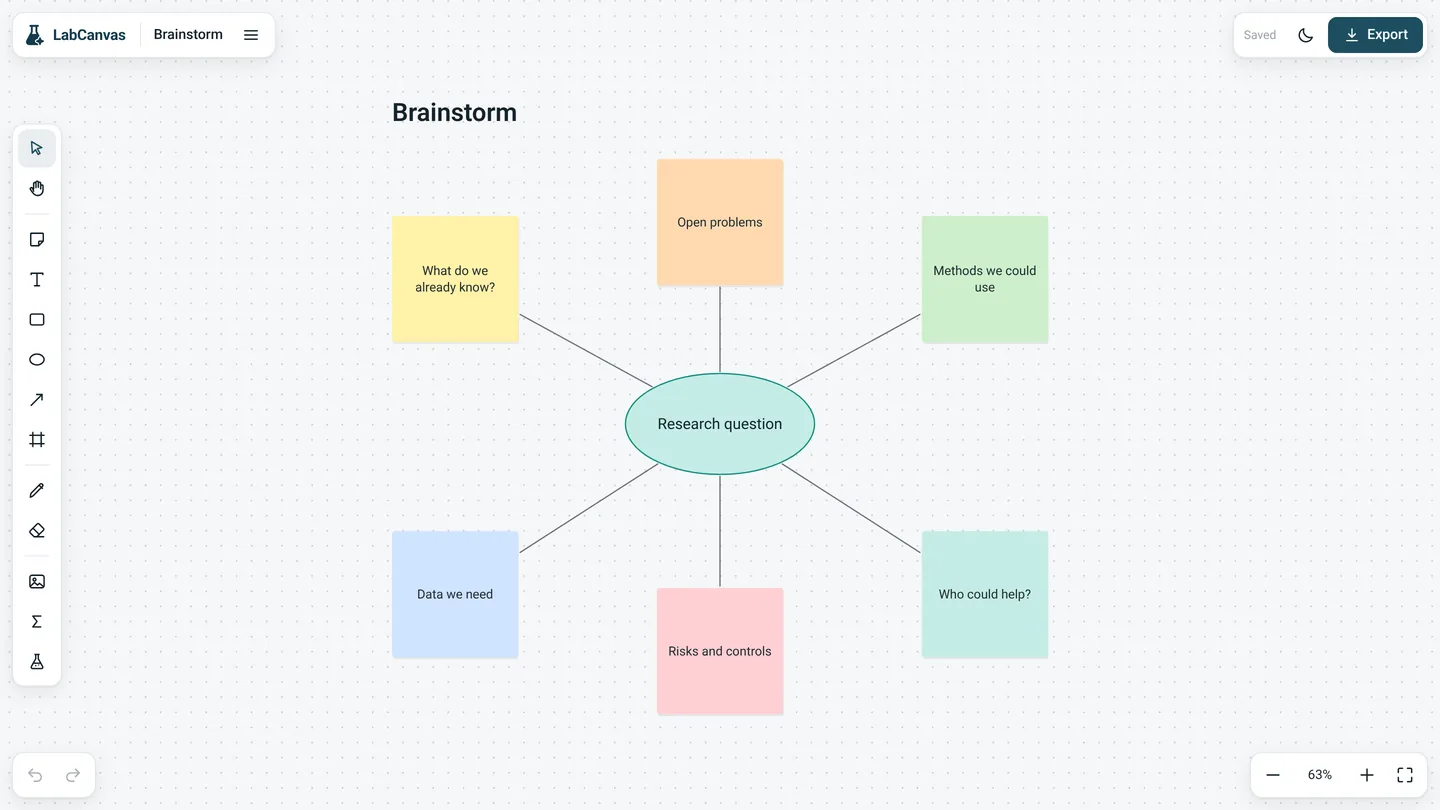
A free online mind map for research: your question in the middle, ideas on sticky notes around it, joined by connectors that stay attached. No account.
Experiment plan template on a free online whiteboard
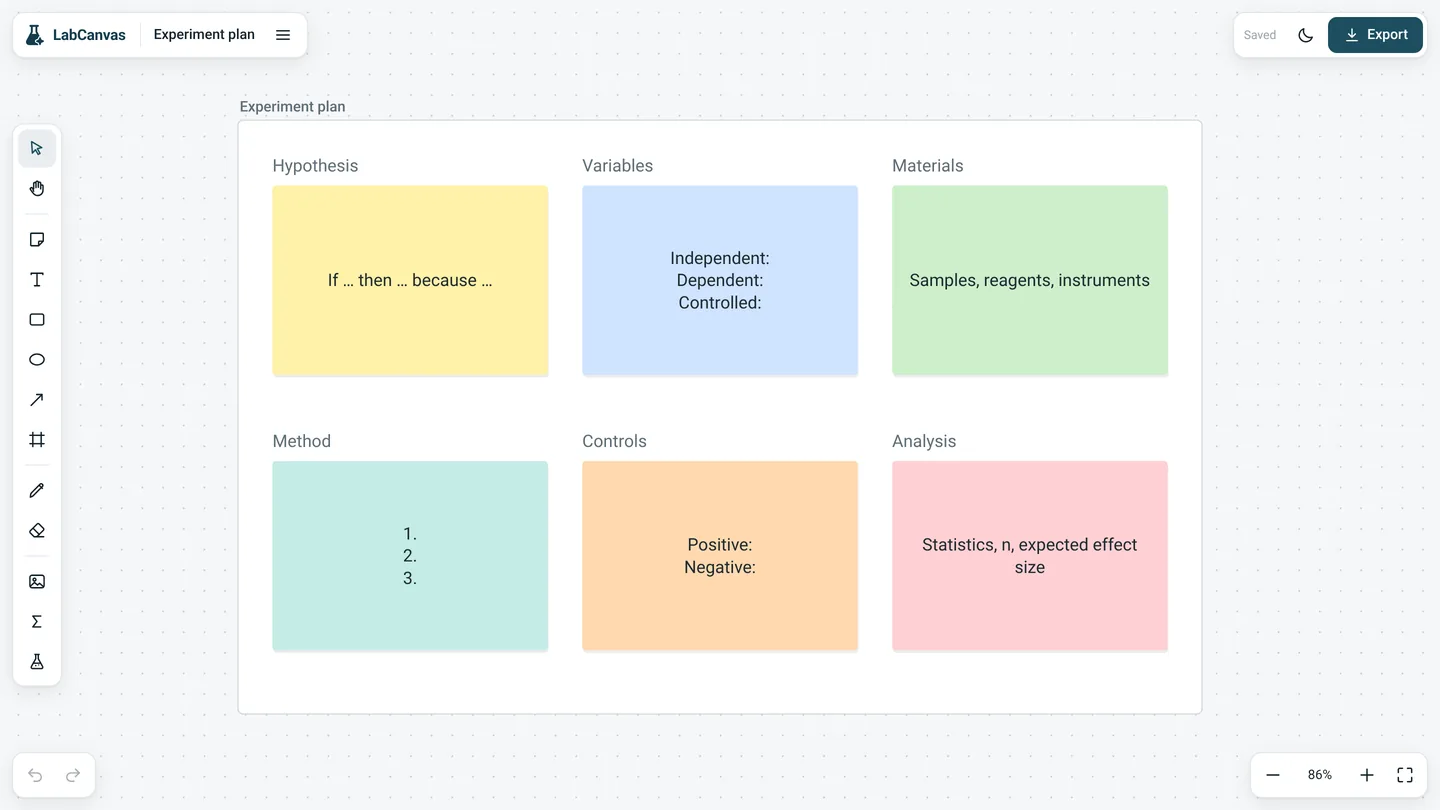
A free experiment plan template: hypothesis, variables, materials, method, controls and analysis on one board, so the whole design is in view. No account.
Journal club and lab meeting board: a free template
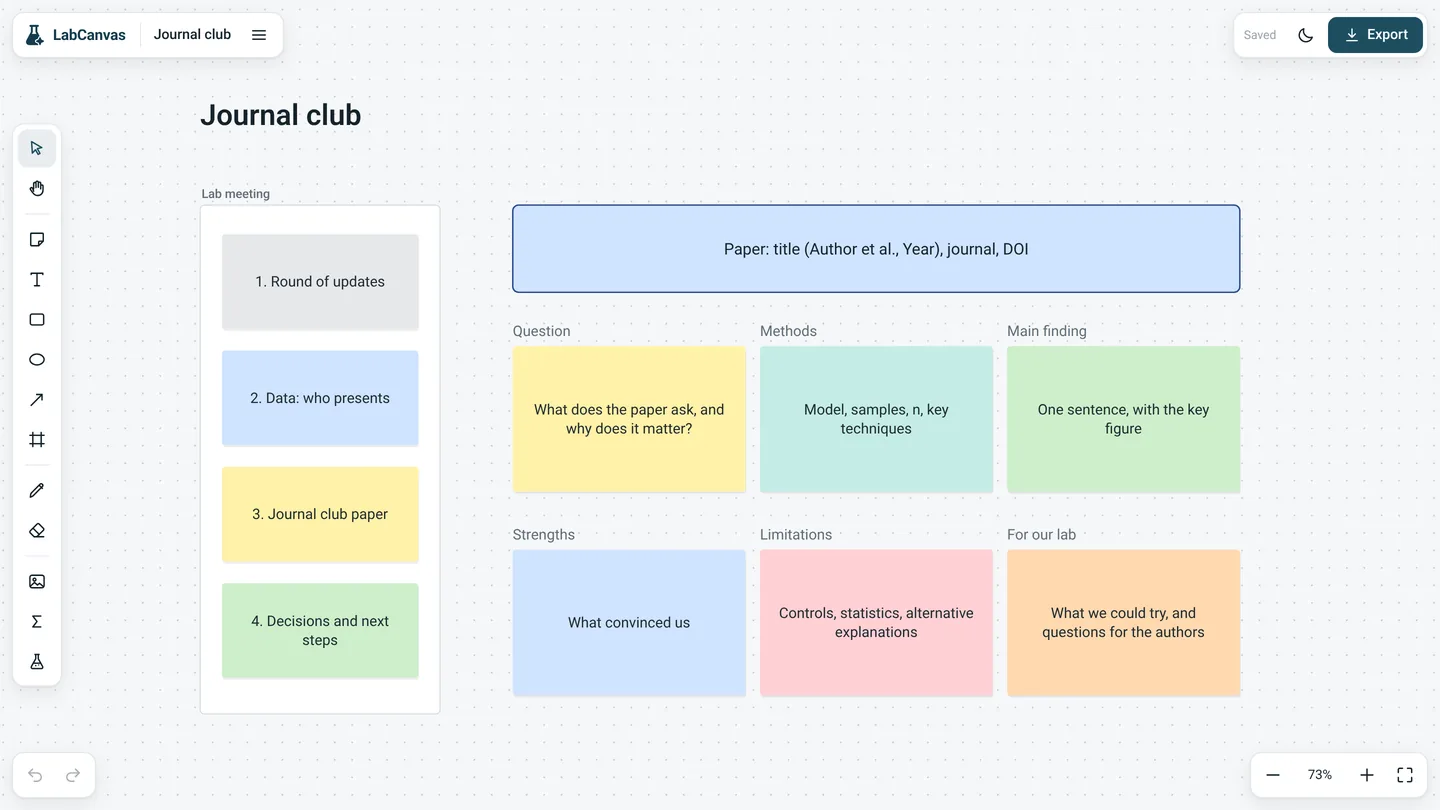
A free whiteboard for lab meetings and journal clubs: an agenda, the paper, and notes for its question, methods, finding, strengths and limitations. No account.