Mind map for research: a free brainstorming whiteboard
A free online mind map for research: your question in the middle, ideas on sticky notes around it, joined by connectors that stay attached. No account.
Contents
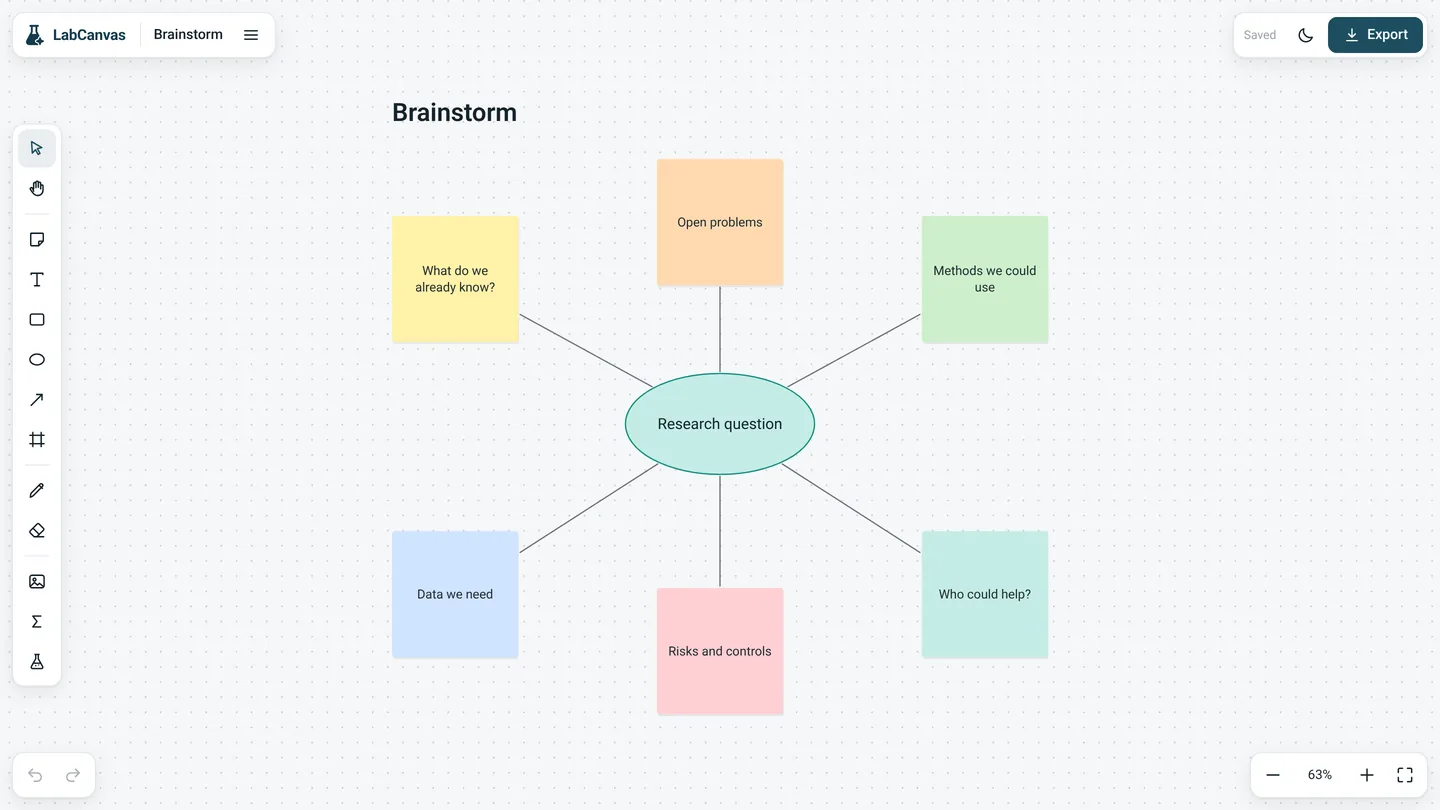
A research question gets clearer when you can see everything around it: what is known, what is open, which methods could work and what could go wrong. This board puts the question in the middle and six prompts around it on sticky notes, each joined to the centre by a connector. Type over the prompts, add notes, and drag them into groups: the connectors follow, so the map stays readable as it grows.
What’s on the board
| Part | What it is for |
|---|---|
| Research question | An ellipse in the middle: write the question in one sentence. |
| What do we already know? | Findings and papers you build on. |
| Open problems | What nobody has answered yet, or answers you doubt. |
| Methods we could use | Techniques, models, instruments, data sets. |
| Data we need | What has to be measured or collected, and how much. |
| Risks and controls | What could mislead you, and how you would notice. |
| Who could help? | Collaborators, core facilities, people who have done it. |
Everything on it is an ordinary note, box, arrow or equation: change the text, move it, recolour it or delete it. The whiteboard guide has every tool and shortcut.
How to use it
- Click Open this board. A new board opens with the question and the six prompts.
- Double-click the ellipse and type your question. Double-click a note to replace its prompt.
- Add ideas: double-click empty board for a new sticky note, or press N. Pick a colour per theme.
- Join ideas with the connector (A): drag from one note to another. Moving either note keeps the arrow attached.
- Group related notes inside a frame (F); moving the frame moves its notes with it.
- Export the map as a PNG (Export, top right) for your notebook or the next lab meeting.
A mind map or a concept map?
A mind map grows from one centre; a concept map names the links between ideas. Both work here: keep the spokes for a mind map, or draw connectors between the outer notes and label them with a text box ("causes", "measured by", "contradicts") for a concept map. For papers and how they relate, the literature map is set up for exactly that.
Other ready-made boards
- Literature map: literature map template
- Experiment plan: experiment plan template
- Journal club and lab meeting: whiteboard for lab meetings and journal clubs
- Chemistry whiteboard: online chemistry whiteboard
- Maths and physics whiteboard: online whiteboard for maths and physics
- Kanban for lab projects: Kanban board for research
Or open a blank whiteboard and start from scratch.
Frequently asked questions
Can I add equations or pictures to the mind map?
Yes. Press M to type a LaTeX equation (typeset by MathJax), paste or drop a picture, or use the Science button (S) to add a molecule from MolDraw or a protein structure from the PDB.
Is it free, and do I need an account?
Yes, it is free, and there is no account or sign-up. Open this board starts a new research brainstorm board in your browser straight away.
Where is my board saved?
In your own browser (IndexedDB), automatically, on your device; nothing is uploaded. Boards you opened before stay as they were: the template opens as a new board. To keep a copy or move the board to another computer, save it as a .whiteboard.json file from the board menu and open it there.
Can I share the board with my group?
There is no sharing link or live editing together. Send the .whiteboard.json file, which anyone can open in their own browser, or export the board as a PNG picture for slides, an e-mail or the lab chat.
Try it in LabCanvas
The whiteboard is free and needs no account: it opens straight away in your browser.
Open Whiteboard free in your browserKeep reading
Literature map template: map papers on a free whiteboard
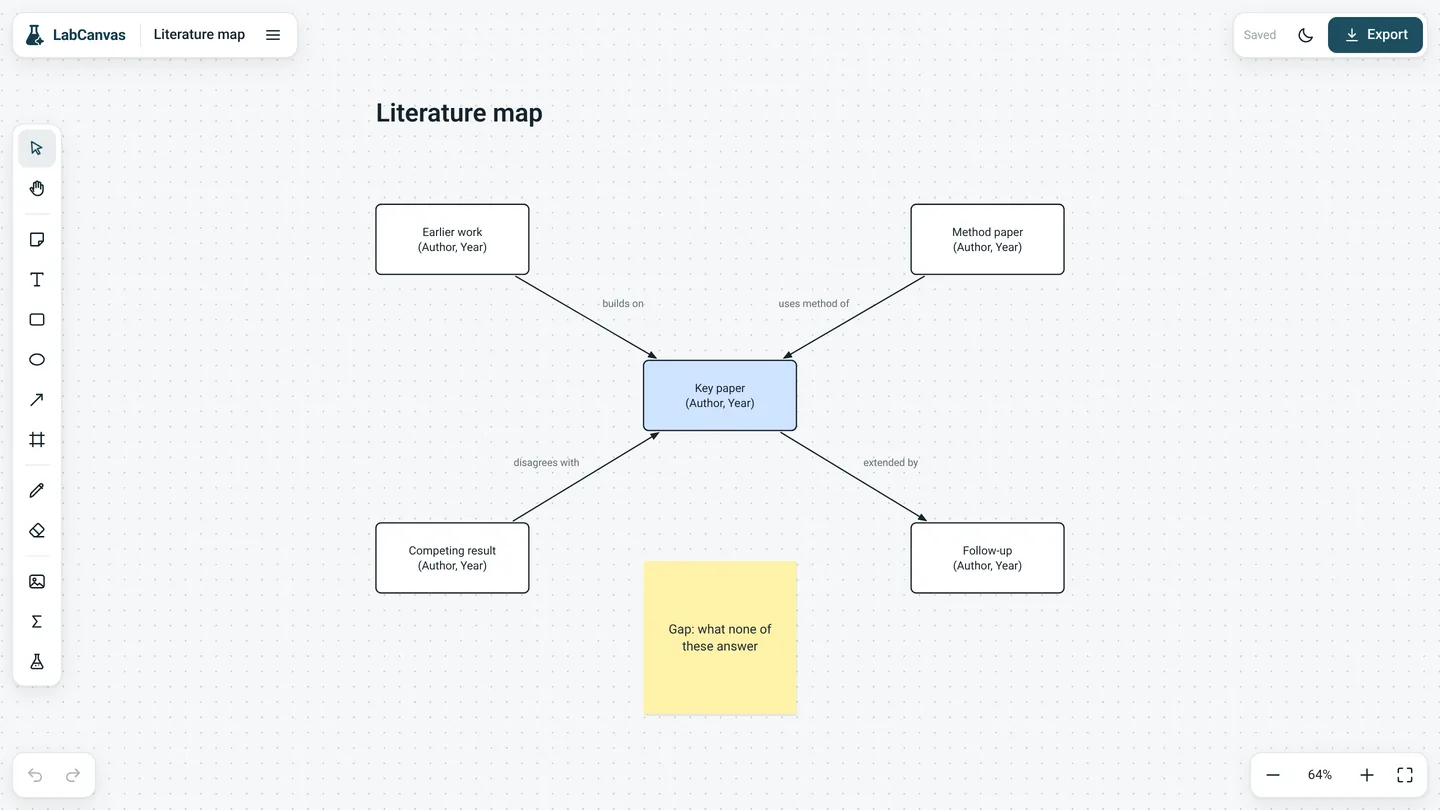
A free literature map template: a key paper in the middle, earlier work, methods, competing results and follow-ups around it, with labelled arrows. No account.
Experiment plan template on a free online whiteboard
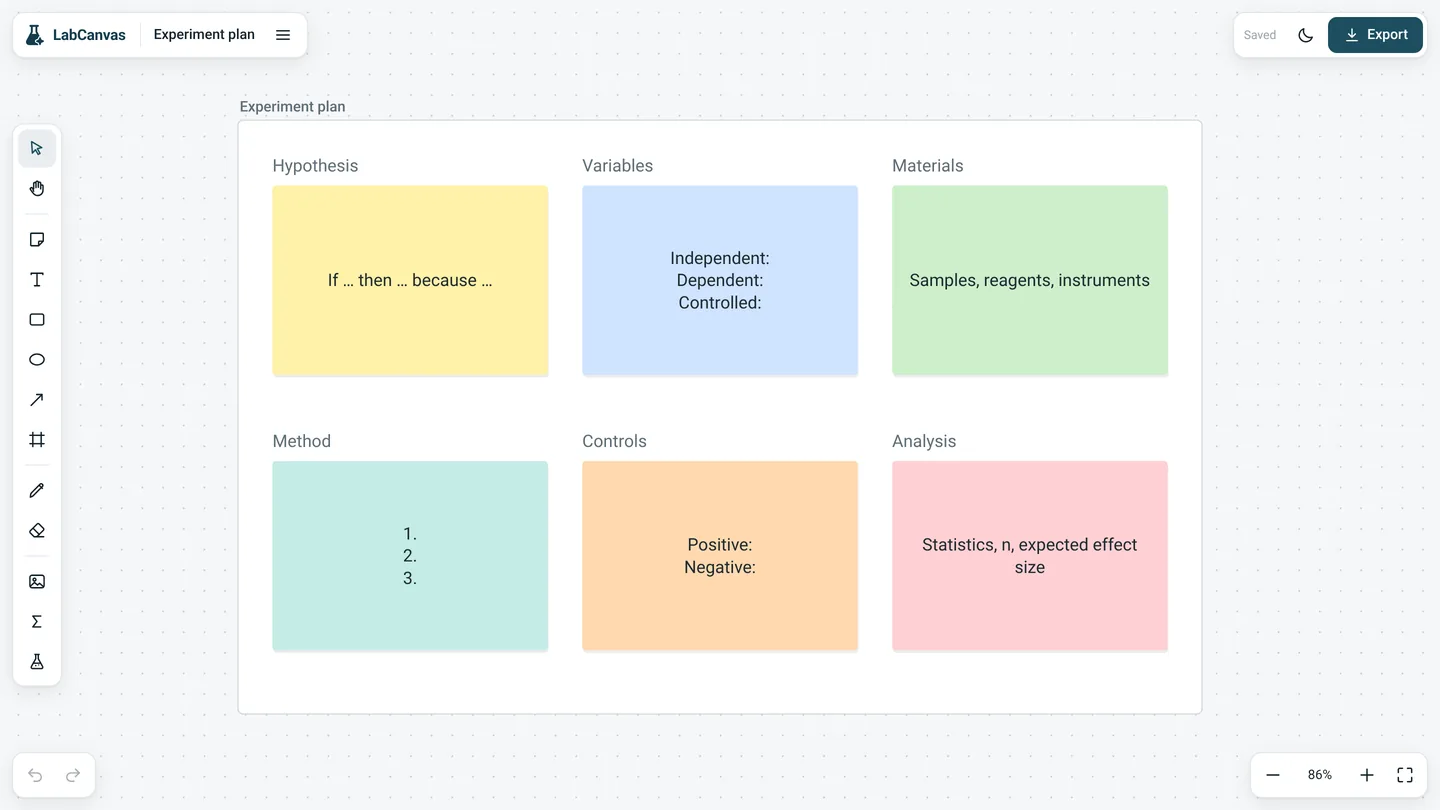
A free experiment plan template: hypothesis, variables, materials, method, controls and analysis on one board, so the whole design is in view. No account.
Journal club and lab meeting board: a free template
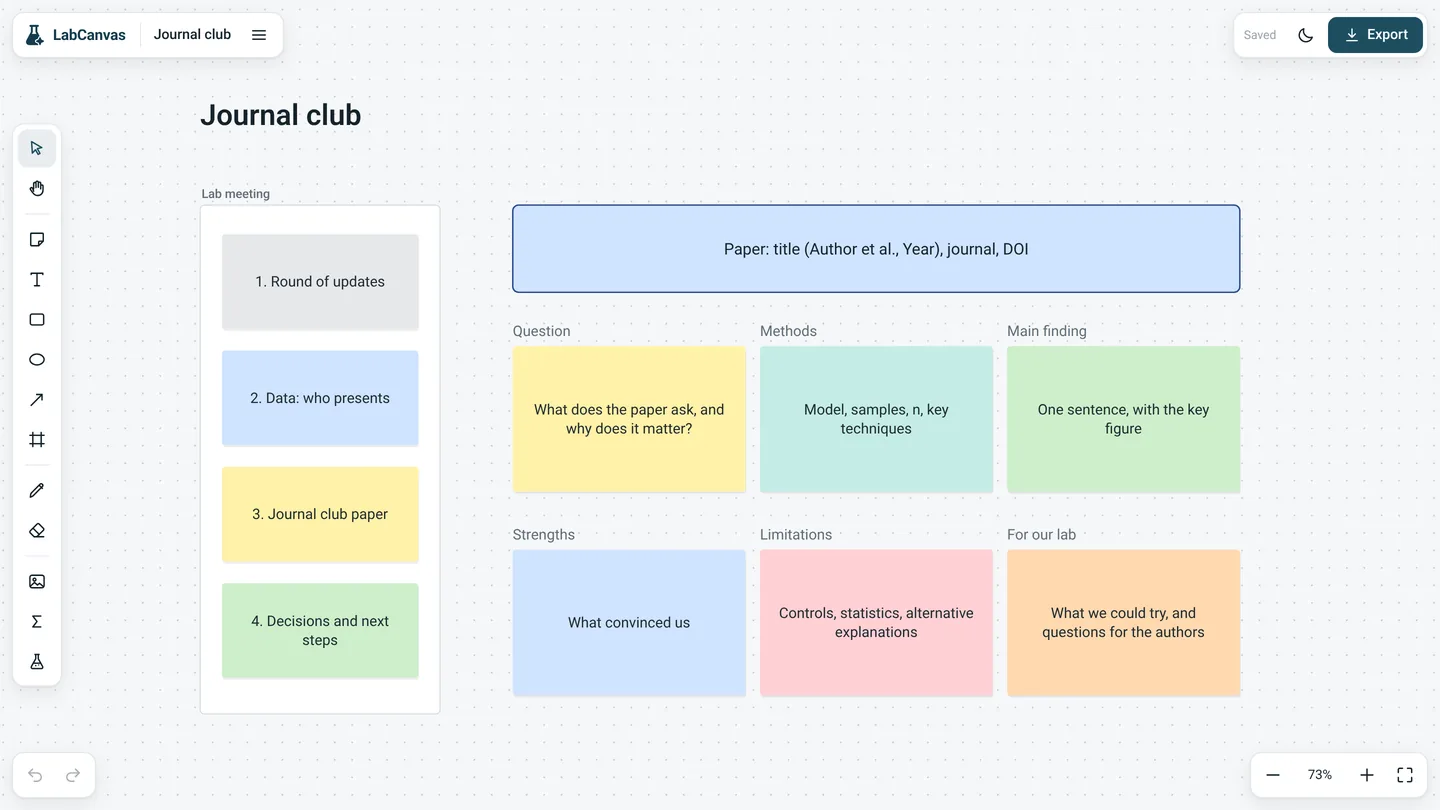
A free whiteboard for lab meetings and journal clubs: an agenda, the paper, and notes for its question, methods, finding, strengths and limitations. No account.