Graphical abstract template · Cancer biology · Graphical abstract
CAR-T cell therapy
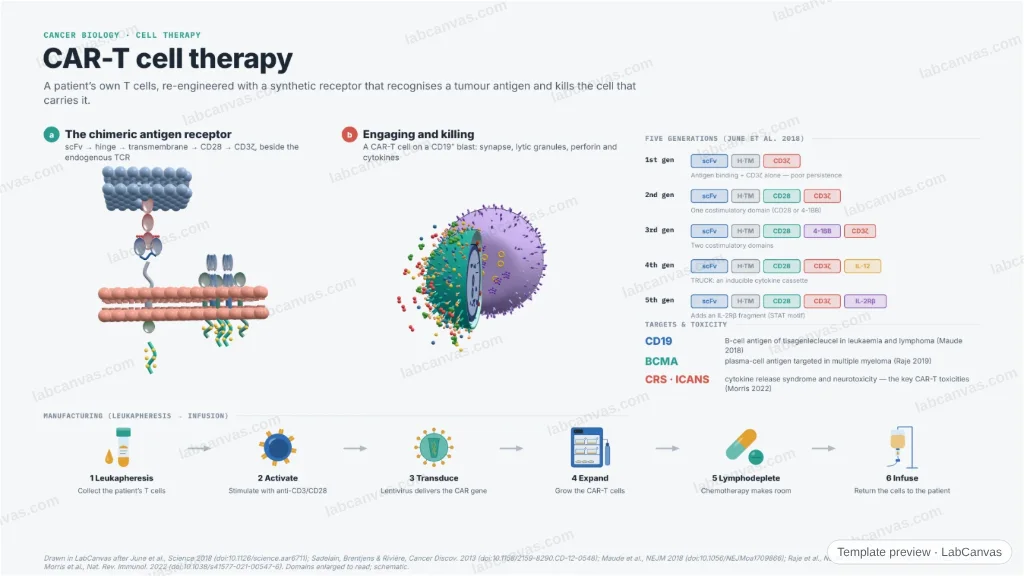
A figure of CAR-T cell therapy. The 3D model shows the chimeric antigen receptor — scFv through hinge, transmembrane domain and costimulation to CD3ζ — and a CAR-T cell killing a CD19⁺ leukaemic blast. Beside them, the five CAR generations module by module, and the manufacturing route from leukapheresis to infusion. Architecture as in June et al. 2018.
Updated 5 cited papers104 editable layers
At a glance
- Category
- Cancer biology
- Method
- Graphical abstract
- Product
- A patient’s T cells re-engineered to recognise and kill a tumour antigen
- Key result
- CD19 CAR-T cells treat B-cell leukaemia and lymphoma (Maude 2018); BCMA CAR-T cells treat myeloma (Raje 2019); cytokine release syndrome and ICANS are the key toxicities (Morris 2022)
- Figure
- 1920 × 1080 px (16:9), 104 editable layers, 6 generated objects
Step by step
- The receptorAn scFv antigen-binding head on a hinge and transmembrane domain, a costimulatory domain (CD28 or 4-1BB) and the CD3ζ signalling tail (Sadelain 2013)
- Five generations1st CD3ζ alone; 2nd adds one costimulatory domain; 3rd adds two; 4th (TRUCK) adds an inducible cytokine; 5th adds an IL-2Rβ fragment (June et al. 2018)
- KillingThe CAR-T cell forms a synapse on a CD19⁺ or BCMA⁺ target, delivers perforin and granzymes and releases cytokines (June et al. 2018)
- ManufacturingLeukapheresis, T-cell activation, lentiviral transduction, expansion, lymphodepletion and infusion (June et al. 2018)
Uses
- Immunotherapy review and graphical-abstract figures
- Talks on cell therapy and CAR design
- Teaching the CAR generations and manufacturing
Papers this template follows
- June et al., “CAR T cell immunotherapy for human cancer”, Science 2018. doi:10.1126/science.aar6711review
- Sadelain, Brentjens & Rivière, “The basic principles of chimeric antigen receptor design”, Cancer Discov. 2013. doi:10.1158/2159-8290.CD-12-0548primary
- Maude et al., “Tisagenlecleucel in children and young adults with B-cell lymphoblastic leukemia”, N. Engl. J. Med. 2018. doi:10.1056/NEJMoa1709866primary
- Raje et al., “Anti-BCMA CAR T-cell therapy bb2121 in relapsed or refractory multiple myeloma”, N. Engl. J. Med. 2019. doi:10.1056/NEJMoa1817226primary
- Morris et al., “Cytokine release syndrome and associated neurotoxicity in cancer immunotherapy”, Nat. Rev. Immunol. 2022. doi:10.1038/s41577-021-00547-6review
Drawn in LabCanvas after June et al., Science 2018 (doi:10.1126/science.aar6711); Sadelain, Brentjens & Rivière, Cancer Discov. 2013 (doi:10.1158/2159-8290.CD-12-0548); Maude et al., NEJM 2018 (doi:10.1056/NEJMoa1709866); Raje et al., NEJM 2019 (doi:10.1056/NEJMoa1817226); and Morris et al., Nat. Rev. Immunol. 2022 (doi:10.1038/s41577-021-00547-6). Domains enlarged to read; schematic.
How templates are written and checked: editorial guidelines.
Questions
What does the “CAR-T cell therapy” template show?
A figure of CAR-T cell therapy. The 3D model shows the chimeric antigen receptor — scFv through hinge, transmembrane domain and costimulation to CD3ζ — and a CAR-T cell killing a CD19⁺ leukaemic blast. Beside them, the five CAR generations module by module, and the manufacturing route from leukapheresis to infusion. Architecture as in June et al. 2018.
What are the steps shown in “CAR-T cell therapy”?
1. The receptor: An scFv antigen-binding head on a hinge and transmembrane domain, a costimulatory domain (CD28 or 4-1BB) and the CD3ζ signalling tail (Sadelain 2013). 2. Five generations: 1st CD3ζ alone; 2nd adds one costimulatory domain; 3rd adds two; 4th (TRUCK) adds an inducible cytokine; 5th adds an IL-2Rβ fragment (June et al. 2018). 3. Killing: The CAR-T cell forms a synapse on a CD19⁺ or BCMA⁺ target, delivers perforin and granzymes and releases cytokines (June et al. 2018). 4. Manufacturing: Leukapheresis, T-cell activation, lentiviral transduction, expansion, lymphodepletion and infusion (June et al. 2018).
Which papers is “CAR-T cell therapy” based on?
June et al., “CAR T cell immunotherapy for human cancer”, Science 2018 (doi:10.1126/science.aar6711); Sadelain, Brentjens & Rivière, “The basic principles of chimeric antigen receptor design”, Cancer Discov. 2013 (doi:10.1158/2159-8290.CD-12-0548); Maude et al., “Tisagenlecleucel in children and young adults with B-cell lymphoblastic leukemia”, N. Engl. J. Med. 2018 (doi:10.1056/NEJMoa1709866); Raje et al., “Anti-BCMA CAR T-cell therapy bb2121 in relapsed or refractory multiple myeloma”, N. Engl. J. Med. 2019 (doi:10.1056/NEJMoa1817226); Morris et al., “Cytokine release syndrome and associated neurotoxicity in cancer immunotherapy”, Nat. Rev. Immunol. 2022 (doi:10.1038/s41577-021-00547-6).
Can I edit the “CAR-T cell therapy” template?
Yes. Open it in the LabCanvas editor: all 104 layers are editable, including 6 generated objects (structures, plots, equipment) with their own settings. Change the text, colours and layout, then export PNG, TIFF or PDF at the width and DPI the journal asks for.
Do I need an account to use this template?
Not to view it here. To open and edit it, sign in to LabCanvas or create a free account (the free plan keeps up to 3 designs). Downloading the figure is part of LabCanvas Pro (US$19 a month or US$199 a year).