Graphical abstract template · Cancer biology · Graphical abstract
Hallmarks of cancer (2022)
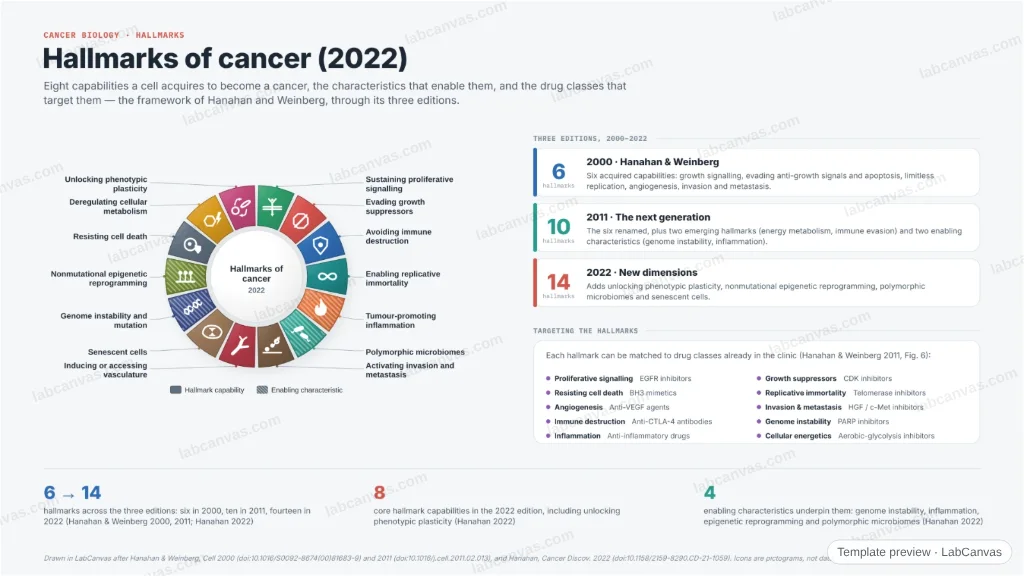
A publication-ready overview of the hallmarks of cancer. The fourteen-spoke Hanahan 2022 wheel — eight hallmark capabilities, four enabling characteristics and two new dimensions — sits beside the three editions (the original six of 2000, the ten of 2011, the fourteen of 2022) and the drug classes that target each hallmark. Every capability and drug class is named as in the papers.
Updated 3 cited papers67 editable layers
At a glance
- Category
- Cancer biology
- Method
- Graphical abstract
- Product
- The fourteen hallmarks of cancer (Hanahan 2022), with their three editions and the drug classes that target them
- Key result
- Six hallmarks in 2000; ten (with two emerging hallmarks and two enabling characteristics) in 2011; fourteen in 2022 (Hanahan 2022)
- Figure
- 1920 × 1080 px (16:9), 67 editable layers, 1 generated objects
Step by step
- The eight capabilitiesSustaining proliferative signalling, evading growth suppressors, resisting cell death, enabling replicative immortality, inducing or accessing vasculature, activating invasion and metastasis, deregulating cellular metabolism and avoiding immune destruction (Hanahan 2022)
- Enabling characteristicsGenome instability and mutation, tumour-promoting inflammation, nonmutational epigenetic reprogramming and polymorphic microbiomes underpin the capabilities (Hanahan 2022)
- New dimensions (2022)Unlocking phenotypic plasticity is added as a hallmark capability; senescent cells join the tumour microenvironment (Hanahan 2022)
- Targeting the hallmarksEach 2011 hallmark has example drug classes: EGFR inhibitors, CDK inhibitors, BH3 mimetics, telomerase inhibitors, anti-VEGF agents, HGF/c-Met inhibitors, anti-CTLA-4, PARP inhibitors, anti-inflammatory drugs and aerobic-glycolysis inhibitors (Hanahan & Weinberg 2011, Fig. 6)
Uses
- Review and perspective figures
- Lecture and seminar slides
- Grant and thesis introductions
Papers this template follows
- Hanahan & Weinberg, “The hallmarks of cancer”, Cell 2000. doi:10.1016/S0092-8674(00)81683-9primary
- Hanahan & Weinberg, “Hallmarks of cancer: the next generation”, Cell 2011. doi:10.1016/j.cell.2011.02.013primary
- Hanahan, “Hallmarks of cancer: new dimensions”, Cancer Discov. 2022. doi:10.1158/2159-8290.CD-21-1059primary
Drawn in LabCanvas after Hanahan & Weinberg, Cell 2000 (doi:10.1016/S0092-8674(00)81683-9) and 2011 (doi:10.1016/j.cell.2011.02.013), and Hanahan, Cancer Discov. 2022 (doi:10.1158/2159-8290.CD-21-1059). Icons are pictograms, not data.
How templates are written and checked: editorial guidelines.
Questions
What does the “Hallmarks of cancer (2022)” template show?
A publication-ready overview of the hallmarks of cancer. The fourteen-spoke Hanahan 2022 wheel — eight hallmark capabilities, four enabling characteristics and two new dimensions — sits beside the three editions (the original six of 2000, the ten of 2011, the fourteen of 2022) and the drug classes that target each hallmark. Every capability and drug class is named as in the papers.
What are the steps shown in “Hallmarks of cancer (2022)”?
1. The eight capabilities: Sustaining proliferative signalling, evading growth suppressors, resisting cell death, enabling replicative immortality, inducing or accessing vasculature, activating invasion and metastasis, deregulating cellular metabolism and avoiding immune destruction (Hanahan 2022). 2. Enabling characteristics: Genome instability and mutation, tumour-promoting inflammation, nonmutational epigenetic reprogramming and polymorphic microbiomes underpin the capabilities (Hanahan 2022). 3. New dimensions (2022): Unlocking phenotypic plasticity is added as a hallmark capability; senescent cells join the tumour microenvironment (Hanahan 2022). 4. Targeting the hallmarks: Each 2011 hallmark has example drug classes: EGFR inhibitors, CDK inhibitors, BH3 mimetics, telomerase inhibitors, anti-VEGF agents, HGF/c-Met inhibitors, anti-CTLA-4, PARP inhibitors, anti-inflammatory drugs and aerobic-glycolysis inhibitors (Hanahan & Weinberg 2011, Fig. 6).
Which papers is “Hallmarks of cancer (2022)” based on?
Hanahan & Weinberg, “The hallmarks of cancer”, Cell 2000 (doi:10.1016/S0092-8674(00)81683-9); Hanahan & Weinberg, “Hallmarks of cancer: the next generation”, Cell 2011 (doi:10.1016/j.cell.2011.02.013); Hanahan, “Hallmarks of cancer: new dimensions”, Cancer Discov. 2022 (doi:10.1158/2159-8290.CD-21-1059).
Can I edit the “Hallmarks of cancer (2022)” template?
Yes. Open it in the LabCanvas editor: all 67 layers are editable, including 1 generated objects (structures, plots, equipment) with their own settings. Change the text, colours and layout, then export PNG, TIFF or PDF at the width and DPI the journal asks for.
Do I need an account to use this template?
Not to view it here. To open and edit it, sign in to LabCanvas or create a free account (the free plan keeps up to 3 designs). Downloading the figure is part of LabCanvas Pro (US$19 a month or US$199 a year).