Graphical abstract template · Cancer biology · Graphical abstract
Colorectal adenoma–carcinoma sequence
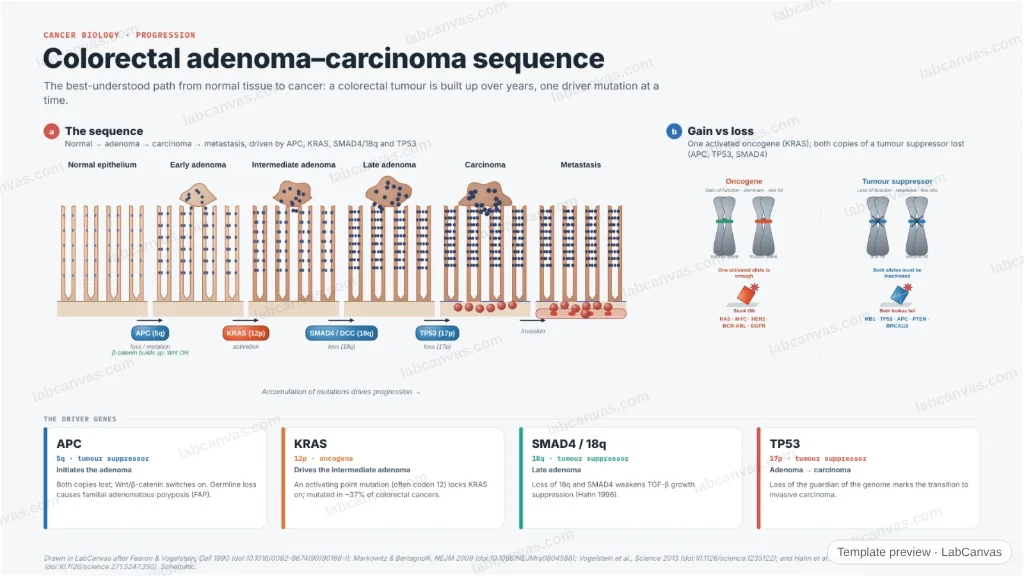
A figure of the colorectal adenoma–carcinoma sequence. Normal epithelium becomes an early adenoma when APC is lost and Wnt switches on, grows through intermediate and late adenomas as KRAS and then SMAD4/18q are hit, and turns into carcinoma when TP53 is lost — the classic Fearon–Vogelstein model. Each driver gene is explained, with the principle that the accumulation of mutations matters more than their order.
Updated 4 cited papers41 editable layers
At a glance
- Category
- Cancer biology
- Method
- Graphical abstract
- Product
- How a colorectal cancer is built up, one driver mutation at a time
- Key result
- A step-wise accumulation of a few driver mutations; it is the accumulation, more than the order, that matters (Fearon & Vogelstein 1990; Vogelstein et al. 2013)
- Figure
- 1920 × 1080 px (16:9), 41 editable layers, 2 generated objects
Step by step
- Initiation (APC)Loss of the APC tumour suppressor switches on Wnt/β-catenin and starts an early adenoma (Fearon & Vogelstein 1990; Markowitz & Bertagnolli 2009)
- Growth (KRAS)An activating KRAS mutation drives the intermediate adenoma; KRAS is mutated in about 37% of colorectal cancers (Markowitz & Bertagnolli 2009)
- Progression (SMAD4/18q)Loss of 18q and SMAD4 weakens TGF-β growth control in the late adenoma (Hahn et al. 1996)
- Carcinoma (TP53)Loss of TP53 (17p) marks the adenoma-to-carcinoma transition, followed by invasion and metastasis (Fearon & Vogelstein 1990)
Uses
- Cancer-genetics review and teaching figures
- Lectures on tumour progression
- Grant and thesis introductions
Papers this template follows
- Fearon & Vogelstein, “A genetic model for colorectal tumorigenesis”, Cell 1990. doi:10.1016/0092-8674(90)90186-Iprimary
- Markowitz & Bertagnolli, “Molecular basis of colorectal cancer”, N. Engl. J. Med. 2009. doi:10.1056/NEJMra0804588review
- Vogelstein et al., “Cancer genome landscapes”, Science 2013. doi:10.1126/science.1235122review
- Hahn et al., “DPC4, a candidate tumor suppressor gene at human chromosome 18q21.1”, Science 1996. doi:10.1126/science.271.5247.350primary
Drawn in LabCanvas after Fearon & Vogelstein, Cell 1990 (doi:10.1016/0092-8674(90)90186-I); Markowitz & Bertagnolli, NEJM 2009 (doi:10.1056/NEJMra0804588); Vogelstein et al., Science 2013 (doi:10.1126/science.1235122); and Hahn et al., Science 1996 (doi:10.1126/science.271.5247.350). Schematic.
How templates are written and checked: editorial guidelines.
Questions
What does the “Colorectal adenoma–carcinoma sequence” template show?
A figure of the colorectal adenoma–carcinoma sequence. Normal epithelium becomes an early adenoma when APC is lost and Wnt switches on, grows through intermediate and late adenomas as KRAS and then SMAD4/18q are hit, and turns into carcinoma when TP53 is lost — the classic Fearon–Vogelstein model. Each driver gene is explained, with the principle that the accumulation of mutations matters more than their order.
What are the steps shown in “Colorectal adenoma–carcinoma sequence”?
1. Initiation (APC): Loss of the APC tumour suppressor switches on Wnt/β-catenin and starts an early adenoma (Fearon & Vogelstein 1990; Markowitz & Bertagnolli 2009). 2. Growth (KRAS): An activating KRAS mutation drives the intermediate adenoma; KRAS is mutated in about 37% of colorectal cancers (Markowitz & Bertagnolli 2009). 3. Progression (SMAD4/18q): Loss of 18q and SMAD4 weakens TGF-β growth control in the late adenoma (Hahn et al. 1996). 4. Carcinoma (TP53): Loss of TP53 (17p) marks the adenoma-to-carcinoma transition, followed by invasion and metastasis (Fearon & Vogelstein 1990).
Which papers is “Colorectal adenoma–carcinoma sequence” based on?
Fearon & Vogelstein, “A genetic model for colorectal tumorigenesis”, Cell 1990 (doi:10.1016/0092-8674(90)90186-I); Markowitz & Bertagnolli, “Molecular basis of colorectal cancer”, N. Engl. J. Med. 2009 (doi:10.1056/NEJMra0804588); Vogelstein et al., “Cancer genome landscapes”, Science 2013 (doi:10.1126/science.1235122); Hahn et al., “DPC4, a candidate tumor suppressor gene at human chromosome 18q21.1”, Science 1996 (doi:10.1126/science.271.5247.350).
Can I edit the “Colorectal adenoma–carcinoma sequence” template?
Yes. Open it in the LabCanvas editor: all 41 layers are editable, including 2 generated objects (structures, plots, equipment) with their own settings. Change the text, colours and layout, then export PNG, TIFF or PDF at the width and DPI the journal asks for.
Do I need an account to use this template?
Not to view it here. To open and edit it, sign in to LabCanvas or create a free account (the free plan keeps up to 3 designs). Downloading the figure is part of LabCanvas Pro (US$19 a month or US$199 a year).