Graphical abstract template · Cancer biology · Graphical abstract
CRISPR screen for cancer dependencies
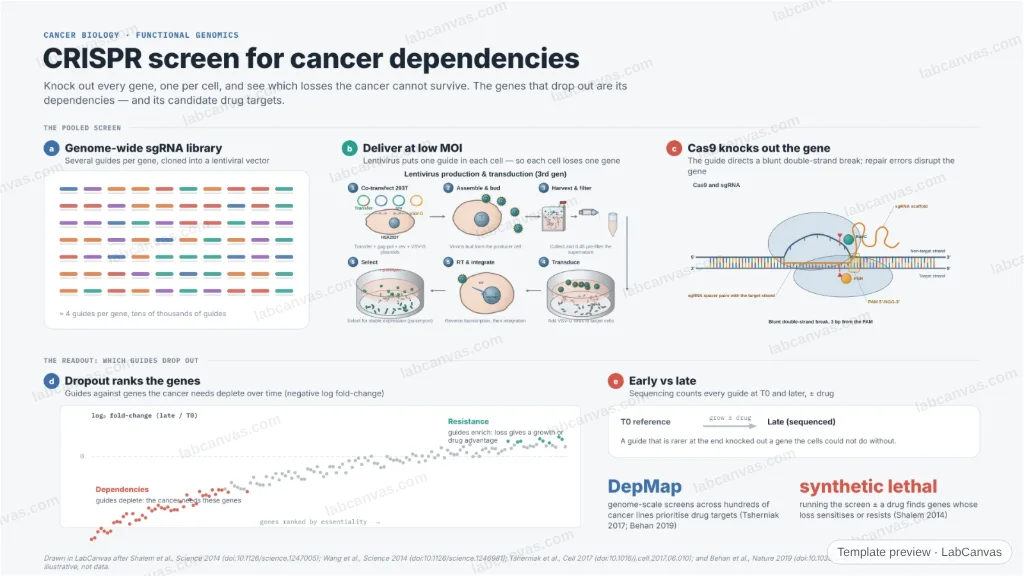
A figure of a pooled CRISPR–Cas9 knockout screen for cancer dependencies. A genome-wide sgRNA library is delivered by lentivirus at low multiplicity so each cell carries one guide and loses one gene; the cells grow, and the abundance of each guide is compared early versus late by sequencing. Guides that drop out mark the genes the cancer needs — its dependencies and candidate drug targets.
Updated 4 cited papers342 editable layers
At a glance
- Category
- Cancer biology
- Method
- Graphical abstract
- Product
- The genes a cancer cell depends on, found by knocking out every gene at once
- Key result
- Genome-scale screens across hundreds of cancer lines (the Cancer Dependency Map) prioritise therapeutic targets (Tsherniak et al. 2017; Behan et al. 2019)
- Figure
- 1920 × 1080 px (16:9), 342 editable layers, 2 generated objects
Step by step
- Make the libraryA genome-wide library of single-guide RNAs, several guides per gene, is cloned into a lentiviral vector (Shalem et al. 2014; Wang et al. 2014)
- One guide per cellCancer cells are transduced at low multiplicity so each cell carries one guide and Cas9 knocks out one gene
- Grow & compareCells grow; the abundance of each guide is read by sequencing early (T0) versus late, with or without a drug
- Read the dropoutGuides that deplete mark genes the cancer needs (dependencies); guides that enrich mark genes whose loss gives resistance (Tsherniak et al. 2017)
Uses
- Functional-genomics review and graphical-abstract figures
- Talks on dependency mapping and target discovery
- Teaching the pooled CRISPR screen workflow
Papers this template follows
- Shalem et al., “Genome-scale CRISPR-Cas9 knockout screening in human cells”, Science 2014. doi:10.1126/science.1247005primary
- Wang et al., “Genetic screens in human cells using the CRISPR-Cas9 system”, Science 2014. doi:10.1126/science.1246981primary
- Tsherniak et al., “Defining a cancer dependency map”, Cell 2017. doi:10.1016/j.cell.2017.06.010primary
- Behan et al., “Prioritization of cancer therapeutic targets using CRISPR–Cas9 screens”, Nature 2019. doi:10.1038/s41586-019-1103-9primary
Drawn in LabCanvas after Shalem et al., Science 2014 (doi:10.1126/science.1247005); Wang et al., Science 2014 (doi:10.1126/science.1246981); Tsherniak et al., Cell 2017 (doi:10.1016/j.cell.2017.06.010); and Behan et al., Nature 2019 (doi:10.1038/s41586-019-1103-9). The dropout plot is illustrative, not data.
How templates are written and checked: editorial guidelines.
Questions
What does the “CRISPR screen for cancer dependencies” template show?
A figure of a pooled CRISPR–Cas9 knockout screen for cancer dependencies. A genome-wide sgRNA library is delivered by lentivirus at low multiplicity so each cell carries one guide and loses one gene; the cells grow, and the abundance of each guide is compared early versus late by sequencing. Guides that drop out mark the genes the cancer needs — its dependencies and candidate drug targets.
What are the steps shown in “CRISPR screen for cancer dependencies”?
1. Make the library: A genome-wide library of single-guide RNAs, several guides per gene, is cloned into a lentiviral vector (Shalem et al. 2014; Wang et al. 2014). 2. One guide per cell: Cancer cells are transduced at low multiplicity so each cell carries one guide and Cas9 knocks out one gene. 3. Grow & compare: Cells grow; the abundance of each guide is read by sequencing early (T0) versus late, with or without a drug. 4. Read the dropout: Guides that deplete mark genes the cancer needs (dependencies); guides that enrich mark genes whose loss gives resistance (Tsherniak et al. 2017).
Which papers is “CRISPR screen for cancer dependencies” based on?
Shalem et al., “Genome-scale CRISPR-Cas9 knockout screening in human cells”, Science 2014 (doi:10.1126/science.1247005); Wang et al., “Genetic screens in human cells using the CRISPR-Cas9 system”, Science 2014 (doi:10.1126/science.1246981); Tsherniak et al., “Defining a cancer dependency map”, Cell 2017 (doi:10.1016/j.cell.2017.06.010); Behan et al., “Prioritization of cancer therapeutic targets using CRISPR–Cas9 screens”, Nature 2019 (doi:10.1038/s41586-019-1103-9).
Can I edit the “CRISPR screen for cancer dependencies” template?
Yes. Open it in the LabCanvas editor: all 342 layers are editable, including 2 generated objects (structures, plots, equipment) with their own settings. Change the text, colours and layout, then export PNG, TIFF or PDF at the width and DPI the journal asks for.
Do I need an account to use this template?
Not to view it here. To open and edit it, sign in to LabCanvas or create a free account (the free plan keeps up to 3 designs). Downloading the figure is part of LabCanvas Pro (US$19 a month or US$199 a year).