Graphical abstract template · Cancer biology · Graphical abstract
Immunotherapy resistance
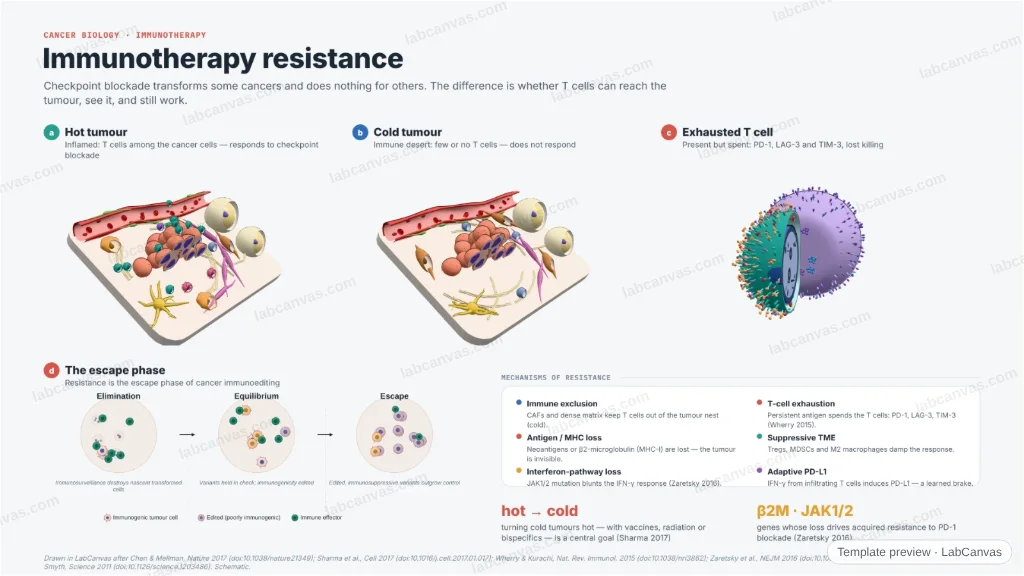
A figure of why cancer immunotherapy fails. Three 3D scenes contrast a hot (inflamed) tumour, where T cells reach the cancer cells, with a cold (immune-desert) tumour that keeps them out, and an exhausted T cell co-expressing PD-1, LAG-3 and TIM-3. Over the immunoediting escape frame, it sets out the mechanisms of primary and acquired resistance — immune exclusion, antigen and MHC loss, interferon-pathway mutations and T-cell exhaustion.
Updated 5 cited papers50 editable layers
At a glance
- Category
- Cancer biology
- Method
- Graphical abstract
- Product
- Why checkpoint blockade works in some tumours and not others
- Key result
- Resistance is primary, adaptive or acquired; it is the overarching "escape" phase of cancer immunoediting (Sharma et al. 2017; Schreiber et al. 2011)
- Figure
- 1920 × 1080 px (16:9), 50 editable layers, 1 generated objects
Step by step
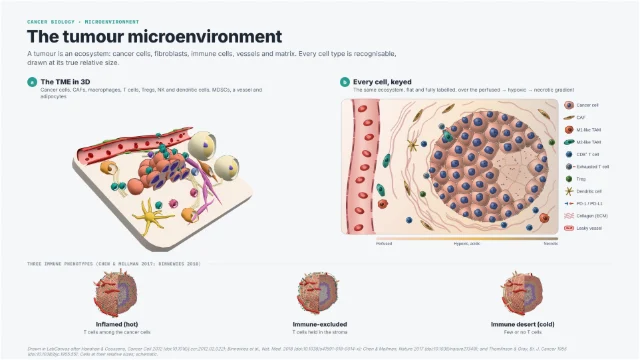
- Hot vs coldInflamed (hot) tumours have T cells among the cancer cells and respond; immune-excluded and desert (cold) tumours keep T cells out and resist (Chen & Mellman 2017)
- Antigen & MHC lossTumours lose the neoantigens or the MHC-I (β2-microglobulin) that display them, so T cells can no longer see them (Sharma et al. 2017; Zaretsky et al. 2016)
- Interferon-pathway mutationsLoss of JAK1/JAK2 blunts the response to interferon-γ and PD-L1 induction, giving acquired resistance (Zaretsky et al. 2016)
- T-cell exhaustionPersistent antigen drives T cells into exhaustion, co-expressing PD-1, LAG-3 and TIM-3 with lost effector function (Wherry & Kurachi 2015)
Uses
- Immuno-oncology review and graphical-abstract figures
- Talks on resistance to checkpoint blockade
- Teaching hot vs cold tumours and exhaustion
Papers this template follows
- Chen & Mellman, “Elements of cancer immunity and the cancer–immune set point”, Nature 2017. doi:10.1038/nature21349review
- Sharma et al., “Primary, adaptive, and acquired resistance to cancer immunotherapy”, Cell 2017. doi:10.1016/j.cell.2017.01.017review
- Wherry & Kurachi, “Molecular and cellular insights into T cell exhaustion”, Nat. Rev. Immunol. 2015. doi:10.1038/nri3862review
- Zaretsky et al., “Mutations associated with acquired resistance to PD-1 blockade in melanoma”, N. Engl. J. Med. 2016. doi:10.1056/NEJMoa1604958primary
- Schreiber, Old & Smyth, “Cancer immunoediting: integrating immunity’s roles in cancer suppression and promotion”, Science 2011. doi:10.1126/science.1203486review
Drawn in LabCanvas after Chen & Mellman, Nature 2017 (doi:10.1038/nature21349); Sharma et al., Cell 2017 (doi:10.1016/j.cell.2017.01.017); Wherry & Kurachi, Nat. Rev. Immunol. 2015 (doi:10.1038/nri3862); Zaretsky et al., NEJM 2016 (doi:10.1056/NEJMoa1604958); and Schreiber, Old & Smyth, Science 2011 (doi:10.1126/science.1203486). Schematic.
How templates are written and checked: editorial guidelines.
Questions
What does the “Immunotherapy resistance” template show?
A figure of why cancer immunotherapy fails. Three 3D scenes contrast a hot (inflamed) tumour, where T cells reach the cancer cells, with a cold (immune-desert) tumour that keeps them out, and an exhausted T cell co-expressing PD-1, LAG-3 and TIM-3. Over the immunoediting escape frame, it sets out the mechanisms of primary and acquired resistance — immune exclusion, antigen and MHC loss, interferon-pathway mutations and T-cell exhaustion.
What are the steps shown in “Immunotherapy resistance”?
1. Hot vs cold: Inflamed (hot) tumours have T cells among the cancer cells and respond; immune-excluded and desert (cold) tumours keep T cells out and resist (Chen & Mellman 2017). 2. Antigen & MHC loss: Tumours lose the neoantigens or the MHC-I (β2-microglobulin) that display them, so T cells can no longer see them (Sharma et al. 2017; Zaretsky et al. 2016). 3. Interferon-pathway mutations: Loss of JAK1/JAK2 blunts the response to interferon-γ and PD-L1 induction, giving acquired resistance (Zaretsky et al. 2016). 4. T-cell exhaustion: Persistent antigen drives T cells into exhaustion, co-expressing PD-1, LAG-3 and TIM-3 with lost effector function (Wherry & Kurachi 2015).
Which papers is “Immunotherapy resistance” based on?
Chen & Mellman, “Elements of cancer immunity and the cancer–immune set point”, Nature 2017 (doi:10.1038/nature21349); Sharma et al., “Primary, adaptive, and acquired resistance to cancer immunotherapy”, Cell 2017 (doi:10.1016/j.cell.2017.01.017); Wherry & Kurachi, “Molecular and cellular insights into T cell exhaustion”, Nat. Rev. Immunol. 2015 (doi:10.1038/nri3862); Zaretsky et al., “Mutations associated with acquired resistance to PD-1 blockade in melanoma”, N. Engl. J. Med. 2016 (doi:10.1056/NEJMoa1604958); Schreiber, Old & Smyth, “Cancer immunoediting: integrating immunity’s roles in cancer suppression and promotion”, Science 2011 (doi:10.1126/science.1203486).
Can I edit the “Immunotherapy resistance” template?
Yes. Open it in the LabCanvas editor: all 50 layers are editable, including 1 generated objects (structures, plots, equipment) with their own settings. Change the text, colours and layout, then export PNG, TIFF or PDF at the width and DPI the journal asks for.
Do I need an account to use this template?
Not to view it here. To open and edit it, sign in to LabCanvas or create a free account (the free plan keeps up to 3 designs). Downloading the figure is part of LabCanvas Pro (US$19 a month or US$199 a year).