Graphical abstract template · Cancer biology · Graphical abstract
Patient-derived organoid drug screen
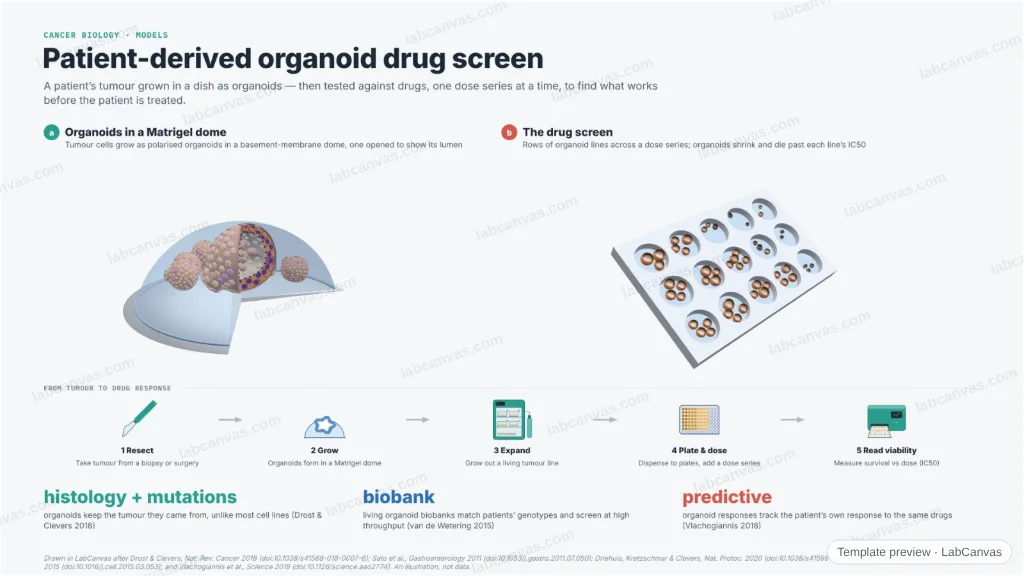
A figure of a patient-derived organoid drug screen. Tumour organoids grown from a patient in a basement-membrane dome keep the tumour’s histology and mutations; dispensed into plates and exposed to a dose series of drugs, they shrink and die as each line passes its IC50. The workflow runs from resection to viability readout, and the organoids can predict how the patient responds.
Updated 5 cited papers42 editable layers
At a glance
- Category
- Cancer biology
- Method
- Graphical abstract
- Product
- A living model of a patient’s tumour, screened against drugs
- Key result
- Living organoid biobanks match their patients’ mutations and are screened at high throughput to link genes to drug response (van de Wetering et al. 2015)
- Figure
- 1920 × 1080 px (16:9), 42 editable layers, 5 generated objects
Step by step
- Grow organoidsTumour cells from a biopsy or resection grow as organoids in a basement-membrane (Matrigel) dome, keeping the tumour’s histology and mutations (Drost & Clevers 2018; Sato et al. 2011)
- Expand & plateOrganoids are expanded and dispensed into multiwell plates (Driehuis et al. 2020)
- Dose seriesEach organoid line meets a range of drug doses; organoids shrink and die as the dose passes their IC50
- Predict responseOrganoid drug responses track the patient’s own response to the same drugs (Vlachogiannis et al. 2018)
Uses
- Precision-oncology review and graphical-abstract figures
- Talks on functional drug testing
- Teaching the organoid screening workflow
Papers this template follows
- Drost & Clevers, “Organoids in cancer research”, Nat. Rev. Cancer 2018. doi:10.1038/s41568-018-0007-6review
- Sato et al., “Long-term expansion of epithelial organoids from human colon, adenoma, adenocarcinoma, and Barrett’s epithelium”, Gastroenterology 2011. doi:10.1053/j.gastro.2011.07.050method origin
- Driehuis, Kretzschmar & Clevers, “Establishment of patient-derived cancer organoids for drug-screening applications”, Nat. Protoc. 2020. doi:10.1038/s41596-020-0379-4primary
- van de Wetering et al., “Prospective derivation of a living organoid biobank of colorectal cancer patients”, Cell 2015. doi:10.1016/j.cell.2015.03.053primary
- Vlachogiannis et al., “Patient-derived organoids model treatment response of metastatic gastrointestinal cancers”, Science 2018. doi:10.1126/science.aao2774primary
Drawn in LabCanvas after Drost & Clevers, Nat. Rev. Cancer 2018 (doi:10.1038/s41568-018-0007-6); Sato et al., Gastroenterology 2011 (doi:10.1053/j.gastro.2011.07.050); Driehuis, Kretzschmar & Clevers, Nat. Protoc. 2020 (doi:10.1038/s41596-020-0379-4); van de Wetering et al., Cell 2015 (doi:10.1016/j.cell.2015.03.053); and Vlachogiannis et al., Science 2018 (doi:10.1126/science.aao2774). An illustration, not data.
How templates are written and checked: editorial guidelines.
Questions
What does the “Patient-derived organoid drug screen” template show?
A figure of a patient-derived organoid drug screen. Tumour organoids grown from a patient in a basement-membrane dome keep the tumour’s histology and mutations; dispensed into plates and exposed to a dose series of drugs, they shrink and die as each line passes its IC50. The workflow runs from resection to viability readout, and the organoids can predict how the patient responds.
What are the steps shown in “Patient-derived organoid drug screen”?
1. Grow organoids: Tumour cells from a biopsy or resection grow as organoids in a basement-membrane (Matrigel) dome, keeping the tumour’s histology and mutations (Drost & Clevers 2018; Sato et al. 2011). 2. Expand & plate: Organoids are expanded and dispensed into multiwell plates (Driehuis et al. 2020). 3. Dose series: Each organoid line meets a range of drug doses; organoids shrink and die as the dose passes their IC50. 4. Predict response: Organoid drug responses track the patient’s own response to the same drugs (Vlachogiannis et al. 2018).
Which papers is “Patient-derived organoid drug screen” based on?
Drost & Clevers, “Organoids in cancer research”, Nat. Rev. Cancer 2018 (doi:10.1038/s41568-018-0007-6); Sato et al., “Long-term expansion of epithelial organoids from human colon, adenoma, adenocarcinoma, and Barrett’s epithelium”, Gastroenterology 2011 (doi:10.1053/j.gastro.2011.07.050); Driehuis, Kretzschmar & Clevers, “Establishment of patient-derived cancer organoids for drug-screening applications”, Nat. Protoc. 2020 (doi:10.1038/s41596-020-0379-4); van de Wetering et al., “Prospective derivation of a living organoid biobank of colorectal cancer patients”, Cell 2015 (doi:10.1016/j.cell.2015.03.053); Vlachogiannis et al., “Patient-derived organoids model treatment response of metastatic gastrointestinal cancers”, Science 2018 (doi:10.1126/science.aao2774).
Can I edit the “Patient-derived organoid drug screen” template?
Yes. Open it in the LabCanvas editor: all 42 layers are editable, including 5 generated objects (structures, plots, equipment) with their own settings. Change the text, colours and layout, then export PNG, TIFF or PDF at the width and DPI the journal asks for.
Do I need an account to use this template?
Not to view it here. To open and edit it, sign in to LabCanvas or create a free account (the free plan keeps up to 3 designs). Downloading the figure is part of LabCanvas Pro (US$19 a month or US$199 a year).